From the gridiron to the altar: Trent Barton to be ordained transitional deacon
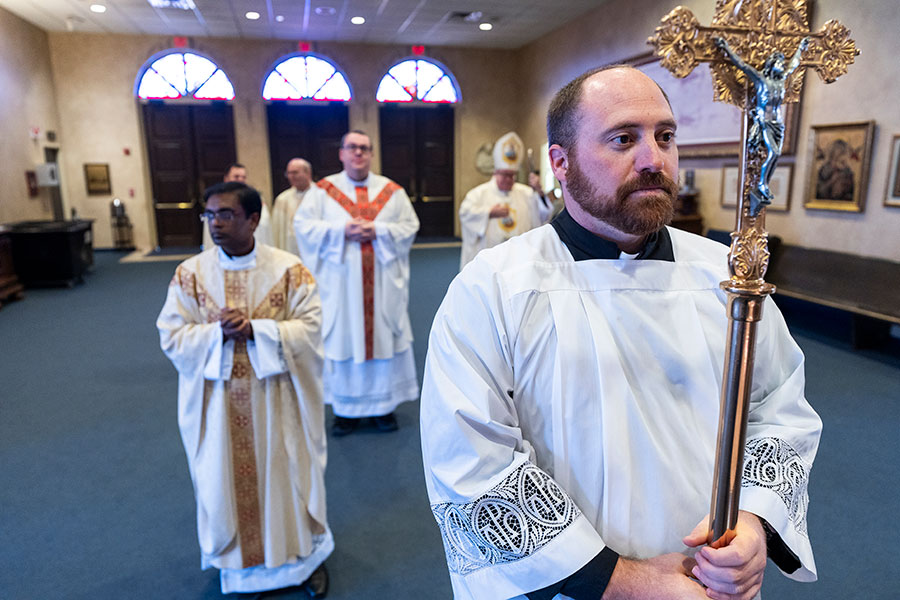
Seminarian Trent Barton prepares to process into Mass for attendees of the Parish Vocations Ministry Workshop on January 25, 2025 at St. Elizabeth Ann Seton Church in Keller. (NTC/Juan Guajardo)
Trent Barton loved coaching college football.
His time on the gridiron though meant more than just mapping out the X’s, O’s, and schematics of the game.
“I enjoyed working with the players and helping them navigate life,” said the Seymour native who competed in football for the town’s high school as a teenager. “I always liked being part of a team.”
But, after spending six years as a full-time assistant coach at Hardin-Simmons University in Abilene, Barton decided to pursue a different goal line.
“One day, I just felt in my heart the Lord was calling me to something else,” he shared. “I started asking questions, and God gave me some answers. After more discernment and speaking with priests in the diocese, I came to the conclusion He was calling me to the priesthood.”
The 37-year-old seminarian moves closer to realizing his vocation on March 18 when he is ordained to the transitional diaconate by Bishop Michael Olson in Fort Worth’s St. Mary of the Assumption Church. Deacon Jim Novak and Deacon Ralph Lira will dress the ordinand in the liturgical dalmatic and stole vestments of his new office.
Becoming a transitional deacon is the last major step in formation before a man is ordained a priest. Deacons baptize, witness marriages, distribute Holy Communion, bring Viaticum to the dying, proclaim the Gospel, preach, and officiate at funerals.
Barton is currently studying at the Theological College of Catholic University of America in Washington, D.C., where he will earn a baccalaureate degree in Sacred Theology this May and begin coursework for a Licentiate in Sacred Theology next fall.
The Sacred Heart in Seymour parishioner credits close family bonds for inspiring and encouraging his vocation.
“My mom was born and raised Catholic, and my father came to the faith when he married her,” explained Barton, who remembers attending Saturday Mass at Sacred Heart with extended family members and then going to his grandmother’s home for dinner every week. “Church and family were a big part of my growing up.”
His late grandmother, Margaret, and her twin, the late Sister Marjorie Marak, SSMN, were influential examples of discipleship.
“I’m sure my grandmother still has something to do with my studying for the priesthood,” he added. “I have no doubt about that.”
To prepare for ordination, Barton is fostering a dutiful prayer life — attending a Holy Hour and being attentive to the voice of God.
“You’re never going to be fully prepared for what you’re going to encounter, but the main thing is to focus on being a good disciple,” he continued. “We’re all called to be good disciples of Christ.”
Barton entered the structured environment of the seminary after living on his own for 13 years.
“In the seminary, you get to know God on a deeper level,” Barton said. “It gives you the opportunity to not only study Him in the classroom, but, at the same time, develop a rich spiritual prayer life.”
One of five sons born to Jerry and Margie Barton, the seminarian said the Rosary is his favorite devotion. Praying it daily was a habit that guided his coaching years.
And there are other lessons learned on the football field that he’ll bring to his ministry as a transitional deacon. Coaching young football players taught him the importance of loving people in their best moments and also their worst moments.
“The guys you coach all make mistakes — some more than others — and you can’t just abandon or leave them,” Barton stressed. “You have to stand by their side and do what you can to help them. Football taught me how to love the sinner.”