
Invitations in Ordinary Time
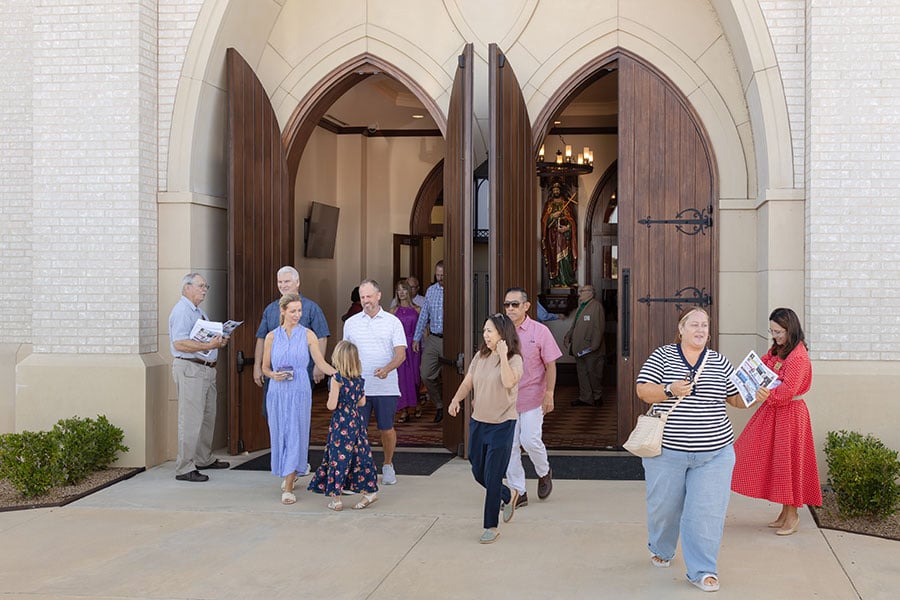
People leave after attending Mass at St. Philip the Apostle Church in Flower Mound on October 5, 2025. (NTC/Scott Wagner)
Summer in Washington D.C. means many things. A quieter pace. Notoriously humid weather. A flood of summer interns. And droves of tourists! As visitors descend on Washington, the Smithsonian’s museums often top their itineraries. This collection of twenty-one museums – and a zoo! – was a gift to the United States created by a bequest from James Smithson. Mr. Smithson, who died in 1829, was an Englishman who never visited the United States. Yet, he bequeathed his entire estate to create the Smithsonian Institution, and it was formally established in 1846 by legislation enacted by Congress and signed into law by President James Polk.
Since then, the Smithsonian has grown into “the world’s largest museum, education, and research complex.” Within its eclectic collections, visitors swarm to see such things as the Hope Diamond, George Washington’s military uniform, the studio model for the Star Trek Enterprise, Dorothy’s ruby slippers from the Wizard of Oz, the space shuttle Discovery, Edith and Archie Bunker’s chairs, a complete collection of both presidential portraits and first ladies’ inaugural gowns, the original flag that “was still there” to inspire The Star Spangled Banner, a 1903 Wright flyer plane, Neil Armstrong’s Apollo 11 suit, a 1931 Model A postal truck, a new baby elephant named Linh Mai, and our giant pandas (the capital’s perennially most popular residents) – to name but a few! Beyond these curiosities, priceless collections of art from around the world, historical artifacts from all stages of our history, and the technological and scientific creations that changed the world are all waiting to be seen.
From where I live and work, all of these treasures are merely a long walk or a short subway ride away. They are free of charge to see, and the doors and gates to the museums are open seven days a week.
Yet, I take these for granted.
I explored these collections intensely as a child on a family vacation to Washington. It was important to my parents that we soak in all these riches, so my siblings and I visited as much of the collections as our vacation time allowed. Now, when there is a special event or exhibit at a museum, I go. When I have unexpected free time and no other plans, I might go downtown to the National Mall to wander through a gallery. But most often, I take for granted the fact that I can visit anytime. So, like most things taken for granted, my visits can easily become infrequent. When I travel and visit faraway cities, I am certain to visit their museums and art galleries with great interest. Yet, all that is in my own backyard can easily be unappreciated.
However, all of this changes when I have out-of-town guests. When they come to Washington, they want to visit the Smithsonian. They arrive eager and enthusiastic about a favorite museum and, with this zeal, invite me to join them on their forays. I eagerly accept their invitations, join them for their visits, thoroughly enjoy my time at the museums, and wonder why I do not come more often.
I wonder if, somehow, there is something to be leaned about the importance of invitations such as these – not simply invitations beckoning us to museums, but invitations to join our parish families. The importance of personal invitations may make more of a difference than we might think.
Our parish churches are, for so many of us, merely a long walk or a short ride away. They are open every day, free of charge and they hold our very deepest treasures. They can be taken for granted. Yet, many members of our parish communities may not be joining us. Perhaps they came often as children because it was important to their parents. Perhaps they come for special events and occasions, be they family celebrations or sacred holidays. Perhaps they come when they have free time or a longing to come for a while. Perhaps they mean to come, but life gets busy.
Yet, our parishes are poorer when they are not with us.
This is when I think of the great power of the invitation. I know that when friends invite me to join them at the museum, I go. I know that the enthusiasm of these invitations is difficult to resist. I know that the company of loved ones makes my visit to these special places a beautiful time. I know that their gentle beckoning reminds me of all that I am missing when I do not come on my own. And, so very often, after they have invited me to come, I find myself going back because I realized anew what I was missing.
With this experience in mind, I think of the importance of inviting others to join us when we come to worship at Mass, enjoy parish events, or sit in silent prayer at our churches. There are complex initiatives for evangelization and outreach, and readily available information about Mass times and parish life. All of these certainly make it possible for all who seek to find. Yet, there is no substitute for a kindly offered personal invitation or an enthusiastically extended welcome to come along. There is no substitute for having someone who cares enough to show loved ones what they may be missing and what treasures they may share. I know the joy of the invitation to enjoy the lesser treasures that beckon tourists to my town. And, this makes me more eager to extend the more important and sacred invitations that can fill hearts and souls in ordinary time.

Lucia A. Silecchia is a Professor of Law at the Columbus School of Law at the Catholic University of America. "On Ordinary Times" is her column reflecting on the ways to find the sacred in the simple.