
Tumbling walls

NTC/Rodger Mallison
In his book A Confession, Leo Tolstoy, a famous Russian writer of the 19th century, describes an event of how his friend lost faith. “On a hunting expedition, when he was already 26, he once, at the place where they put up for the night, knelt down in the evening to pray — a habit retained from childhood. His elder brother, who was at the hunt with him, was lying on some hay and watching him. When [he] had finished and was settling down for the night, his brother said to him: ‘So you still do that?’ They said nothing more to one another. But from that day [he] ceased to say his prayers or go to church. And now has not prayed, received Communion, or gone to church, for thirty years.”
Tolstoy describes how what happened to his friend was not a pressure to join his brother’s ideas or even some kind of intentional decision, but rather “like the push of a finger on a wall that was ready to fall by its own weight.”
Tolstoy goes on to describe his own loss of faith as a teenager beginning with a misplaced goal: to perfect himself. As he pursued self-perfection, his wall of faith became less about God and more about himself.
It wasn’t long before his own wall crumbled to the ground and he ran forward, clinging after power and success.
For those who profess faith, what’s holding up the wall?
Is it mere willpower, discipline, habit, culture, or perhaps others’ opinions? What or who truly resides in the depths? Is it Jesus Christ? Or is it maybe something we’re doing for Him?
Perhaps it’s a project, a lifelong project of self-betterment, of achieving, progressing, growing, so that one day, eventually, in the future, at some vague moment, we’ve finally made it? Maybe it’s the family, a memory, a moment, a “dream” you’ve been holding on to.
Another way to ask the question is: What is sustaining you? What gets you from day to day? What do you look forward to?
The truth is that for many it’s something unstable, something not deeply rooted. And in a culture of entertainment and exhaustion, one cannot overlook the real possibility that the main motivator of each day might simply be getting back to the couch.
While rest is good, and while many of the above goals or habits may be worth pursuing and even from certain perspectives considered holy … they are not Him. They cannot stand in the center. And when they do, we must face the disquieting fact that they do not actually fulfill. They do not hold up the walls.
What then do we need? We must come to the true moment of conversion when we finally accept that our present life on Earth is not meant to fulfill us, but rather that God, who is Life and fulfillment Himself, is present, and in fact, fulfilling. He offers us Himself each day as the One who stands in the depths; the One who can hold up the walls. And not only does He hold them, but He strengthens them, builds them up, and fashions them into a castle, or as Jesus says in Luke, a Kingdom.
So we pray. We pray not only for something, but for Him. We pray for more of Him. We pray that He takes His place on the throne in the depths of hearts, and from there holds up the walls.
It is only this that converts, that changes, that inspires. It is only this when found and taken hold of, particularly by our youth, that brings about more courageous and passionate hearts who follow the Lord as priests and religious.
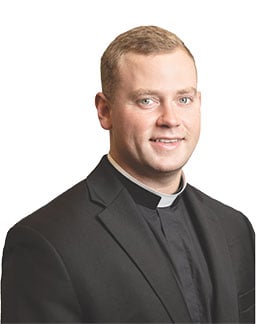
Father Brett Metzler serves as Chaplain at Nolan Catholic High School in Fort Worth and as the Vocations Director for the diocese. Find his regular columns for the North Texas Catholic here