
AI expert shares insights with Bishop Olson, lay faithful
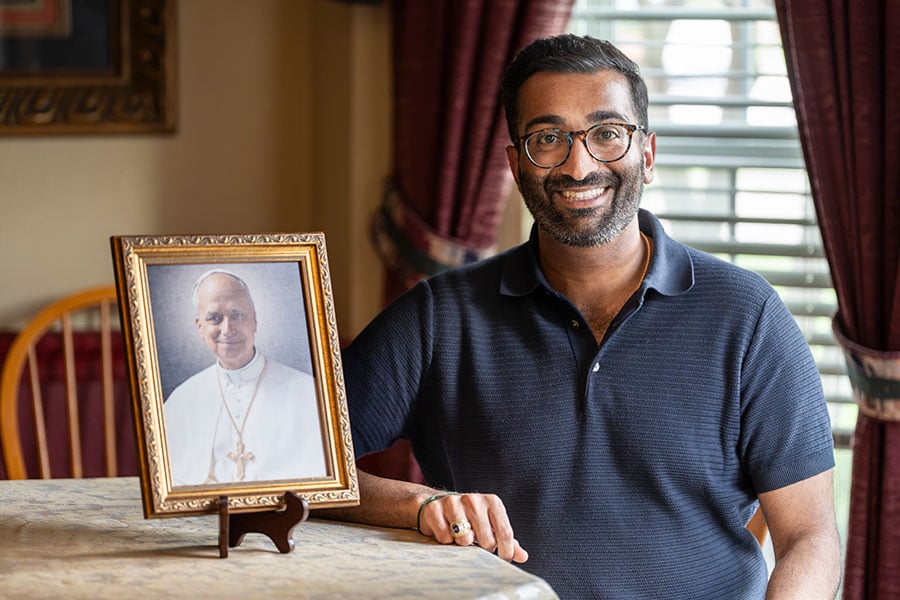
Devan Patel, a lawyer, professor, and AI ethics expert, on June 16, 2026 in Arlington. (NTC/Juan Guajardo)
FORT WORTH — Could Devan Patel, a lawyer by education and a strategist by profession, also be described as an AI prophet?
As someone who has studied the ethics of artificial intelligence for more than six years, these days Patel shares his message about the healthy use of AI with policy makers, clergy, educators, community leaders, technology engineers, and just about any concerned audience.
Not only do Patel’s assessments dovetail with Pope Leo XIV’s first encyclical, “Magnifica Humanitas” (Magnificent Humanity: On Safeguarding the Human Person in the Time of Artificial Intelligence), but Patel was one of about 10 Americans in the room at the Vatican when Pope Leo released the encyclical.
The invitation to be present for the release of the encyclical followed a summit that Patel hosted at the Vatican in October 2025 for Christian and Jewish faith leaders, policy experts, and military officials to discuss the moral, legal, and security implications of AI. The group released a joint statement on AI ethics that included a practical framework to ensure AI promotes human dignity and the common good while maintaining accuracy, transparency, security, and privacy.
Since the release of “Magnifica Humanitas” on May 15, Patel has been a prominent national voice explaining the pope’s encyclical, which lays a moral framework for the use of artificial intelligence.
AI Concerns
In his encyclical, Pope Leo calls AI a powerful tool. Patel explained that Pope Leo warns artificial intelligence “can be engaged with, and it can serve humanity well, but it’s also not neutral. The folks who fund it, folks who build it, folks who deploy it all have their own views, all have their own philosophies,” in which humanity is regarded with a utilitarian viewpoint.
Already, artificial intelligence is impacting the economy and job market, accelerating job losses. Many students, from primary grades through college, rely on AI to complete assignments and don’t master educational fundamentals. In the wrong hands, AI is a powerful means to create deepfake videos or commit fraud.
Even the ability to form relationships is not immune from AI. Some children and other vulnerable people have been harmed by chatbots that allure them into a “friendship.” However, these interactions can encourage suicide or can lead a person into harming another.
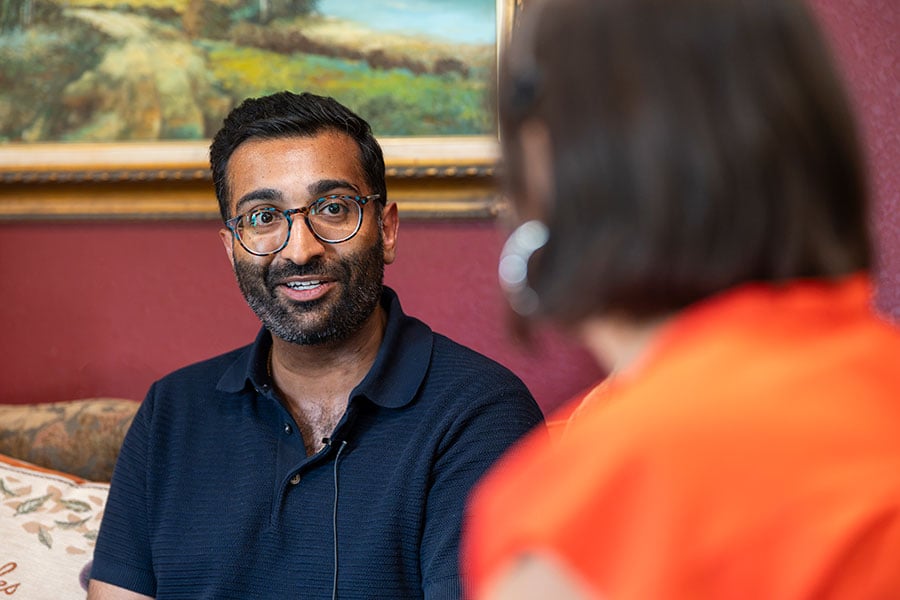
Patel said, compared to the industrial revolution or the agricultural revolution, “The threat of this [AI] revolution is even greater in disruption, dehumanization. We’re working with a much larger scale of opportunity, but also a larger scale of dehumanization possible … certainly issues of what it means to be human and what it means to be in community and relationship.”
The Church’s role
A 2,000-year-old spiritual institution may not be the obvious solution to the perils and problems of AI.
But “without a doubt,” Patel said, the Catholic Church is uniquely positioned to be the global leader on the moral use of AI.
First, he explained, “from a mere structural point of view, the Church is the only one with the capacity in the world,” with a hierarchy, structure, and “very clear chain of command, operation, delegation.” Combined with the universal nature of the Church, communication can travel down to the parishes and up to Church leadership.
Secondly, he continued, “Of course, the deposit of faith … At least 2,000 years of this theological underpinning that has given us such a wealth of understanding of the human person, of our relationship with each other, our relationship with God, and our relationship with various institutions and developments.”
The Church’s teachings on the nature of humanity are seemingly antithetical to AI but might be the most beneficial in developing effective policies. Catholics understand that human frailty is not a problem to be overcome, but actually a strength of humanity.
Patel explained, “In fact, it is our fragility, it's our frailty, it is our dependence on others where God most shines. It is through the suffering of Jesus Christ where the greatest love came.” On the cross, Jesus demonstrated the weakness of the human body, “and through that we encountered God's face.”
Given the Church’s structure and the teachings, the Church can educate and insist that AI must serve humanity, rather than serve as a replacement of humanity.
First steps
Patel shared some practical ideas on becoming informed and influential.
“First, I double down and implore folks to read [“Magnifica Humanitas”] because it’s a phenomenal work. … It’s not a document written for philosophers and theologians only; it’s meant for families, for educators, for the layperson in and out of the Church.”
He explained the first half of the encyclical reminds readers of Catholic social teaching about solidarity, subsidiarity, universal destination of goods, and other “rich teachings of the Church.”
The second half tackles artificial intelligence. “The pope is calling us to really wrestle with which road we want to go down, and it’s beautiful, it’s well done, it’s articulate, but ultimately it is real,” said Patel.
Patel advised parents and educators in particular to be aware of the technology that children are using and how they interact with it.
He also encouraged technology-free times and places.
“There’s a lot of brain chemistry that goes on during boredom, during leisure, during daydreaming, that’s actually quite healthy for us. We want to reinforce for children the capacity to sit in discomfort, of boredom — to sit and be idle, because in an age of instant gratification, we’re only setting them up for failure,” he explained.
Guardrails on technology and protective legislation can be enacted if assisted by market forces “from the ground up. Communities, parishes, schools can really speak up here and have a leading voice in the conversation … there’s really opportunity here, from both the top down and the bottom up, to really put pressure on Silicon Valley and get answers, get real safeguards. So I implore everyone to be involved, to stay involved,” he said.
To develop rational and beneficial policies on the development and use of AI, “We need experts in humanity. We need experts in culture, we need experts in relationships — all these things that make us human, all these things that differentiate us from other animals and ultimately from machines. We need a holistic vision of the person,” Patel said.
Although Patel encourages responsible deliberation, discipline, and practical policies for the use of artificial intelligence, he doesn’t oppose AI.
He said, “This technology that we have is already doing so much good as well,” citing medical advances and AI algorithms to help the Catholic curious find resources to learn more about the faith as excellent current uses of AI.
Ultimately, he said, Catholics should take heart in the shepherd on the throne of St. Peter. “We have a man who is clearly chosen by the Spirit. He’s the man for the moment, and I think we can rest easy in that we have a shepherd who knows where he’s leading his flock.”
Silicon Valley, DC, Rome, and Fort Worth?
Patel sees himself as a bridge between Silicon Valley, Washington, DC, and Rome.
He was born and raised in the heart of Silicon Valley, where much of this technology was conceived and launched. Since graduating from University of Notre Dame Law School, he has worked in Washington, DC, where he founded Crux Advisory Group, which provides strategic counsel on AI ethics and religious liberty, among other topics. And, after 19 years of study and prayer, he entered the Catholic Church at Easter 2023.
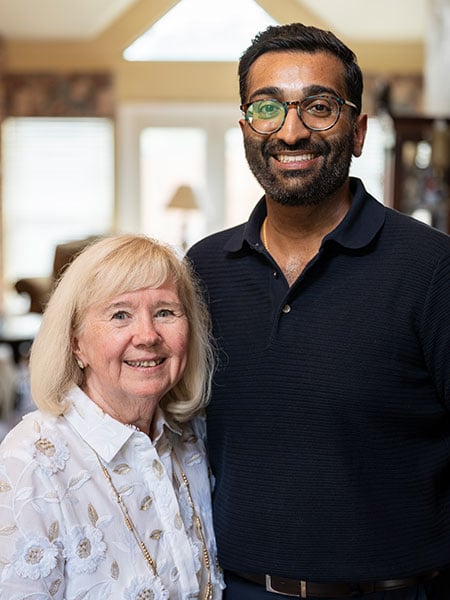
Patel’s close friend and St. Vincent de Paul parishioner Breda Shelton arranged for Patel to speak with Bishop Michael Olson about AI. After the insightful conversation, the bishop expressed a desire for Patel to share his thoughts with seminarians, deacons, and priests in the near future.
After the meeting with Bishop Olson, Patel recorded an episode of the diocesan podcast “Lights, Catholic, Action!” with Shelton. The episode will premiere on July 21. He also sat for an interview with the North Texas Catholic, so that the faithful of the diocese can grow in understanding of AI issues.