
Saints who illuminate our path

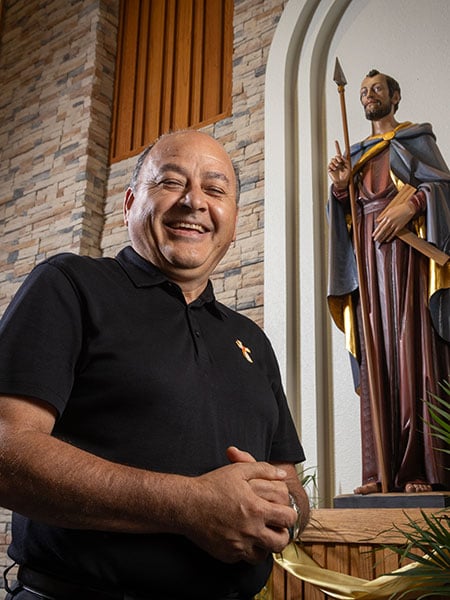
St. Rose of Lima Parish of Glen Rose. (NTC/Rodger Mallison)
What is a saint? According to the United States Conference of Catholic Bishops, saints — whether officially canonized or not — are people who lived lives of heroic virtue, offered their lives for others, or were martyred for their faith. They are worthy of imitation.
This is true of St. Rose of Lima, St. Thomas the Apostle, and St. Bartholomew, whose feast days we celebrate during July and August. Their lives reflect the words Pope Francis used to describe the saints: “People filled with God, incapable of remaining indifferent to the needs of their neighbor, and witnesses to radiant paths that are possible for us as well.”
St. Thomas the Apostle: From Doubt to Faith (July 3)
“We do not know how Thomas was called by Jesus to be an Apostle, but the moments in which he speaks in Scripture make him, in my opinion, the patron saint of all of us,” said Deacon Humberto Serrano of St. Thomas the Apostle Parish in Fort Worth.
Thomas is best known for his doubt when the risen Jesus first appeared to the other Apostles.
“At some point, all of us have doubted our faith,” the deacon explained.
For this reason, many saints have considered Thomas’ doubt to have been part of God’s plan. St. Gregory the Great wrote: “The unbelief of Thomas has done more for our faith than the faith of all the other disciples,” because by touching Christ’s wounds, Thomas helped confirm the faith of entire generations.
Another important moment occurs when Lazarus, Jesus’ close friend, dies. When Jesus announced He would go to him, Thomas said: “Let us also go, that we may die with Him.”
Those words ultimately became reality. After Jesus’ Ascension, Thomas preached and evangelized in India, where he was eventually martyred.
Deacon Serrano noted that many Christians today also “die” for the Gospel when they face rejection, ridicule, or persecution for living their faith, yet they are called to persevere courageously.
The Feast of St. Thomas is celebrated on July 3. St. Thomas the Apostle Parish in the Diocese of Fort Worth, founded in 1937, marks the occasion with Mass and a dinner. The deacon shared that “both clergy and parishioners take part in this celebration, remembering the words of St. Thomas, ‘My Lord and my God,’ and recognizing that after doubt comes certainty, thanks to God’s mercy.”
St. Rose of Lima: Love, Sacrifice, and Surrender to God (August 23)
“Jesus, may You always be with me,” was the phrase St. Rose of Lima repeated several times while renewing her religious vows shortly before her death on Aug. 23, 1617.
St. Rose of Lima, the first canonized saint of the Americas, was born in Lima, Peru, in 1586 with the name Isabel Flores de Oliva. Because of her great beauty, her mother began calling her Rosa (Rose), a name she later adopted at her confirmation.
Her life was marked by penance, sacrifice, service to others, and immense love for God. From an early age, she desired to consecrate herself to God. After reading about St. Catherine of Siena, she decided to follow her example. Despite the objections of family and friends, she began fasting frequently, wore rough clothing, and sought to hide her beauty in order to live in humility and complete dedication to God.
When her parents opposed her entering a convent, Rose decided to remain a “virgin in the world” and, at age 20, joined the Third Order of St. Dominic. Her penances became increasingly rigorous. She frequently wore a crown of thorns adorned with roses, offering her sacrifices in reparation for offenses against God, the idolatry of her country, the conversion of sinners, and the souls in purgatory.
When she was not helping support her family through needlework, she cared for the sick and the poor from her parents’ home, where she also devoted long hours to prayer.
St. Rose of Lima Parish in Glen Rose was dedicated to this saint in 1993. Pastor Father Brandon LeClair said St. Rose of Lima is a powerful example of how to master our desires and offer them to the Kingdom of God: “It will require sacrifice and surrender to God, but it is something worthwhile. In the midst of the chaos of this world, she helps us focus on what truly matters —God in our lives.”
St. Bartholomew: “Come and See” (August 24)
St. Bartholomew, also known as Nathanael in the Gospel of John, was one of the Twelve Apostles chosen by Jesus and gave his life in defense of the faith.
Diane Etzel, one of the first parishioners of St. Bartholomew Parish in Fort Worth, said St. Bartholomew reminds us that “If we truly seek and desire to know God, He always finds a way to draw near to us.”
Nathanael met Jesus through Philip. However, when he learned that Jesus was from Nazareth, he doubted that He could be the Messiah. Philip invited him to a personal encounter with Jesus, saying: “Come and see” (Jn 1:46).
Nathanael accepted the invitation.
When Jesus saw Nathanael approaching, He said: “Here is truly an Israelite in whom there is no deceit” (Jn 1:47).
Recognizing the truth of these words, Nathanael asked Jesus how He knew him. Jesus replied that He had seen him earlier under the fig tree. Upon hearing this, Nathanael acknowledged Jesus as the Son of God (Jn 1:48–49).
“The Lord finds us in whatever way is necessary, just as He did with Nathanael. He doubted, but Jesus came to meet him, and He does the same for us,” Etzel shared.
After Jesus’ Resurrection, tradition holds that St. Bartholomew evangelized in the East and died after being flayed alive in India. For this reason, images of St. Bartholomew often depict him holding a knife and what appears to be a cloth but is actually his own skin, symbolizing the manner of his martyrdom.
“The Feast of St. Bartholomew is celebrated on Aug. 24 and reminds us to ask for his intercession so that we may be courageous in defending our faith and remain steadfast in it, just as he was,” Etzel concluded.