
The ethics of genetically modifying human embryos
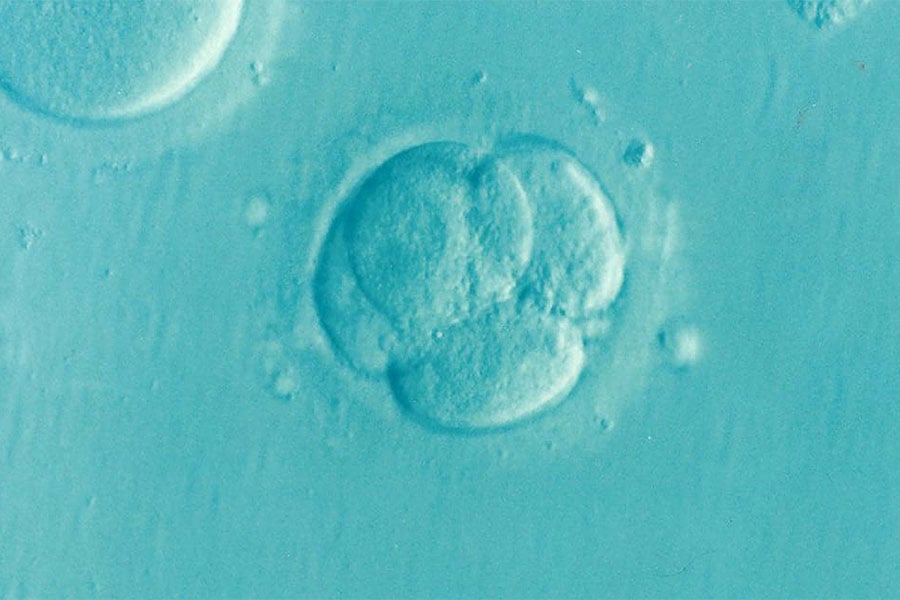
An embryo under the microscope. Dr. Elena Kontogianni/pixabay.com
A recent set of experiments at Columbia University seeking genetically to modify human embryos has rightly generated shock waves.
Led by geneticist Dieter Egli, the research relied on a newer technology for modifying genes known as “base editing.” In contrast to earlier methods like CRISPR that typically cut and replace longer stretches of DNA, base editing, as summarized in news reports, “allows scientists to replace individual genetic letters more carefully. In simple terms, it works less like cutting a page out of a book and more like correcting a typo.”
Attempting to make genetic modifications in a more efficient manner than had been previously achieved is precisely the kind of experiment that could and should have been carried out in animal embryos, not human embryos. The same basic biological information reported in these studies could readily have been obtained that way.
Moreover, the human embryos produced in these experiments were often intentionally sacrificed to obtain their embryonic stem cells, which were used for additional research. Creating humans for the purpose of destroying them is invariably unethical and should be illegal.
The experiments at Columbia University were unethical from the outset: researchers sought out eggs from women for the purpose of fertilizing those eggs to create embryonic humans in glassware, so they could then serve as raw materials for research and experimentation. Researchers also obtained embryos directly from "patients who decided that their treatment in the fertility center was complete and that the embryos were no longer needed for the purpose of reproduction,” to borrow the phrasing included in the original paper. In other words, parents were asked to hand over their “leftover” tiny children from fertility clinics so scientists could carry out experiments on them.
The fact that the Columbia University Human Embryonic and Human Pluripotent Stem Cell Research Committee as well as the University’s Institutional Review Board granted their approval for these procedures and experiments reminds us of the moral bankruptcy surrounding so many of these review entities at our renowned universities. Too often such committees and boards end up rubberstamping offensively unethical experiments if they can find even the thinnest shred of a rationale or justification for doing so.
This research quintessentially involves a basic moral mistake that is becoming ever more widely accepted in the biosciences: The youngest human beings, whether abandoned in fertility clinics or created de novo in petri dishes and test tubes, are treated not as ends, but as research fodder to help scientists achieve particular investigative goals.
Informed consent is always important when dealing with humans who are very vulnerable, particularly when they are being used as research subjects. The parents of the children created in vitro for these experiments could not give valid consent because ethical consent by definition focuses on improving health. It excludes directly causing their death or otherwise using them merely as a means to an end.
It is important to note that the Catholic Church is open, in principle, to gene editing to fix genetic abnormalities, as long as the risks are very low for the embryonic patient and heritable changes to the DNA of our species are not made. Such repair is simply a form of direct medical therapy for the afflicted individual. If such therapy on embryos were technically feasible, it should occur in the womb of the mother following a natural conception, not through procedures reliant on the immoral practice of IVF. The experiments reported by the Columbia University researchers were clearly nontherapeutic, as the plan always involved destroying the embryos.
Human embryos are among the most vulnerable of God’s creatures. They constitute a unique class of individuals deserving of special protections. The complex science of genetic modification at this time still involves enormous risks to the embryo. Those who encourage such practices suggest that parents should have the right to make changes to their children to help them and future generations. The science, however, including the unintended effects, remains only dimly understood. For example, when the tp53 gene was genetically modified in mice to offer them protection from cancer, it unexpectedly also contributed to the mice’s premature aging.
Catholics need to be concerned about the prospects of genetically modifying future generations.
In the past, many Catholics seem to have missed the boat in recognizing and articulating the moral unacceptability of creating children in test tubes via IVF, and now participate in such technologies at rates that don't differ significantly from the general population.
As genetic enhancement of embryonic children becomes more commonplace, it is important to learn from that failure. Now is the time to remedy the widespread lack of understanding and serious reflection on the moral and ethical issues involved in genetic modification of human embryos, lest Catholics and others be swayed by the technological temptation to do further harm to the youngest and most vulnerable human beings.

Rev. Tadeusz Pacholczyk, Ph.D. earned his doctorate in neuroscience from Yale and did post-doctoral work at Harvard. He is a priest of the diocese of Fall River, MA, and serves as the Senior Ethicist at The National Catholic Bioethics Center in Philadelphia.