Conversion for the Ages: Faithful Catholics reflect on their initiation into the Catholic Church

A man lights a candle from Ezra Gonzalez during the Easter Vigil Service on April 19, 2025, at St. Francis of Assisi Church in Grapevine. (NTC/Angela Wengrenovich)
Cori Gonzalez wasn’t raised Catholic, but every time she attended a wedding, funeral, or first Communion Mass, a sense of peace washed over her.
“Growing up in Southern California, my parents were not regular churchgoers, but I had a lot of friends who were Catholic. If I went to their home for a sleepover, I’d go to Mass with them,” said the Colleyville resident, recalling her early experience with the faith.
Over the years, Gonzalez’s interest and curiosity about the Catholic Church never waned. After marrying and having children, going to Protestant services left her feeling disheartened.
“There was always something off-putting about what the pastor said or the service itself,” the mother of four explained. “I often heard negative remarks about Catholicism. We were told Mary wasn’t a perpetual virgin and Communion was just a symbol.”
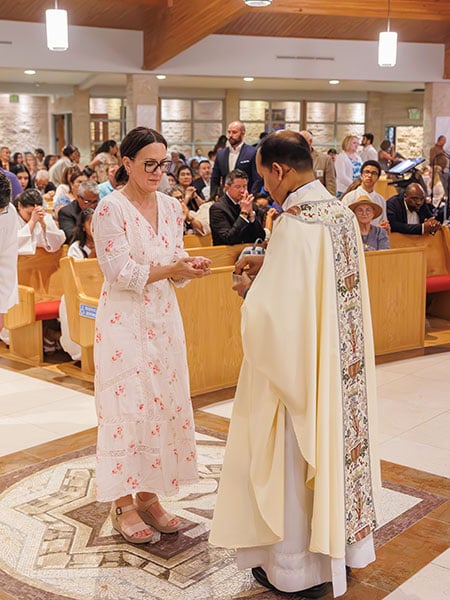
Gonzalez began attending Mass with her daughters, but the urge to explore Catholicism came with questions. Her eldest son, Ozzie, who was enrolled in a Catholic university in Oregon and was on his own faith journey, helped her find the answers. His theology professors at Gonzaga University and the University of Portland influenced the 24-year-old’s religious pursuits and encouraged research.
“My son would explain things and recommend books to read,” she continued. More information was gleaned from Bishop Robert Barron’s “Word on Fire” podcast, the Catholic prayer and meditation app Hallow, and “The Catechism in a Year” podcast with Father Mike Schmitz.
“Everything I read and listened to was Biblical and the opposite of what most of the Protestant churches I went to said about Catholicism,” Gonzalez stated emphatically. “Books helped me understand why Catholics do things. Why do we pray to Mary? Why are there statues of saints? If you understand, it makes sense.”
Parishioners at St. Francis of Assisi in Grapevine welcomed Gonzalez and her daughters, Ezra, 18, and 10-year-old Zoee, into the Church during the April 19 Easter Vigil Mass. Her son, Ozzie, received the Easter sacraments at his Washington state parish.
Teaching the faith
The Gonzalez family joins the more than 1,250 candidates and catechumens in the diocese entering the Church this Easter.
“Last year we set a record with 629 baptisms, and this year, we’ll exceed that with 752 baptisms. We’re still compiling the number of professions of faith [baptized Christians receiving the Eucharist and Confirmation],” said Jason Whitehead, diocesan director of evangelization and catechesis. “I’m very happy with the work that’s been done these last few years and the fruit we’re seeing from our labor.”
Formerly known as the Rite of Christian Initiation for Adults (RCIA), instruction for prospective converts wanting to become Catholic was renamed the Order of Christian Initiation of Adults (OCIA). In 2021, the U.S. Conference of Catholic Bishops approved a new translation of the process and its corresponding curriculum. The USCCB decided “Order” was a more accurate and precise translation of the Latin text and reflected the ongoing spiritual journey of faith formation instead of a one-time “rite” or ceremony.
Whitehead, a convert who entered the Church in 2012, credits part of the diocese’s success in attracting new Catholics to the way it prepares catechists to teach the faith.
“In our diocese, one of the chief goals is to get catechesis back to two things — it should be Gospel-centered and content-based. Proclaiming the Gospel and teaching the faith is what we stress in the department of catechesis,” he explained. “It’s only through those means people can come to divining the Catholic faith.”
Changes came after what some call a “crisis” in catechesis, according to the diocesan director. Starting in the 1960s, faith formation focused on experience rather than content. Generations of Catholics stopped learning the Catechism of the Catholic Church.
“This is the backdrop to why so many Catholics have fallen away from the faith,” Whitehead said before citing an example. “People are told to attend Mass but weren’t taught the full significance of what is done during the liturgy and why.”
Eventually, people feel they’re just going through the motions.
“You can only maintain that behavior for so long before people start to wonder why go to church at all,” he pointed out.
Seeking answers
Raised a Southern Baptist, Joshua Wattley withdrew entirely from religion as a young adult. But, with age and maturity, he began to realize the value of a strong faith foundation.
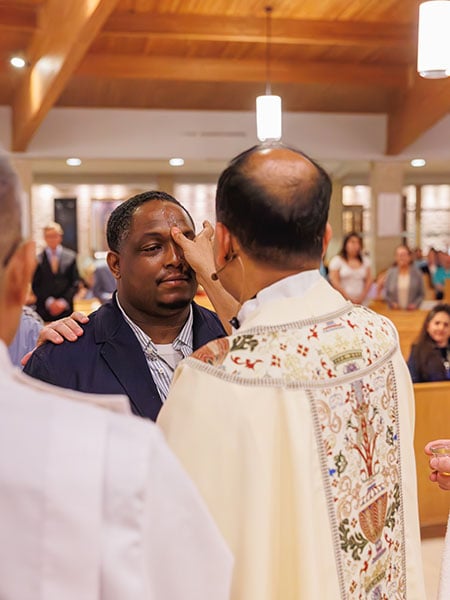
“I started learning about the history of the Church and the Protestant Reformation. It answered a lot of questions and ultimately led me to the Catholic Church,” said the human resources manager. “I was exposed to things I never knew.”
According to Wattley, there are approximately 30,000 different Christian denominations.
“And I wanted to know why,” he explained. “Learning about the different formations of Protestantism made me realize I wasn’t aligned or in agreement with the majority of them.”
Prodigious research helped him unravel some of the misconceptions about Catholicism. Electing a pope to lead the Church was one of them.
“Now I see the necessity for having that authority figure and how essential it is to our faith and the Body,” the Indiana native continued.
Wattley began formal instruction in the faith in September 2024 at St. Francis of Assisi Church. He attended Mass at other locations but felt drawn to the close-knit parish in Grapevine.
“I was greatly influenced by Jennifer Proctor. We had some great, hopeful conversations,” he said, referring to the parish’s coordinator of adult faith formation. “She has a genuine spirit for bringing more people into the Church and faith.”
Finding peace
A dedicated catechist helped Christine Vincent find a spiritual home at Our Lady of Guadalupe Parish in Fort Worth following a series of tragedies that devastated her personal life. The health care worker’s husband died a year after she retired, and her father passed away six months later. Being mugged and injured in a supermarket parking lot left her with post-traumatic stress disorder.
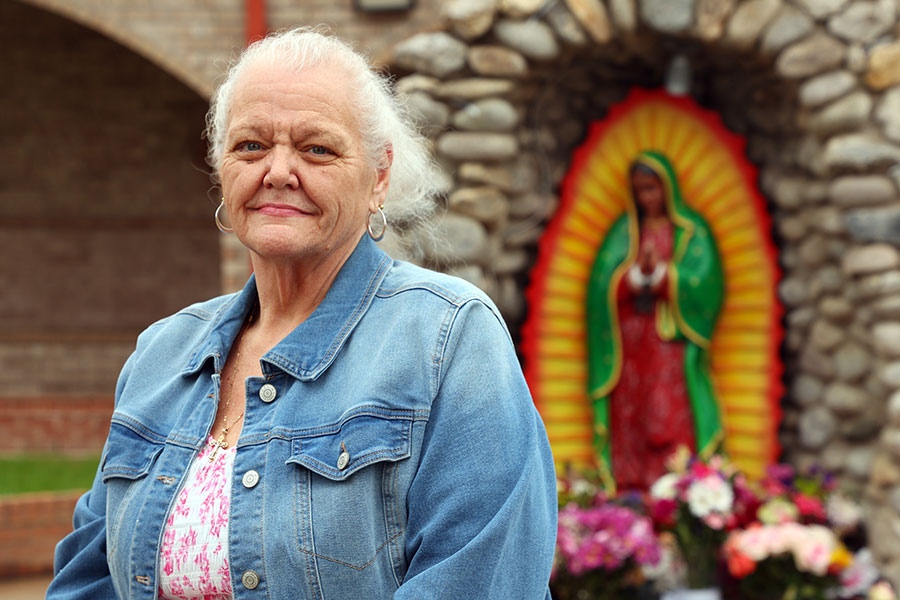
“My whole world was crashing,” Vincent remembered. “It was a lot to handle, and, after a while, you lose hope.”
The Pennsylvania native met Virginia Rodriguez, the parish’s director of religious education, during a nursing assignment.
“Her son was my patient, and we became friends,” Vincent explained. “I became integrated into that huge family.”
Not raised in any particular religion but always a believer, she was influenced by the matriarch’s strong faith and decided to explore Catholicism. Vincent remembered being the oldest prospective convert in her RCIA group.
“On the first day of class, the pastor came in and asked everyone why they chose to be there,” the retiree recalled. “I told him I had a hole in my heart and didn’t know how to fix it. I hoped becoming closer to God would make me whole again.”
Vincent came into the Church in 2022 and continues to take adult formation classes. Now a Eucharistic minister, she’s found peace and a personal relationship with Christ.
“It’s helped me tremendously,” the OLG parishioner said. “Emotionally, you go through so many things, but God puts people in your life to encourage you.”
Her advice to others coping with loss and hopelessness: “If you’re troubled, follow your heart and find the Lord.”
Experiencing the Light of Christ
There aren’t many Catholic converts who can say they were baptized by a pope. Michelle Klash is one of them.
When the Coppell High School graduate enrolled in the University of Dallas to study economics in 1991, she never imagined meeting St. John Paul II was in her future.
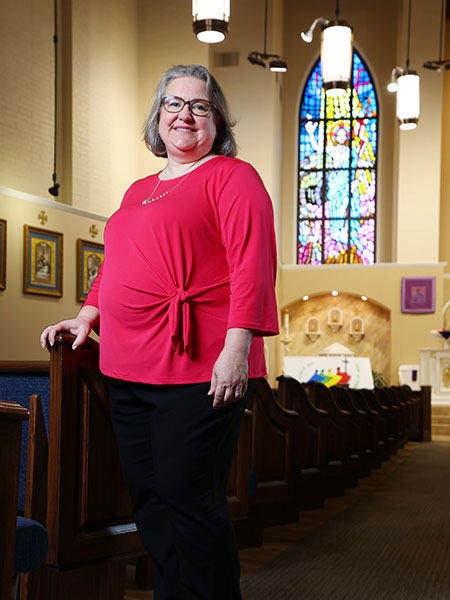
“I was interested in UD’s Rome program,” she said, recalling her decision to attend a Catholic college. “Other than it was close to home, I had no real good reason to go there. The Holy Spirit was guiding me.”
Raised without a strong religious background, Klash became immersed in the Catholic culture that permeates the Irving campus. Eventually, she decided to begin RCIA instruction under the guidance of UD’s chaplain Father Gregory Kelly (now bishop of Tyler). When it came time to receive the Easter sacraments, the college sophomore was spending the semester in Rome.
“Father Kelly petitioned the Vatican for suggestions on where I could be baptized, and they added me to the Easter Vigil,” she explained.
On Holy Saturday 1993, Klash walked into a darkened St. Peter’s Basilica with 30 other catechumens for a once-in-a-lifetime experience.
“I was completely unfamiliar with the Easter Vigil,” the convert admitted. “Just walking into that beautiful church, lit by candlelight and then all the lights turning on inside, was amazing. It felt warm, like home, and that’s an unusual thing to say about a marble building.”
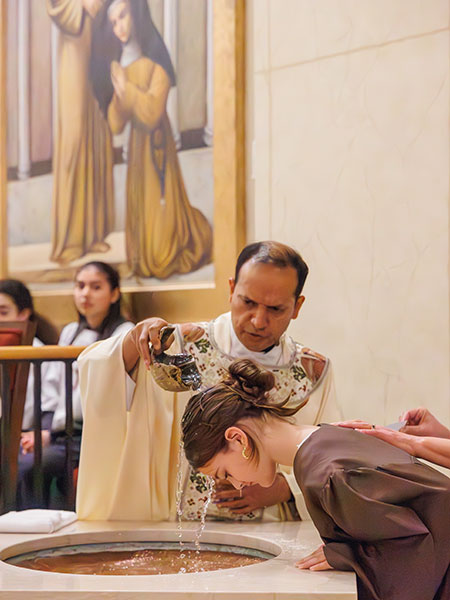
When Pope John Paul II poured baptismal water over her head, all doubts about what she was doing were gone.
“I don’t think there are words to describe how I felt that day,” said the married mother of three. “All of my questions were answered. I knew exactly what I was doing and that it was right.”
After the ceremony, the “quiet but genial” elderly pontiff greeted each new Catholic with a smile. Klash received a beautiful baptismal certificate penned in Latin and Italian, a white lace baptismal veil, and rosary. The Vatican photographer provided a visual keepsake of the Mass.
Today, the former corporate finance professional guides others through the conversion process as the OCIA coordinator at St. Ann Parish in Burleson. Ten people were baptized at Easter with another six preparing for confirmation on Pentecost.
The peace she felt during the baptism rite is something Klash wants others to experience. Over the years, the UD graduate has attended the Easter Vigil Mass numerous times as a sponsor and catechist.
“There’s so much symbolism, especially the light of Christ entering the church and then filling the church,” she said. “The Paschal story is a wonderful visual for all Christians — not just those coming into the Church.”
Studying the early Church
For most of his adult life, Catholics gave Gary Morgan “the creeps.”
“Although I didn’t become a Christian until I was in my 20s, I lived in a fundamentalist, Protestant culture,” he explained. “Catholics kneeling and burning candles in front of an image of the Virgin Mary looked like bowing down to someone who is not God. It’s a knee-jerk reaction many have, and so did I.”
The Catholic convert now understands Mary and saints, who lived out their Christian faith at a high level, inspire and set an example for others to follow.
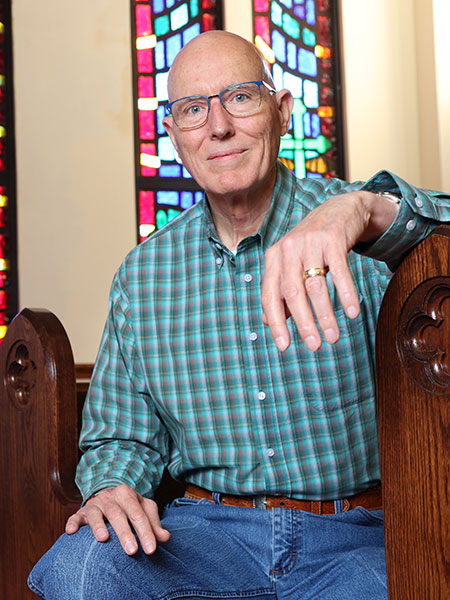
“They are able to intercede for us with prayer,” Morgan pointed out. “One of the huge differences between Catholicism and Protestantism is the communion of saints. Non-denominational, contemporary churches have a gravely different view of these things.”
After attending Midwestern Baptist Theological Seminary, the Texas native went on to pastor mission, Baptist, and cowboy churches. In May 2001, he became leader of the Cowboy Church of Ellis County — one of the first western-heritage congregations affiliated with the Baptist General Convention of Texas. For several years, it was the largest cowboy church in North America.
Morgan’s son, Jonathan, a former atheist who became an Orthodox Christian, inspired his father’s conversion to Catholicism.
“I wanted to understand where he was coming from and dialogue with him,” said the longtime resident of Waxahachie. “I wanted to find some commonality in faith.”
The Protestant minister began reading the works of the early Church fathers — books fundamental to Orthodoxy as well as other faiths. Studying Clement of Rome, Ignatius of Antioch, and Polycarp had a profound impact.
“It was so obvious they were Catholic, thought Catholic, and worshipped Catholic, and the documents supported that,” Morgan stressed.
The pastor also recognized the strong link between the Catholic and Jewish faiths.
“Christianity evolved from Judaism,” he added. “The Apostles were brought up in a Jewish environment, and much of Catholicism reflects that. Protestants don’t see that connection.”
Morgan read 50 or 60 books and all the ante-Nicene fathers before he approached anyone about converting. The Coming Home network, an online archive for those learning about the Catholic Church, became an important resource.
Sensitive to the feelings of the nondenominational congregation he shepherded for 22 years, the St. Jude parishioner and his wife, Donna, kept their 2023 entry into the Catholic Church a low-key event, sharing the news only with close family and friends.
“It was a delicate situation,” conceded Morgan, who planned a seamless transition of leadership at his former church before leaving. “I was deeply concerned that I could do something to damage the faith of the people in that community.”
Now the coordinator of adult formation and education at St. Jude, he advises others considering Catholicism to read books by Catholic authors. “The Faith of Our Fathers” by Cardinal James Gibbons is a favorite recommendation. The convert also says to expect personal challenges that come with adopting a new faith.
“You may feel lonely or scared, but absolutely do it,” Morgan insisted. “I knew in my heart this was God’s will.”
Praying for converts
Helping converts grow in faith after completing OCIA is an important priority for parishes, according to Whitehead.
“Learning about the faith cannot stop at the Easter Vigil,” he emphasized. “After receiving the sacraments, there’s a mindset that says, ‘They’re good to go.’ We should never think of any Catholic in that context.”
Along with developing opportunities for adult formation with trained catechists, parishioners should also pray for new converts. By coming into the Church, many have made their lives more complicated.
“They’re not coming from Catholic families and may not have many Catholic friends,” Whitehead explained. “They’re entering an entirely different world often viewed by non-Catholics and anti-Catholics as utterly foreign and negative. They need a lot of prayer and help in learning how to be Catholic.”