
Born in fire: The story of Pentecost and why it matters
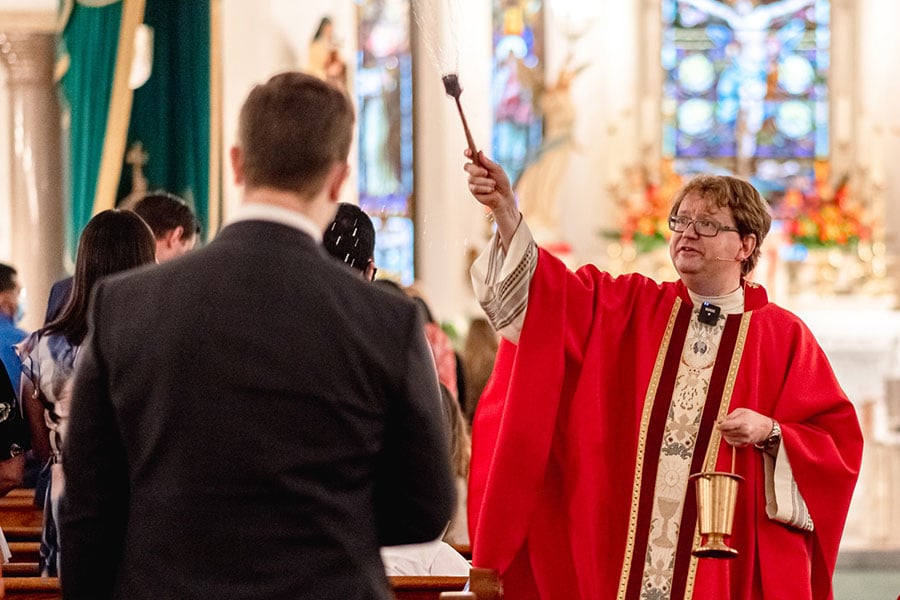
Father John Robert Skeldon, rector of St. Patrick Cathedral, blesses the congregation with holy water May 30, 2020. (NTC/Kenneth Munyer)
It seems fitting that the drama and glory of the Easter season concludes with an equally dramatic feast day — the Solemnity of Pentecost. As we read in Acts 2, the Holy Spirit rushes into the upper room as a "violent wind" and "divided tongues, as of fire" come to rest on each of the Apostles. Each is transformed by the Spirit with a miraculous gift, the ability to share the Gospel in other languages, signaling the beginning of the Church's mission to bring Christ to all people, cultures, and nations.
But because of its place on the liturgical calendar, 50 days after Easter Sunday and sandwiched between the end of school, the start of summer, and celebrations of first Communion and confirmation, Pentecost can feel overlooked or under-celebrated.
Yet it is one of the three most important solemnities in the Church's liturgical year, alongside Christmas and Easter.
Andrea Woolums, director of religious education at St. Mark Parish in Argyle, put it simply: "Pentecost is one of my favorites because it's all about transformation — the power of God to transform us into the people we are called to be."
Pentecost’s Jewish roots
The Christian feast of Pentecost has its roots in the Jewish holiday of Shavuot, the feast of seven weeks: a harvest celebration Jews observed 50 days after Passover, during which new grain was dedicated to God. Over time, it came to commemorate something far greater: God's covenant with Israel in the giving of the law to Moses at Mount Sinai.
Pope St. John Paul II explained the deep connection between the two feasts in a 1998 Wednesday audience: "Pentecost is the new Sinai; the Holy Spirit is the New Covenant; it is the gift of the new law."
St. Augustine echoed this understanding centuries earlier: "Here is a great and wondrous mystery, brethren: if you observe closely, on the day of Pentecost [the Jews] received the law written by the finger of God and on the same day of Pentecost the Holy Spirit came" (Sermo Mai, 158, 4).
While God's covenant with Israel was written in the law, at Pentecost the Apostles received something new — the Holy Spirit himself, poured out to strengthen them for a mission to preach the Gospel to the ends of the earth.
The Christian Pentecost
The outpouring of the Holy Spirit recorded in Acts 2 was remarkable on many fronts. The Apostles were so thoroughly transformed that when devout men from every nation heard them proclaiming "the mighty works of God," they were bewildered and amazed, some even thought they were drunk! Peter corrected them by drawing a direct line to God's promise through the prophet Joel: "In the last days… I will pour out my Spirit upon all flesh, and your sons and your daughters shall prophesy… And it shall be that whoever calls on the name of the Lord shall be saved" (2:28,32).
Early Christians also understood Pentecost as a reversal of Babel, the Old Testament story in which God divided human languages and scattered the nations. Where Babel created division, Pentecost healed it. The Holy Spirit's action at Pentecost was, as the International Theological Commission describes it, a "divine unification, koinonia" — a communion that crosses every boundary of language and culture.
Father Jonathan Demma, pastor of Sacred Heart Parish in Wichita Falls, sees Pentecost as a living reality, not just a historical one.
"The message of Pentecost is to allow God the room to bestow more gifts on us," he said. "We can tend to get comfortable in our talents and our abilities, but the lesson of Pentecost is that the same living Spirit that surprised the Apostles is the same Holy Spirit given to us in the sacraments. If we allow him the room, he will continue to surprise us with new gifts that we'll be able to share with others in ways we would have never expected."
Pope John Paul II explained in his 1986 encyclical Dominum et Vivificantem ("The Lord and Giver of Life"), the Holy Spirit’s outpouring not only served to embolden the Apostles for building up the Church, but to transform and strengthen the very hearts of each believer.
Woolums pointed to Peter as the clearest proof of what that transformation looks like: "Peter went from a weak leader who denied Christ in the presence of a servant girl to the Peter who, just after Pentecost, preached Christ boldly to the people. That's the power of the Holy Spirit. Just as Peter was transformed, we have to rely on the Holy Spirit to proclaim Christ in our lives."
Pentecost and the sacraments
Pentecost is not simply a past event. The Church explicitly connects it to our sacramental life today — most visibly in confirmation, but also in baptism. The Catechism of the Catholic Church (§1288) teaches that the gift of the Holy Spirit at Pentecost completes "the grace of baptism" in the newly baptized through the laying on of hands.
Fr. Demma explained it this way: "Through baptism, when we receive the fullness of the Holy Spirit, and in confirmation, when we are sealed with the Holy Spirit, we are sent out." Every baptism and every confirmation is, in a real sense, a personal Pentecost.
Mary’s presence
Mary's presence in the upper room on that day is no small detail. Fr. Demma sees in it a model for every disciple: "Christ reveals His message to us through divine revelation, the Holy Spirit tells us how to carry it out, and Mary supports us with her prayer and leads us by her example."
Woolums agreed: "Let's remember that Mary was in the upper room on that day, so we should always be open to prayer and come into the presence of Mary, our Mother. Anytime you are open and in prayer in the presence of Mary, seeking the will of God, the Holy Spirit will be there to answer you."
Clare Venegas is a wife, mother of three, and active parishioner at St. Mark Church in Argyle.