Mapping it out: the Diocese of Fort Worth updates parish boundaries
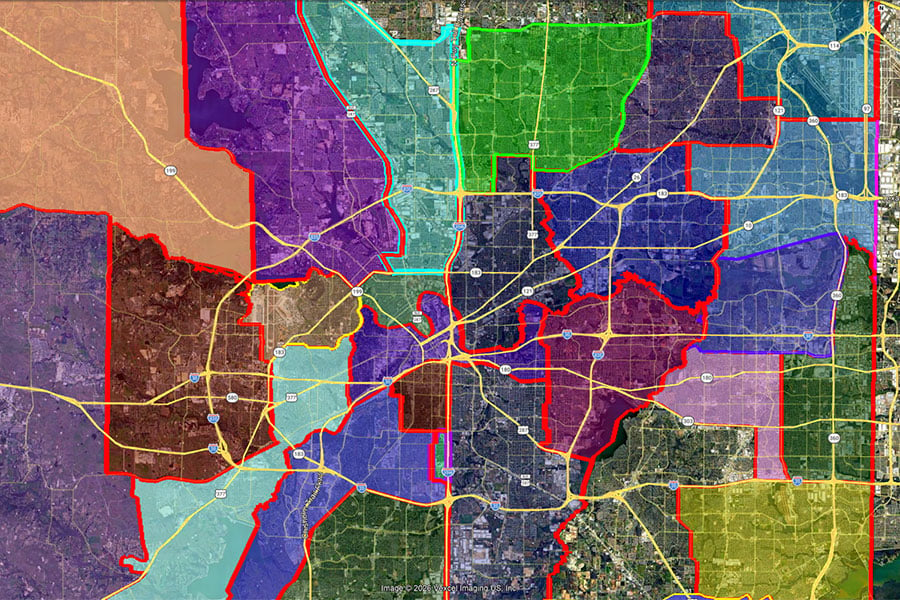
A map of parish boundaries within central Tarrant County.
FORT WORTH — The territory is stable, but the population is getting larger. With 92 parishes in 28 counties, the Diocese of Fort Worth was cited as the third fastest growing diocese in the U.S., according to a study by the Center for Applied Research in the Apostolate at Georgetown University.
The addition of parishes is one of several reasons that the diocesan administrative office has undertaken a project to ensure that each parish’s boundaries are accurate and up to date.
The North Texas Catholic asked Kevin O’Brien, director for parish/school services, and Jason Whitehead, director of evangelization and catechesis, to explain the basics of parish boundaries and why they matter.
EDITOR’S NOTE: This interview has been edited for clarity and brevity.
NTC: What is the purpose of parish boundaries?
Whitehead: The heart of parish boundaries is in part due to an aspect of the nature of the Church. The Catechism of the Catholic Church (763) describes the Church as the Kingdom of Christ on Earth. It is due to that one aspect of the nature of the Church, that it’s a kingdom, that it is ruled as such. And so it has jurisdictions, which is the central concept around which parish boundaries are set.
Parish boundaries are something that on average I would say the average Catholic doesn’t really become aware of until they try to get married, and then it becomes really important.
NTC: Are we required to attend Mass within our parish boundaries?
Whitehead: No. But let’s look at how it could affect marriage. For example, I live in Keller, so the boundaries would make St. Elizabeth Ann Seton my canonical parish. But I actually live closer, a little bit, to Good Shepherd. Let’s say my son wanted to get married, and we’re going to Good Shepherd and we approach Father Ciski for the marriage. He would point me to Father Flynn because Father Flynn’s my pastor, regardless of where I actually attend.
NTC: Would that also happen for baptisms and first Communion?
Whitehead: So permission is to be given by one’s canonical pastor to receive the sacraments elsewhere. When it comes to marriage, that touches upon validity.
O’Brien: From a practical standpoint, there are two types of parishes: public, which are territorial and have boundaries, and private (or personal).
The way I look at public parishes focuses on canon law. Canon law uses the concept of domicile, where you physically live. When you’re doing something with canon law, one of the primary questions is: What parish do you live inside of?
NTC: And what is a private parish?
Whitehead: Your typical public parish is territorial with geographic boundaries, but for a private parish, the boundary is the diocesan boundary.
O’Brien: A good example of a personal parish is Christ the King in Fort Worth. Even though it’s literally a stone’s throw away from another parish, it serves a national community and celebrates all of its Masses in Vietnamese. St. Benedict is another one — a personal parish that serves those who prefer the Extraordinary Form of the Mass.
NTC: Why is the Diocese of Fort Worth updating some parish boundaries?
O’Brien: Short answer — to make them complete and accurate. In some cases, parishes have been added but the boundaries haven’t been updated. In other cases, previous boundaries were listed as “where people go by matter of custom,” but boundaries, per canon law, should be delineated, which means you can draw it on a map.
NTC: What are some of the parameters used to define boundaries?
O’Brien: Major roads, highways and freeways, state boundaries, county lines, city lines, school district lines. Even creeks and rivers. It’s rather fascinating because a lot of our parish boundaries have the Red River as part of their boundary, but if you actually look at satellite images, that boundary moves over time.
NTC: In what situations do you redraw parish boundaries?
O’Brien: A great example of this is the establishment of St. Teresa of Calcutta Parish in Roanoke. It was actually carved out of five different parishes. When a new parish is established, they should go back and redraw or redecree the boundaries that were there.
In this project we found a parish whose original boundaries covered three counties, but now there are four other parishes inside of its boundaries. So we have the administrative task of going back and correcting that original boundary.
NTC: And this doesn’t happen often, but if a parish is closed…
O’Brien: Exactly. If a parish was closed and a new boundary decree was not issued, it can leave a gap. We found a couple of those in our diocese, unfortunately.
NTC: Why are we redefining parish boundaries now?
O’Brien: It’s doing the right thing. Let’s correct any inconsistencies instead of just letting it persist until it becomes a problem. We’re trying to be proactive, to create a 100 percent complete, accurate map of the boundaries of every parish. We should do it, and Rome expects us to have that.
When we began this project, Bishop Olson emphasized, "We’re out to add definition and clarity, modifying as little as possible.”
NTC: How many parishes are affected by this redefinition of boundaries?
O’Brien: There’s a total of 11 or 12 issues that we found that need to be addressed, and each one affects anywhere between two and as many as six parishes. So easily more than 20 parishes will have their boundaries tweaked.
NTC: Will this project have any practical implications for the diocese?
Whitehead: For most parishioners, no. We live in a highly mobile society, and Bishop Olson has no intent to enforce territorial boundaries.
For priests, it may help them define duties — hospital call, for instance. And going back to the marriage example, delegations must be made when a Catholic wants to get married in another parish, aside from his territorial parish. His canonical pastor must delegate that to the celebrating pastor for validity of the sacrament — so it’s an important one.
O’Brien: For the most part, after this goes into effect, your average person in the pew will be affected as much as he already is, which is practically not at all. The only time they may encounter any effect would be primarily with marriage and/or the marriage tribunal.
NTC: What is the process of changing parish boundaries?
O’Brien: Canon law lays out a process for changing boundaries, so this was already thought of and anticipated in the law.
Anytime an established boundary will be changed or clarified, the bishop takes his proposals to the presbyteral council, the inner circle of priests that guide and advise him. The bishop presents his plan to the council and listens to their advice and feedback. Based on this consultation, we made a few adjustments.
The next step that canon law requires is to make the parish aware of the changes to an existing boundary, even if, in many cases, it was not properly set up. This is the parish’s opportunity to listen and provide any feedback for the bishop to consider.
Bishop Olson has a schedule to visit with the affected parishes in a town hall format. Anyone in the parish who has an interest in the new boundary is welcome to come and comment. Our schedule of parish meetings should wrap up by early July.
The final step in the process is for the bishop to issue a decree stating the boundaries of the parish. When this is done, copies will be provided to parishes along with a drawing of their boundaries.
NTC: Is there a map available to better inspect parish boundaries?
O'Brien: Not at this time. However, the faithful are welcome to call their parish and inquire about their boundaries.