
A look at Mary’s home in Ephesus

An altar in the House of Virgin Mary is the place where Mary has spent her last days, according to tradition. (istock.com)
When Jesus, therefore, saw His mother and the disciple standing by, whom He loved, He said to His mother, "Woman, behold, thy son." Then He said to the disciple, "Behold, thy mother." And from that hour the disciple took her into his home (John 19:26, 27).
With those words the dying Christ commended His mother to the loving care of St. John the Apostle. Where Mary lived with the Beloved Disciple afterward is an open question.
John, you recall, with his father Zebedee, was in a thriving fishing partnership with Andrew and Simon bar Jonah some 90 miles north in Galilee (Luke 5:10). The young man was known to the servants of the high priest (John 18:15,16), very likely because John, with his brother James, oversaw delivery of salted fish to customers in Judea, including the priestly families of Annas and Caiphas. Doubtless, the family maintained a home in or near Jerusalem.
Following Pentecost, despite persecution, John stayed in Jerusalem, active within the Church while caring for the Mother of God. Around the year 38, following a three-year period of reflection, Paul came back to Jerusalem, encountering John, along with James “the brother of the Lord,” and Peter. Respectfully, Paul called them “the pillars of the Church” (Galatians 1:17, 18; 2:9).
Sometime after, John betook himself to Ephesus in Asia Minor, wrote St. Irenaeus, bishop of Lyons. This detail came from his teacher, St. Polycarp, who was himself taught and appointed bishop of Smyrna by John the Apostle (Against Heresies, book 3, chapter 3, section 4).
But was the Holy Virgin with John? This is where the plot thickens.
The tale of how the site, revered by Christians and Muslims alike as the home of the Virgin, begins in mystery with Blessed Anne Catherine Emmerich. She was a 19th century German Augustinian canoness, a bedridden mystic who bore the imprint of the stigmata.
In a vision she saw:
The Blessed Virgin's dwelling was not in Ephesus itself, but from three to four hours
distant. It stood on a height upon which several Christians from Judea, among them some of the holy women related to her, had taken up their abode. Between this height and Ephesus glided, with many a crooked curve, a little river. The height sloped obliquely toward Ephesus.
Dying in 1824, the sickly nun never set foot in Turkey. A compilation of her visions, The Life of the Blessed Virgin Mary, appeared in 1852.
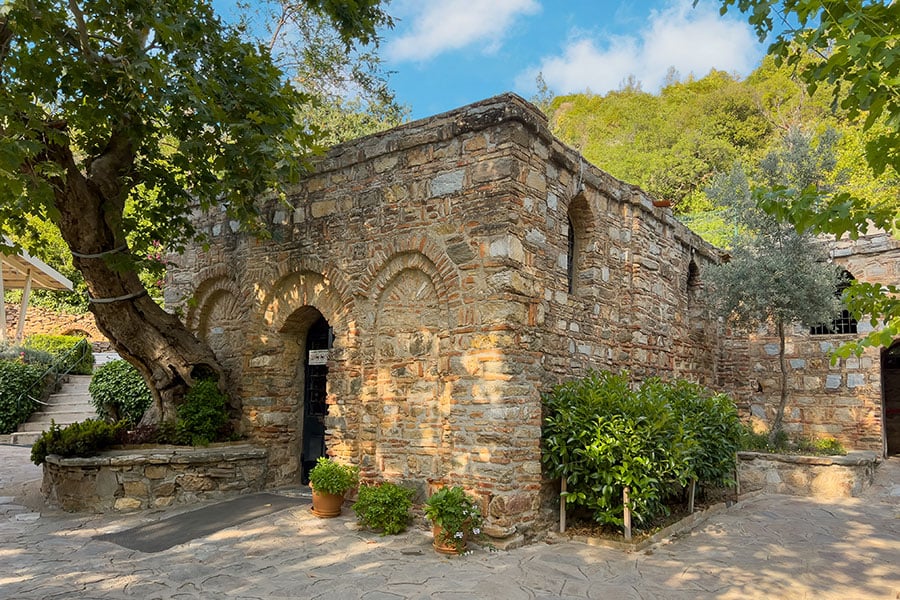
In 1881, using the book as a guide, a French priest, Father Julien Gouyet, found a roofless, ruined house on a sloping hill by a spring, matching Sister Anne’s description. Father's Gouyet's discovery inspired Sister Marie de Mandat-Grancey, a French noblewoman who had entered the Daughters of Charity, a missionary working in Smyrna (now Izmir). In 1891, she convinced two Lazarist priests stationed nearby, Fathers Eugène Poulin and Henri Jung, to assist her in locating the house.
On August 15, the Feast of the Assumption, the priests found the same demolished house on the slopes of Nightingale Hill. Intriguingly, Greek villagers nearby called it Panaya Kapulu (Doorway to the Virgin).
Pleased, Sister Marie took charge, writing her father for money enough to purchase not only the site but all of Nightingale Hill. Nobody’s fool, she wanted neither secular nor Islamic interference with her plans to restore the ruins. Negotiations with the Ottoman Empire were long and delicate yet successful.
Sister Marie, officially named Foundress of Mary’s House (Domus Mariae in Latin; Meryem Ana Evi in Turkish), began cleanup and restoration. She built a pilgrimage center with priests of the Lazarist order to operate it. The ruins were rebuilt as a chapel between 1898 and 1902. A residential building for guests and sisters to staff it was built in 1903.
With Father Jung named director of restoration, archeologists discovered foundations of a church built around the domicile in the 4th century. Later excavations disclosed the atrium of a 1st century B.C. Roman villa, further legitimizing the possibility of Mary and John having lived there, but no graves from that period were found. Catholic and Orthodox pilgrimages began in 1896.
Mary’s House remained in Sister Marie’s care until five years before her death in 1915. Cause for her canonization has begun. In 1910, she transferred title to co-discoverer Father Poulin. The property eventually passed into possession of the Lazarist order.
In 1917, embroiled in the Great War, Turkish authorities confiscated Nightingale Hill, declaring it a restricted military location. The Lazarists, allowed to return to Ephesus in 1920, found the area neglected and some buildings demolished. Limited pilgrimages resumed in 1926 but, after 10 years, the Lazarists, again, were forced to leave. Not until 1947 did Turkish authorities finally recognize the private ownership of the site and the pilgrimages began again in 1949.
The online Turkish Archeological News (2019, modified in 2022) reports how:
The Turkish government [realizing] the tourist potential of this place … built a paved access road to the sanctuary. This smart move of the Turkish authorities resulted from the proclamation made in 1950 by Pope Pius XII concerning the dogma of the Assumption of Mary.
The project to restore Mary’s House was begun by Joseph Emmanuel Descuffi, Bishop of Izmir. “This last structural intervention took place in 1951 when the entire complex was reconstructed, and the sanctuary received its present form” (Ibid.). Now pilgrims from all over the world came to Ephesus to venerate the Virgin Mother.
The restored House of Mary, now a modest chapel with a small altar set within an apsidal recess, has a few other rooms to pass through. Pilgrims bringing home water from the nearby spring can see a key-shaped baptismal pool of the Byzantine period. On a prayer wall, pilgrims leave devotional petitions and prayers.
In 1896, Pope Leo XIII named the Domus Mariae an official place of pilgrimage. Pius XII blessed the House of the Virgin Mary with the status of a Holy Place in 1951. St. John XXIII granted pilgrims a plenary indulgence under the usual conditions in 1961. St. Paul VI became the first pope to visit the site in 1967 and, along with later popes, St. John Paul II in 1979 and Benedict XVI in 2006, celebrated Holy Mass on its altar.
May the blessed Lady Mary, assumed body and soul to share in her Son’s glory, continue to pray that we all join her, world without end. Amen.
AUTHORS NOTE: Your Humble Scribe is most grateful to Abigail Portia, whose tour of Mary's House in 2013 inspired this article.
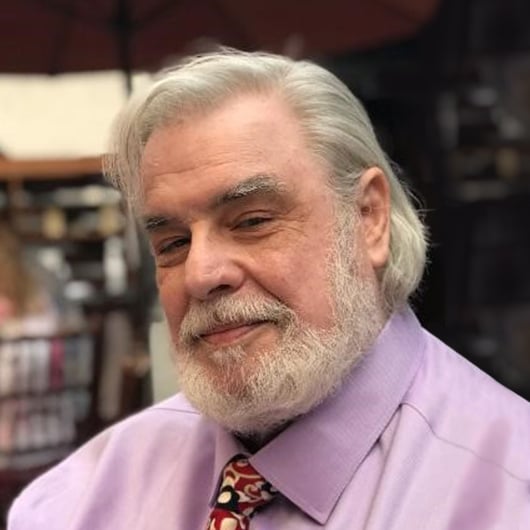
Sean M. Wright, an award-winning journalist and an Emmy-nominated television writer, is a Master Catechist for the Archdiocese of Los Angeles. He is a member of Our Lady of Perpetual Help parish in Santa Clarita, CA and responds to comments sent him at [email protected]. Find more of his columns here.