Advocates and tribunal work together to bring parishioners back to the sacraments after divorce

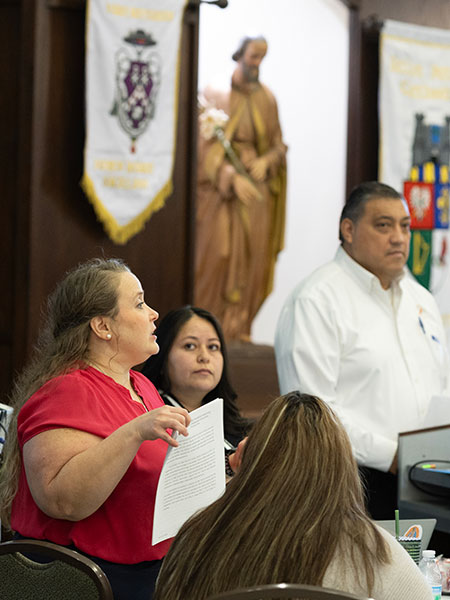
Deacon Jesus Valadez explains a point in a training session for tribunal advocates at St. Patrick Parish Hall on March 1. (NTC/Rodger Mallison)
Being there first and foremost, but also helping others navigate the painful, often confusing challenges of divorce and reconciliation with the Church, is how Cheyenne Marrinan, office manager for the Diocese of Fort Worth’s Ecclesiastical Tribunal, describes the marriage annulment journey.
“We hear a lot of sad sob stories, unfortunately,” Marrinan said, “as people go through the process of talking about some of the worst parts of their lives. But we also hear some of the most beautiful stories in their desire to return to the sacraments and get married in the Church. We get to help them go full circle, which is really something beautiful to be a part of.”
St. Elizabeth Ann Seton parishioner Toni Vasquez, who serves as a chief advocate for the tribunal, concurred when asked about the benefits of helping others through the process.
“It’s scary for many people,” Vasquez said. “A lot of times they don’t know what options they have or if they have any. Through the process they have to think back on an unhappy situation and kind of live through all that again. But afterwards, many of them end up saying it was so healing to go back and revisit everything and through that, realize they’re okay now. They can make peace with it, find closure and move forward. So, in that way, this is really a beautiful ministry.”
Being there for others in their time of need is rewarding as well, Vasquez added.
“Because it is a confusing, many times sad, process,” Vasquez said. “So to have an advocate who has dealt with these situations before be there with them through that healing journey [provides] someone to talk to and walk through that with them.”
It’s a twofold mission, Marrinan and Vasquez said: helping people seeking a marriage annulment through the tribunal while also helping those people return to the sacraments of the Church, especially the Eucharist.
About 140 volunteer advocates serve the diocese, though several work with multiple parishes. Additional volunteers, especially Spanish and Vietnamese speakers, are always needed.
Coming home
The often-used term annulment is a misnomer, Marrinan and others point out. Although it is a legitimate legal construct within secular civil law, what many refer to as marriage annulment within the Church is actually a declaration of nullity.
It is, according to the annulment section of Holy Family Parish’s website, “a declaration by a Church tribunal [a Catholic Church court] that a marriage thought to be valid according to Church law actually fell short of at least one of the essential elements required for a binding union.”
The declaration of nullity, if granted by the tribunal, “allows divorced persons to remarry in full communion with the Catholic Church.”
Making matters more confusing perhaps is the fact that nothing is declared null by the process. Rather, the tribunal declares that a marriage thought to be valid within the Church actually fell short of at least one of the essential elements.
Those essential elements, among others, require that the spouses were free to marry; that both were capable of giving their consent to marriage and freely exchanged that consent; and that both entered the marriage intending to be faithful to one another, married for life, and open to the possibility of having and raising children.
“There are lots of grounds for nullity,” Marrinan said. “Too immature, being forced into marriage because of pregnancy, being scared, or fleeing a bad home situation.”
The process can take time and is rarely cut and dried, Vasquez said.
“It’s not one-size-fits-all,” Vasquez said. “We look at each individual situation on its own merits. And we have to remind people that just because they’re seeking a [declaration of nullity] doesn’t always mean the tribunal will grant it.”
Individual approach
Holy Family parishioner Dr. Mary Keller, who serves as an advocate and assists the tribunal, said the process compares to detective work or medical care, in that each situation must be approached individually to best determine the needs of each person or couple.
Keller considers her advocate role as a vocation enhanced by her previous experience in education, in nonprofit work, and as a certified mediator through the Texas Bar Association.
“It’s a combination first of compassion and empathy for the people involved,” Keller said. “But behind that you’re helping them through the process. It’s about listening to their story to help find what’s right for them.”
Doing so brings great gratitude, Keller said, both through helping others return to the sacraments and in growing her faith life.
The process is demanding at times, but ultimately rewarding, Marrinan said.
“I’ve seen people who have wept at how much they miss receiving the Eucharist,” Marrinan said, “in physical and emotional pain at being separated from Christ, so helping them get back is a very moving, emotional part of this ministry.”
Father Tim Thompson of All Saints Parish in Fort Worth serves as judicial vicar for the diocese.
He said, “While the tribunal makes those decisions, certainly as a priest, I often talk to people seeking a [declaration of nullity], some who think nothing can be done, to help determine their options and more so bring them back to the sacraments.”
Vasquez stressed the tribunal, not the advocates, decides matters of declarations of nullity.
“That’s something I was afraid of when I was first asked about volunteering as an advocate,” Vasquez said. “But we don’t do that. What we do is talk with them, help with questions, and walk with them through the process.”
Vasquez spoke of common misunderstandings, such as the incorrect belief by many that children born of previous marriages are illegitimate, which is not the case.
She and others added one need not be a lawyer, counselor, or otherwise experienced to volunteer as an advocate as training and peer support are provided on an ongoing basis.
“It really is a very rewarding ministry,” Marrinan said. “Anyone interested is welcome to contact their parish or the website for the diocese to learn more. We have all kinds of people serving as advocates, but we always need more.”