
An issue of life-and-death

Mobilizing Catholics in the Diocese of Fort Worth to help abolish the death penalty was the aim behind a recent two-day assembly of priests and deacons from across the diocese.
The death penalty is inconsistent with pro-life values focused on the sanctity of all life and upholding human dignity, according to the Catholic Church.
Bishop Michael Olson said he wanted to bring the Catholic Mobilizing Network, a Catholic charity focused on eliminating the death penalty in the United States, to the diocese to educate priests and deacons to encourage their congregations.
"Capital punishment is a very pressing issue concerning human dignity, justice, and the fostering of a pro-life culture,” Bishop Olson said. “It's very pressing because of the recent developments in doctrine concerning this issue over the last 50 years. It’s important that our priests and deacons be informed about the reality of capital punishment in Texas for the sake of their preaching in the formation of the conscience of our lay faithful."
In 2018 under the leadership of Pope Francis, the Church revised the “Catechism of the Catholic Church” to state, “in the light of the Gospel, that ‘the death penalty is inadmissible because it is an attack on the inviolability and dignity of the person’” and calls the Church to work “with determination for its abolition worldwide.”
Justice as punishment vs. restoration
Krisanne Vaillancourt Murphy, Executive Director of the Catholic Mobilizing Network, said priests play a key role in helping people understand the Catholic Church’s stance on capital punishment. She cited a recent study from Georgetown University that surveyed more than 1,000 Catholics: a third were unsure about the Church’s teaching, a third thought it was admissible in rare cases, and another third said it was never allowed.
In the past, Church guidance had indicated that the death penalty was allowed in very rare cases of extreme harm.
“Now, it’s crystal clear about the inviolability and human dignity of every person,” Murphy said.
Capital punishment is incompatible with the Gospel and the teachings of Jesus and His desire to bring healing, she said.
The goal, according to Murphy and the Catholic Mobilizing Network, is not just abolishing the death penalty but bringing about restorative justice.
The legal system asks what law was broken, who broke the law, and how should they be punished?
“Restorative justice asks, what was the harm, who was impacted, and how, and what can be done to make it right,” Murphy said.
While nothing can replace a person whose life was taken, offenders who can acknowledge their responsibility and listen to those impacted by harm can experience restorative justice.
‘Jesus has the power to change people’s hearts’
With a focus on both ending capital punishment and restorative justice, the two-day event in Fort Worth highlighted compelling stories from people who have been directly impacted by the death penalty, including a father who has become an outspoken advocate against the death penalty after his daughter was murdered; the sister of a man who was exonerated after spending five years on death row; the former jury foreman in a Tarrant County death penalty case who has since become opposed to the death penalty; and a priest who serves as a spiritual advisor to individuals on death row.
Father Tim Thompson, pastor of All Saints Parish in Fort Worth, said he was moved by the stories of the priest who ministered to prisoners on death row.
Fr. Thompson said that the Church is called to advocate a move from punitive justice to mercy.
“We do need to have justice, but if that’s our only thinking we end up with a harsh society that no one can survive in,” he said. “Justice has been reduced in our mind to punishing, but in the end it doesn’t satisfy.”
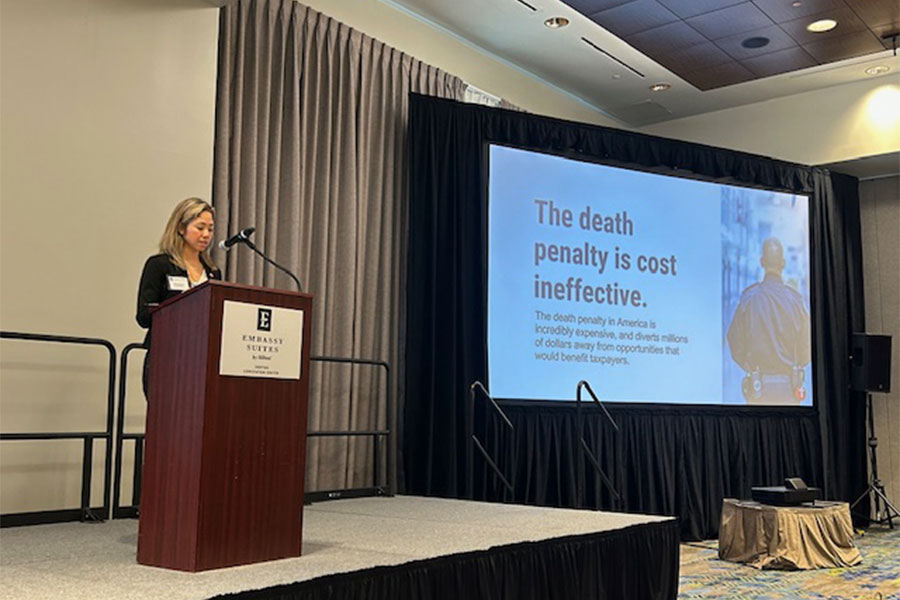
The death penalty and the current state of the criminal justice system have a negative impact on communities.
“If someone seeks forgiveness, that’s good for the soul, but vengeance is bad for us, affects our hearts, and deepens resentment,” Fr. Thompson said. “The death penalty is part of the issue, but how can we become a society of restorative justice and redemption?”
Father Richard Collins leads the prison ministry in the diocese, and he and his team minister to hundreds of Catholics in more than a dozen federal, state, and local prisons and jails across the region. The second largest prison in the state, the James V. Allred Unit, is in the diocese near Wichita Falls and houses some 3,600 inmates.
Fr. Collins said the focus on human dignity, which was highlighted in the CMN assembly, is “very helpful.”
The death penalty is the culmination of a punitive system that is largely broken.
He noted the tension between security and rehabilitation and how today’s prisons focus more on punishment than rehabilitation.
“We have to have public safety, but the system has to encourage rehabilitation, not just lock people up for a long time and not help them,” he said.
The Church and restorative justice point to a better way.
“For us coming with faith, we believe Jesus has the power to change people’s hearts,” Fr. Collins said. “The Church has a mission to do that.
“We want people to have that experience with the Lord Jesus that brings about lifelong change, and to then be able to go back to their community and be a more positive person and live Christian values.”
What can faithful Catholics do?
Texas is one of a handful of states actively pursuing capital punishment, and Tarrant County is one of the hot spots, along with Houston’s Harris County, with the most inmates on death row.
There are a number of issues with the death penalty in addition to the sanctity of human life.
According to the Catholic Mobilizing Network, 1 person has been exonerated for every 8 people who were executed.
Also, capital punishment shows a strong racial bias. Men of color convicted of murdering a white victim make up the vast majority of people on death row.
What can faithful Catholics do?
Fr. Collins asked that they keep the diocesan prison ministry and the system as a whole in their prayers.
“I think just a real sense of prayer for change in criminal justice for more rehabilitation is important,” he said.
Murphy echoed the need for prayer and a focus on the abolition of the death penalty as a pro-life issue. Churches can focus on it during October’s Respect Life Month with concerted prayer and education. They can invite speakers who are directly impacted by the death penalty.
She also said that concerned Catholics can contact the governor’s office and the Texas Board of Pardons and Paroles. Despite Gov. Greg Abbott’s Catholic faith, he remains a staunch supporter of the death penalty, Murphy said.
Texas Catholics also can contact their state congressional delegates and write letters to the editor in local publications. The ultimate goal is to not just eliminate the death penalty but to transform the criminal justice system, Murphy said, by focusing on accountability, responsibility, mercy, forgiveness, and healing.
She mentioned the story Jesus told in John 8, where He told a crowd ready to kill a woman caught in adultery, “Let he who is without sin cast the first stone.” One by one, the crowd disappeared.
“We’re on a journey of forgiveness,” Murphy said. “We have a lot of work to do so we can experience healing through Jesus Christ and His model.”