
The Beautiful Game
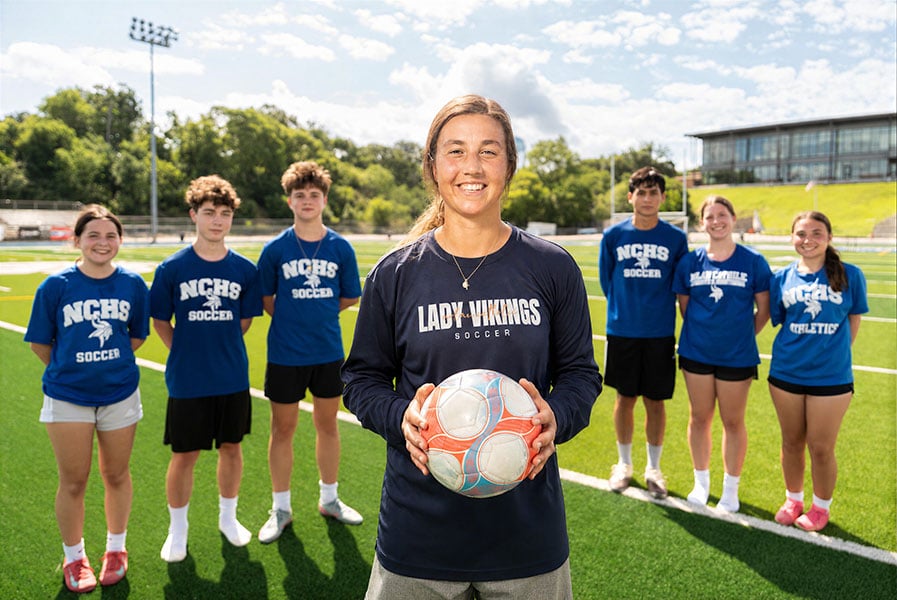
Nolan Catholic High School teacher and soccer coach Lauren Sajewich poses with student athletes after practice on June 10. (NTC/Juan Guajardo)
When the previous World Cup began in June of 2022, Pope Francis hoped it would be a way to unite people and foster goodwill among nations.
“May this important event be an occasion of encounter and harmony among nations and may it promote fraternity and peace among peoples,” Pope Francis said.
When his home country of Argentina eventually defeated France to win the championship match, his response was humble and measured.
“Bless God,” were his only words.
The former pontiff understood how important the sport of soccer/football is to millions of people around the world and that while his fellow countrymen were celebrating in the streets, many, many more people felt disappointed.
As people around the world revel in the 2026 World Cup hosted in North America, properties and virtues of “the beautiful game” will be on full display.
But perhaps a subtler, less obvious phenomenon is the parallels between World Cup soccer and the Catholic faith itself.
Working as a team
Lauren Sajewich, a theology teacher and soccer coach at Nolan Catholic High School, started playing the sport at the age of 5.
Growing up in suburban Chicago, Sajewich would eventually play college soccer at Texas Christian University and said the similarities between soccer and Catholicism are some of her favorite topics of discussion.
“Soccer is a team sport, and Catholicism is a body, specifically the Mystical Body of Jesus Christ here on Earth,” Sajewich said. “Just like a team is made of many positions and strengths, so is the Church dependent on its members to faithfully contribute to the whole with their abilities and strengths. With all of our strengths also come weaknesses. The beauty of soccer is you get to see both in a team of players.”
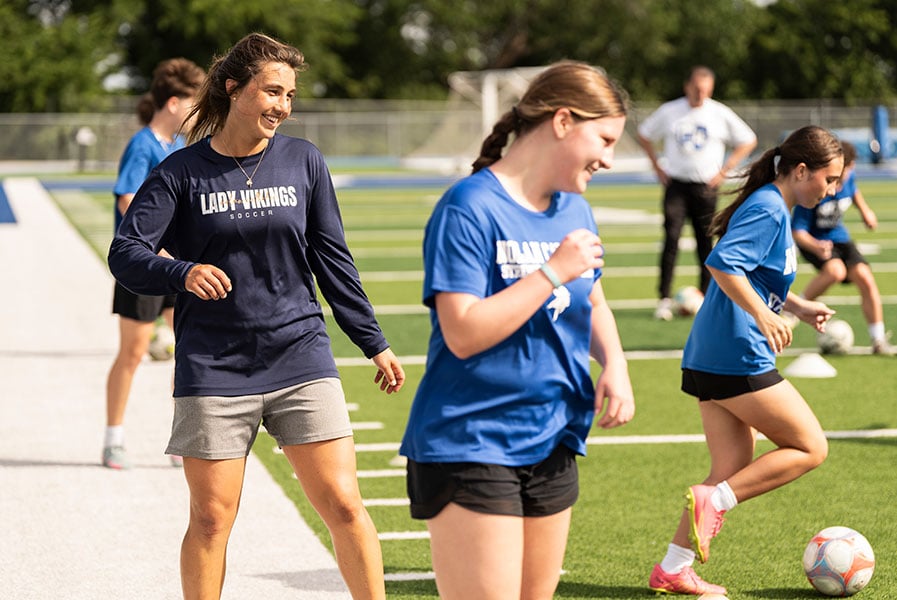
Sajewich said Catholicism also brings out both strength and weakness in each of its individual members.
“In the pursuit of holiness, all of our shortcomings and faults will be realized,” Sajewich said. “In the pursuit of excellence on the field and off the field, the same will occur. With the pursuit of excellence and holiness comes the development of many virtues.”
Two of her favorite virtues, humility and magnanimity, are especially pertinent to the sport of soccer.
“The physical demand of soccer opens the door to big-heartedness, which is magnanimity, because it asks a lot physically of an individual but also a spirit of loving sacrifice,” Sajewich said. “To chase a ball down after a teammate loses it. To make a mistake and make the gut-busting run to get back in position.
These are opportunities soccer gives to build virtue, in addition to the relationships that are formed in the highs and lows of the game, much like the people that are there for you when you experience the highs and lows of your faith.”
A member of St. Elizabeth Ann Seton Parish in Keller, Sajewich believes what makes the World Cup such an appealing event for so many people is that it gives them something to root for and something to belong to that is bigger than them.
“We have such a deep longing as human beings to belong to something bigger than ourselves, which is a longing that can only really be fulfilled in the Trinitarian life of God,” Sajewich said. “St. Augustine says, ‘You have made us for yourself, O Lord, and our hearts are restless until they rest in you.’ The community of love that is the three persons of the Trinity is always inviting us to be more deeply in relationship and communion with others here in this world as well, which is what people are looking for and why I think the World Cup is so appealing — besides, of course, being the best game in the world.”
Life lessons
Yasmin Cuevas, director of religious education at St. Peter the Apostle Parish in White Settlement, organizes a parish youth league soccer team and integrates faith elements such as prayer before and after games.
Cuevas took that approach to the game to reinforce a notable life lesson.
“It’s important to show the teens to bring God to the field,” Cuevas said. “To include Him in everything that we do.”
Cuevas said her players are excited about the World Cup, and she hopes her students understand how their faith and their favorite sport complement each other.
“They both create a community,” Cuevas said. “They bring people together and provide a sense of belonging, purpose, and identity. Both environments foster a sense of being part of something bigger than oneself; both players and the laity work together for the common good. It unites people of diverse backgrounds; it brings families together — it’s shared from generation to generation.”
Body, mind, and soul
Javier Escutia, a seminarian who just completed his pastoral year at St. Jude Parish in Mansfield, said the 2014 World Cup is when his passion for the sport really began to blossom.
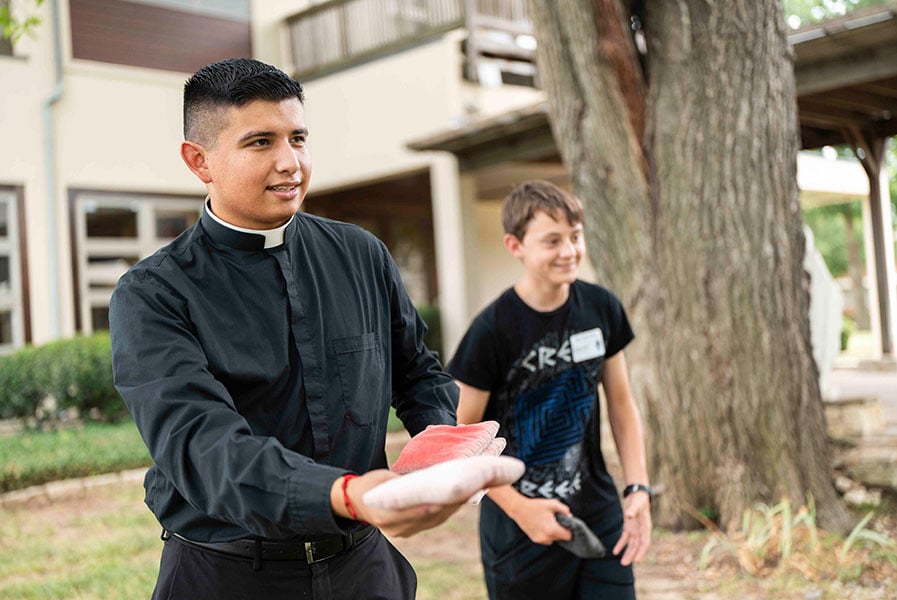
“As a child, my father tried to teach me how to play soccer, but I did not really find it interesting,” Escutia said. “But after watching that World Cup, I began to follow, learn, and play the sport.”
Escutia, who is studying theology at Assumption Seminary in San Antonio and will likely be ordained a transitional deacon in the spring of 2027 and a priest in the spring of 2028, said what makes the World Cup such an important event is that it is the “world’s” competition.
“It is larger than the Olympics,” Escutia said. “Soccer is the world’s sport, which means the entire world is watching it, especially the final.”
Escutia said besides the excitement of the tournament itself, the World Cup truly embodies the principles of Catholic social teachings and provides economic opportunities in ways that make the event valuable to everyone.
“The World Cup raises awareness about immigration, poverty, racism, social justice, just living conditions, just working conditions, and civil rights,” Escutia said.
“The World Cup, again, brings unity and peace, which the Church actively promotes,” Escutia said. “And the Church recognizes the value of the sport. In fact, popes, including the late Pope Francis, who was an avid soccer fan, often spoke about the importance and value of the sport.
“He always promoted it as a sign of unity and peace, encouraged soccer players to work well for the good of the world, and emphasized the benefits of the sport, such as working the body, mind, and soul.”