
Christmas and the Love of God
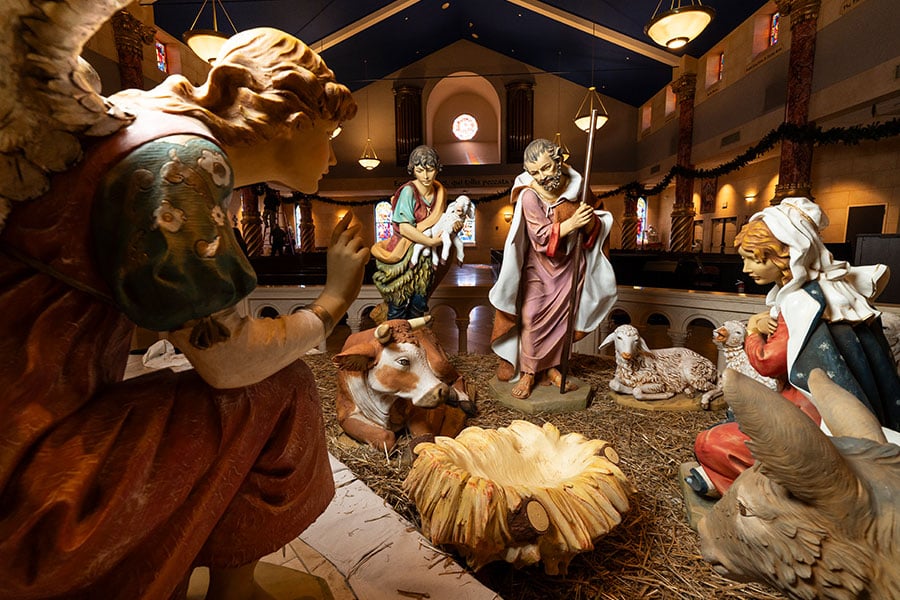
NTC/Juan Guajardo
The Christmas season is finally here. Without question, my favorite time of year. There is something tangibly different about Christmas, all of which originates in the Incarnation.
Referred to by many as the “magic” of Christmas, the distinct feel of this time of year revolves around what the Catechism calls “The Christmas Mystery.” In the Nativity of our Lord, within the context of the humble poverty He undertook, heaven’s glory is made manifest (Catechism of the Catholic Church 525). At the heart of the mystery resides the “marvelous exchange” where the “Creator has become man, born of the Virgin,” and we “have been made sharers in the divinity of Christ who humbled Himself to share our humanity” (CCC 526).
The mystery that is Christmas speaks to the purposes of the Incarnation, most notably Christ enabling us to partake in His divine nature (CCC 460). Of course, this is inseparable from Him showing us the extent of God’s love (CCC 458), for in this “the love of God was made manifest among us, that God sent His only Son into the world, so that we might live through Him” (1 John 4:9).
St. Paul asks the perfect rhetorical question then, when he asks, “Who shall separate us from the love of Christ?” (Romans 8:35). For the love of God is unconditional, a love through which He chooses to bind Himself to us, a love beautifully exhibited in His Nativity.
As examples of trials we experience in life, St. Paul mentions a few circumstances or occasions, one of them being the “sword.” Lord willing, few, if any, of us will experience the “sword” as a form of trial in the literal sense. More broadly applied however, the “sword” can be taken figuratively to mean any form of injury, coercion, or manipulation. In this sense, many of us have been tested by the “sword.”
St. Paul, however, reminds us that, despite the “sword” and the suffering we endure as a result, we are not forgotten and cannot be separated from the love of God, but rather, “are more than conquerors through Him who loved us” (Romans 8:37). Paul continues by stating the fact that “neither death, nor life…nor things to come…nor anything else in all creation will be able to separate us from the love of God” (Romans 8:38).
His comment regarding “life” is interesting, for he is referring to the love of life and how a child of God should not fear to do so. How often, as Catholics, have we had the impression that the suffering of the “sword” should be our norm, meant to be endured regardless, denying ourselves escape from the “sword,” even to the point of viewing this life as being meant for suffering rather than to be enjoyed to the full?
Of course, we are not to be worldly. However, we are called upon to love the life we are given and possess it with all abundance granted and designed by God. We should enjoy His gift of life. By direct connection, we should enjoy its author, God.
How can we not enjoy One who loves us so? How can we not love One who “intercedes for us with sighs too deep for words” (Romans 8:26)? Of course, the sigh Paul is talking about here is the sigh one gives when one is in such deep love and admiration of another that they are at a loss for words. The Spirit, the very breath of God, the breath of love itself, brings us into the midst of this divine love, into divine love in action. This is how Christ is formed in us. Herein is where the mystery of Christmas is fulfilled in us (CCC 526).
How can we not love in return? How can we not enjoy Him? How can we not find freedom in Him, His love, and His gifts? How can we not have a Merry Christmas?

Jason Whitehead is the diocesan director of evangelization and catechesis. He entered the Church in 2012 and subsequently received a master’s degree in theology. Find his regular columns for the North Texas Catholic here.