
Ethics behind the artificial tool

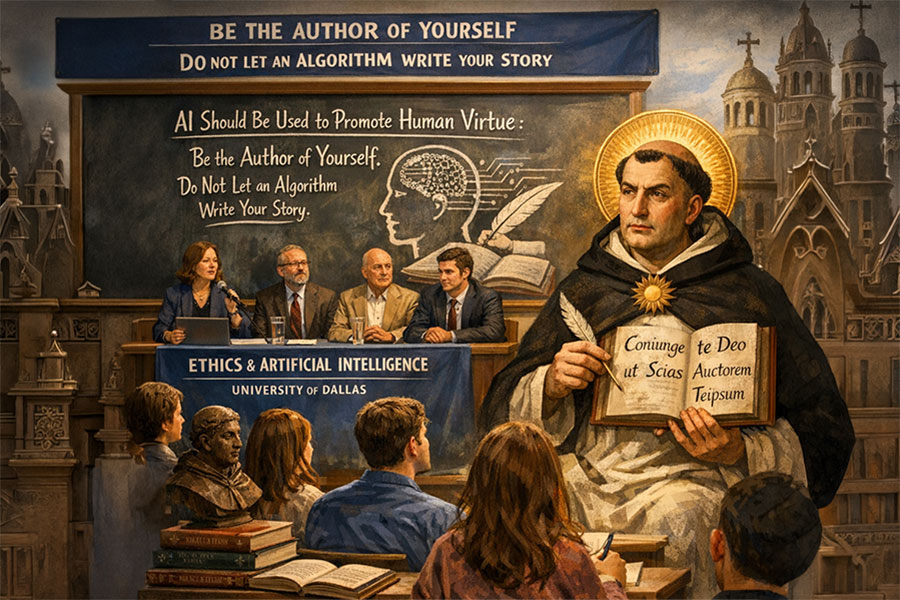
An image capturing St. Thomas Aquinas, God, and an artificial agent, symbolizing the dialogue between faith, reason, and technology. This image was created using artificial intelligence by Microsoft Copilot, which is powered by OpenAI’s GPT models.
DALLAS — Arguably more than other recent technological advances, artificial intelligence engenders twin responses of uneasiness and possibility. An emerging, albeit rapidly evolving, technology firmly rooted in the here and now whether welcomed or not, AI is one also mired in ethical concerns and uncertainty.
“We live in a world of AI and there’s no going back,” said Dr. Chris Malloy, University of Dallas theology professor. “But prudence is not easy because navigating uncharted waters gives us no ready-made answers. So, it requires intellectual and moral struggle.”
Referencing Aldous Huxley’s “Brave New World,” Malloy stressed the Second Vatican Council’s call for Catholics to engage in the world as it is. Which, with AI, requires concerted effort to “foster the marvelous and mitigate the monstrous.”
“It’s important too to remember that invention is the work of man and that God enables and calls for invention,” he said.
UD students likewise voiced mixed enthusiasm and unease over AI’s presence.
“What are your thoughts on AI?” a dry erase board in the lobby area of a UD building read.
One student wrote, “Yes, it can be helpful,” while another wrote, “Two thumbs up.” A third wrote that it can be helpful and, either way, is “not going away.”
“Destroy it with fire” and “trash” two other students weighed in on the opposite. Another wrote it should be banned save for research, scientific, and weather forecasting uses. Another wrote that AI “should not be used to replace human connections and creativity.” Yet another said AI hampers critical thinking while promoting dependency. Another student labeled AI “bad for polar bears.”
“The notion of the individual dilutes to the degree that technology takes control of our acts,” author Juan Villoro warns in “Horizontal Vertigo: A City Called Mexico.”
Pope Leo XIV likewise weighed in during last year’s Conference on Artificial Intelligence, Ethics, and Corporate Governance.
“Your presence attests to the urgent need for serious reflection and ongoing discussion on the inherently ethical dimension of AI, as well as its responsible governance,” Pope Leo said. “AI has been used in positive and indeed noble ways to promote greater equality, but there is likewise the possibility of its misuse for selfish gain at the expense of others, or worse, to foment conflict and aggression.”
State Sen. Tan Parker of Flower Mound, who co-chairs the Texas Artificial Intelligence Advisory Council, discussed the need for guidelines and ethical consideration last year at Nolan High School.
“AI is a tool to augment human performance,” Parker said. “We need to always make certain that AI tools are just that, tools that augment, not replace human performance. We don’t want to see it used for detrimental and destructive things.”
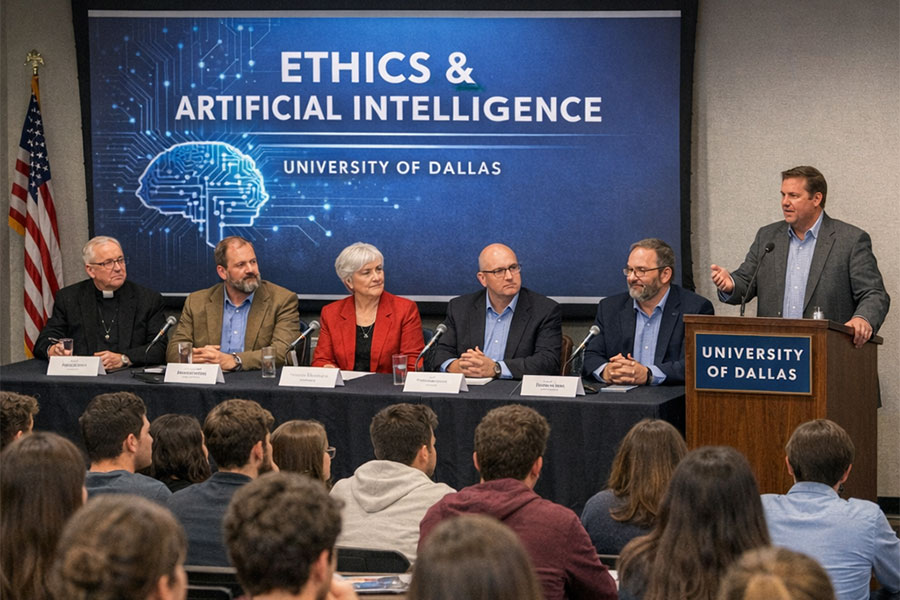
In that spirit, Father Nicanor Pier Giorgio Austriaco, OP, a professor of biological sciences and sacred theology at the University of Santo Tomas in the Philippines, presented a talk on AI titled “Towards a Thomistic Virtue Ethics for Artificial Intelligence” as part of UD’s Landregan Lecture series.
Fr. Austriaco said technology advances realized during earlier eras of the Industrial Revolution initially unsettled many, much as still-developing AI technology does today. Fr. Austriaco also referenced the Church’s response to earlier social revolutions tied to emerging technology.
The point of his talk, Fr. Austriaco said, is to focus on AI ethics from a spiritual approach.
“AI is a system with the ability to process data in a way that resembles cognizant behavior,” Fr. Austriaco said.
He detailed the logistics and various systems and uses of AI from its current algorithm applications to Netflix, TikTok, virtual companions, self-driving cars, biological research, and more. Along the way, Fr. Austriaco highlighted AI’s benefits and potential drawbacks. Of the latter, he spoke of AI’s addictive nature shown in social media content recommendations as well as the potential for spread of misinformation, bias from programmers, and other dangers.
Virtual AI companions, for example, can be used to remind people to take their medicine, feed their pets, etc. On the other hand, they can distract people from the real world into a “bubble of fantasyland,” Fr. Austriaco said, mentioning a recent story of a woman who wanted to marry her AI companion.
Fr. Austriaco spoke of copyright implications such as determining ownership of AI-generated photos, art, and poetry. While the need for AI guidelines is clear, consensus on such guidelines — given cultural and legal differences throughout the world — remains a moving target.
Fr. Austriaco suggested a path forward taking into account Catholic virtues and ethics.
“Through God’s grace, that involves dealing with authentic good as opposed to some random, made-up good, which takes into account that which perfects our nature, which makes us good human beings,” Fr. Austriaco said.
Approaching the question from the Thomistic, that is, St. Thomas of Aquinas, view requires consideration of the individual, common, and ecological goods in assessing AI applications, Fr. Austriaco said.
“The individual good perfects the individual human agent while the common good perfects the human community,” Fr. Austriaco said. “The ecological good perfects the environment.
“What’s important to remember is that they are entangled. You can’t say, ‘My individual good is good in a way that’s completely divorced from the common and ecological goods.’”
Such considerations should apply to all AI uses and advances, Fr. Austriaco said, as well as all developers, users, and regulators of AI. It’s imperative inasmuch as possible to limit AI functions from exploiting the vulnerable or the environment or replacing genuine human interaction with each other and God.
“The individual good cannot be realized apart from the common good,” Fr. Austriaco said. “But the modern view is that you can become you without us. The Thomistic view is that there is no you without us.
“AI should be used to promote human virtue. Be the author of yourself. Do not let an algorithm write your story.”
UD graduate student Lily Matula colored herself an outlier in her age group given her skepticism of AI.
“Which is why I was curious to hear Fr. Austriaco’s thoughts on a Thomistic view of an ethical framework for AI,” Matula said. “I hadn’t heard a compelling Catholic take on this yet, so it was fascinating to hear what someone so knowledgeable on the subject had to say.
“I don’t know I’d say I’m in favor of AI now. But I do like the notion of approaching it from a classical ethical framework informed by higher principles.”