
Evangelization in a World of Uncertainty
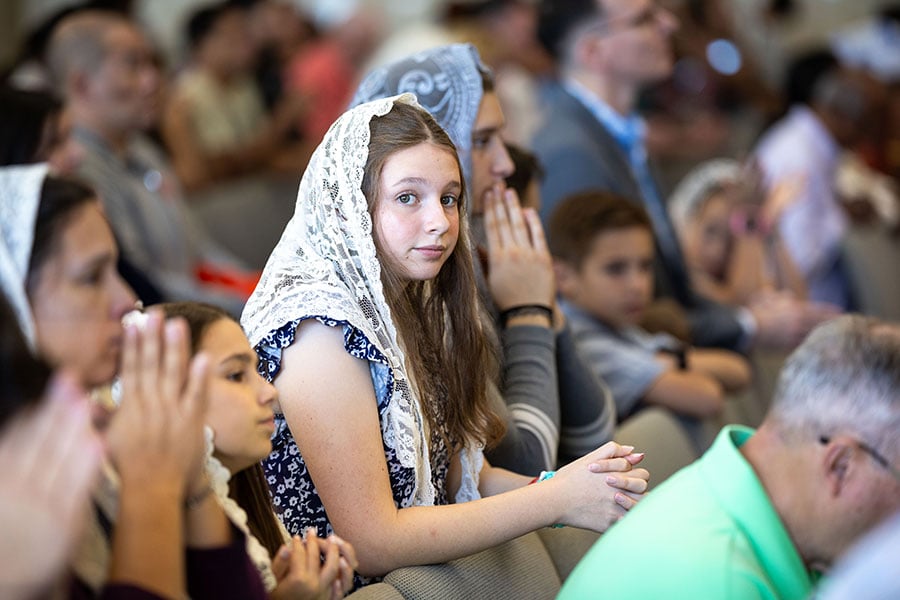
Parishioners pray at the World Mission Sunday Mass celebrated by Bishop Michael Olson at St. Martin de Porres Parish in Prosper on Sunday, October 19, 2025. (Photo by Kevin Bartram)
More than ever, modern society has more questions than answers. At any age, however, key existential questions such as “Why am I here?” are central. This essential question must be addressed as the Church seeks to spread the Good News.
This question’s importance has to do with one’s purpose, which gives meaning to life. Without meaning, man’s life becomes bleak and dark, without hope. In a state of uncertainty, we always seek a purpose, whether that be work, hobbies, sports, or activities empty of all meaning and harmful. Part of the Good News which the Church provides is a definite and common purpose for all our lives: eternity with God in heaven.
In heaven, we will enjoy our reward in glory, participating in the “Beatific Vision,” wherein we will see God “face to face.” The other part of the Good News is the Church possesses within herself, as constituted by Christ, all the means to fulfill her mission of leading people to this supernatural purpose.
In general terms, the Church is uniquely equipped to lead us to eternity by means of transmitting to us divine revelation and sanctifying grace. By these means, the Church divinizes us, equipping us for eternity, giving us the power to believe in God, think like God, and act like God, living the supernatural life here in this world to inherit the eternal supernatural life in the world to come.
The Church teaches us about the supernatural life through the theological virtues of faith, hope, and charity. Given our topic of evangelization, the nature of faith is paramount. Faith is not something man comes to on his own.
While consistent with his nature, he does not have the power to come by it naturally. He requires the gift of grace to enable him to “believe in God and believe all He has said and revealed to us, and that Holy Church proposes for our belief, because He is truth itself” (Catechism of the Catholic Church, 1814).
Such a definition of faith helps indicate the necessity of grace but also illustrates how those who have yet to come to faith must be led to such a life. When the Church talks about faith, it highlights two distinct aspects, “divine” and “Catholic” faith.
The first component, divine faith, is of the very essence of faith, for it addresses why we believe. (The second component is concerned with what we believe.) This “why” we believe is at the very core of faith since it determines who it is we believe in, us or God. If we believe in something based upon our own authority, this is called “human” faith. Such faith is not supernatural and therefore, not saving. If we believe because we have become convinced of the truth based on the authority of God, this is divine faith, a supernatural faith, without which it is impossible to please God.
So, the question arises, “How do we lead people to such a faith?” “How can someone come to believe in the unquestioned authority of God and base their lives upon His word?” Souls must be led to see how God Himself has verified His authenticity in what the Church calls the “motives of credibility” (CCC 156) — specific aspects of God’s revelation where He left positive indication of the veracity of His claims. Examples include fulfilled Old Testament messianic prophesies which give clear indication of the divine authorship of Sacred Scripture.
Such truths must be shared with this world so they can come to faith, a necessary component of which is certitude (CCC 157). If you know someone consumed by questions and uncertainty, seek to give them the answer, Jesus Christ. To help them find Him, tell them He loves them and has come to give them peace. Then, take them to His written word and show them how He can speak to them through its pages.

Jason Whitehead was received into the Catholic Church in 2012 and subsequently received a master’s degree in Theology from Holy Apostles College and Seminary. He began working for the Diocese of Fort Worth in 2014 and currently serves as Department Director of Evangelization and Catechesis. Find his regular columns for the North Texas Catholic here.