Flourishing faith
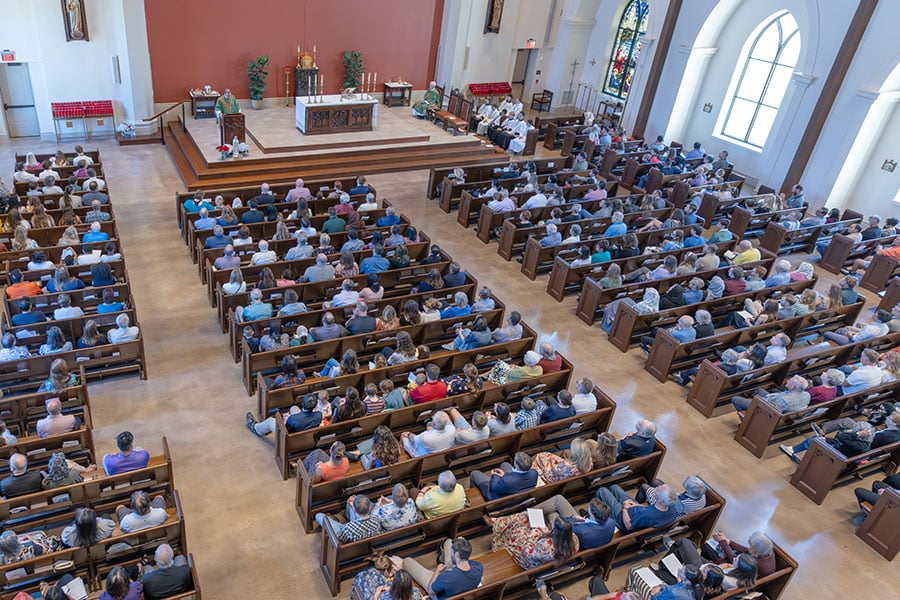
Parishioners fill the parish at Flower Mound's St. Philip the Apostle Church, which opened in 2022 and has plans to expand. (NTC/Scott Wagner)
The Diocese of Fort Worth grew by 871,000 new parishioners between 2000 and 2020, according to a 2021 study by the Center for Applied Research in the Apostolate at Georgetown University. The diocese was behind only Atlanta and San Bernadino, Calif.
Such growth falls in line with U.S. Catholic trends over the last 40 years. Nationwide, the number of Catholics grew 40 percent, from 48 to 67 million over that time period, according to an August National Catholic Register article.
Although U.S. numbers have grown, they have not done so uniformly throughout the country. There too, Fort Worth falls in line with national growth trends.
Of the top 10 national growth areas, all but one — the Archdiocese of New York — occurred in the south or west regions of the U.S. Six of those regions are in Texas or California.
Concurrently over the same period, many once Catholic strongholds, particularly in the Northeast and Midwest, have experienced declines in the number of Catholics, in some cases leading to parish closures and mergers, according to the same article. The population in those regions, which totaled about 70 percent of the nation’s Catholics in 1980, now sits at 47 percent as of 2019.
Diocesan growth has also, to some extent and for several of the same reasons, mirrored the explosive growth of North Texas and most of the state over recent years.
Those big-picture migration reasons include economic and societal conditions, among other factors.
Challenge and opportunity
Diocesan population increase, while a plus overall, also brings growing pains, said several associated with the diocese. Parishes experiencing similar growth face the challenges of sufficient infrastructure to accommodate new parishioners.
Such challenges include COVID and rising construction costs, Diocesan Director of Construction and Facilities Tom Ross said.
“Until about five years ago, when COVID hit hot and heavy, we were on a pretty normal pace for construction,” Ross said. “That, and the population boom in North Texas overall, has really impacted the diocese.”
Growth arrived simultaneously with soaring price increases for building materials.
“The other thing is that, even with price increases, we and others in North Texas continued to build,” Ross said. “Because of that, the market understood that it could bear those prices, which means now it’s going to stay that way.”
Challenges come too in the possibilities of expanding existing churches.
“Because a lot of our churches are old and designated historical, we can’t really alter or expand those buildings,” Ross said.
That said, the diocese is prepared and taking steps to meet the challenges of new growth, Ross added.
“I’m not sure what the major draw is in a lot of states losing residents while we’re gaining residents,” Ross said. “Texas doesn’t have a state income tax. That and other things probably make it attractive, especially from an economic standpoint.”
Diocesan Director of Evangelization and Catechesis Jason Whitehead said the diocese’s new Catholic arrivals consist both of longtime residents converting from other religions as well as newly transplanted Texans.
“It’s partly the overall population influx,” Whitehead said when asked to attribute diocesan growth. “It’s also our more concerted efforts in sound catechesis and a movement of the Holy Spirit in creating increased interest in all things related to Catholicism.”
The growth, while not without challenges, definitely represents opportunity, Whitehead said.
“One wherein we can reach more people for Christ,” he said.
Seeking substance
Arlington’s St. Maria Goretti Parish Director of Faith Formation Keith Parker offered his take on diocesan growth, especially among college-age and younger people.
“I think the focus on more inclusion in the Catholic arena is appealing to many who feel disenfranchised with the prosperity gospel that is sweeping many Protestant churches in America,” Parker said. “Many seem to be looking for meaning beyond health and wealth messages, and the tradition of the Catholic Church is becoming more attractive to those trying to follow the call of Jesus in a fractured society.”
Parker added the diversity and inclusiveness of most parishes appeals to many as well.
“Put all that with the lack of community everyone has experienced the last several years and it seems like the right time for many to reconsider the Catholic Church,” Parker said.
Deacon Larry Sandoval of Keller’s St. Elizabeth Ann Seton Parish said 100 to 120 sign up for OCIA classes each year and that they’d probably have more if they had more room. Those newcomers include Catholics never confirmed, members of other faiths, and those of no faith.
“They see the beauty of the Mass and the peace it brings them. That makes them wonder what this Catholicism is all about,” Dcn. Sandoval said. “Ultimately, I would attribute it to the Holy Spirit working in their lives.”
Dcn. Sandoval said he interviews each candidate at the beginning of the 10-month course to learn what brought them to the Church — stories he called a joy to hear.
“I had a man in his 70s last year who saw the change in his son and daughter-in-law after they went through OCIA,” Dcn. Sandoval said. “He said he wanted to be part of that because it seemed so joyful.”
Dcn. Sandoval credits the growth of area Catholic populations to the pastoral care present at the parish as well as the appeal of the truth and tradition of the Church.
Maria Rosales teaches OCIA classes at St. Patrick Cathedral. Rosales said Fort Worth’s cost of living and small town feel with urban amenities draws many to the region.
“People are also getting back to normalcy from the COVID years,” Rosales said. “Young couples are starting families and there’s a conscious effort in keeping the traditions and connections to a local parish.”
Many people of other faiths, especially those of mega churches or nondenominational faiths, feel disconnected or disenfranchised and are seeking something more substantive, Rosales said.
“I feel [the growth] is both exciting and challenging,” Rosales said. “When I started, I didn’t realize until later that God had this planned for me all along. I knew it would be challenging, but I welcomed the opportunity.”