
From Texas to Eternity: An encounter with the Saints in Rome
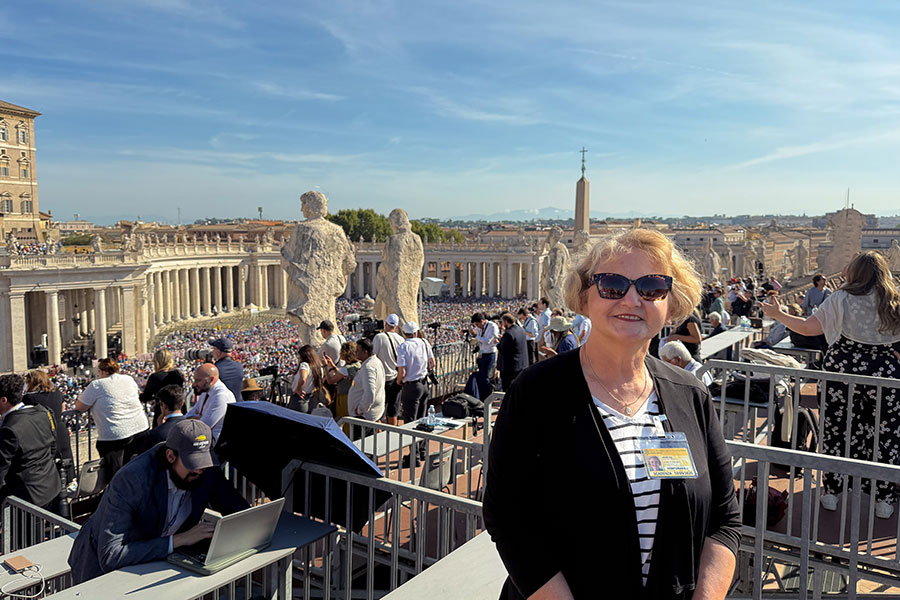
Sharon Perkins, correspondent in attendance, poses atop the colonnade of St. Peter's overlooking the crowd. (courtesy photo/Susan Perkins)
Rome is known as “The Eternal City,” and indeed that is what it is. Not to infer that the city will last forever (it’s fallen before and may well fall again), but in the sense that for the pilgrim, this geographic seat of the Roman Catholic Church is timeless — its past, present, and future meld and flow together in one continuous stream.
This was my experience when I attended the canonization Mass of two of the Church’s newest saints: Pier Giorgio Frassati (1901-1925) and Carlo Acutis (1991-2006), in the piazza of St. Peter’s Basilica in Rome.
Carlo Acutis, who is recognized for his intense devotion to Jesus in the Holy Eucharist and his creation of a website on Eucharistic miracles, appeals especially to the millennial generation of which he was a contemporary, whereas Pier Giorgio Frassati was known for his heroic virtue, his nurturing of authentic and holy friendships, and his deep compassion for the poor.
Both lived short but incredibly holy lives which have captivated the attention of young Catholics.
The canonizations of these two young men were to have taken place separately in April and August 2025, but the death of Pope Francis and the election of Pope Leo XIV necessitated their postponement. Thus a personal pilgrimage to Rome in early September for both the Jubilee Year of Hope and an academic Marian conference provided an unexpected opportunity for me to participate in this exciting and long-awaited event on September 7, 2025, with thousands of cheering, banner-waving brothers and sisters in Christ.
On a beautiful, sunny Sunday morning, Pope Leo XIV, speaking in Italian, walked out before Mass to informally greet the huge crowd — especially the young people present — and noted that this was both a solemn occasion and one of great joy.
A living past
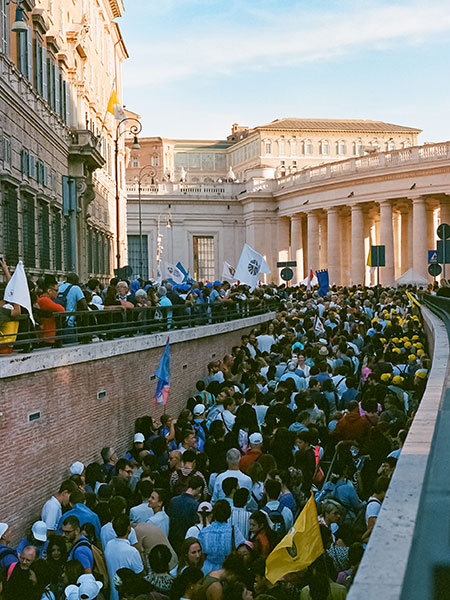
Standing atop the colonnade of St. Peter’s with other journalists, I was first struck by my proximity to the 140 giant statues of saints and martyrs carved in the late 17th century, silently observing the proceedings below. Though made of stone, I could imagine their voices joining ours in the petition: “Most Holy Father, Holy Mother Church beseeches Your Holiness to enroll among the saints Blessed Pier Giorgio Frassati and Carlo Acutis, and that as saints they may be invoked by all the Christian faithful”—and then echoing the chorus of the Litany of the Saints as if to say, “Welcome to our number, brothers!”
Of course, the fact that hundreds of popes, martyrs, and other holy men and women are buried not only in the catacombs outside of the city, but also beneath St. Peter’s Basilica, reinforces the paraphrased saying attributed to Tertullian (160-240 AD): “The blood of the martyrs is the seed of the Church.”
To be sure, more than 80,000 pilgrims attending the open-air Mass stood on holy ground and gave the martyrs much to rejoice over!
Saint Acutis’ impact close to home
During the days surrounding the canonization, it became apparent to me that the influence of these two newly canonized saints would have a much broader reach than Rome in September of 2025. I was inspired by the future evangelization already happening in places like New York City, Houston, and in our home diocese of Fort Worth.
Andrea Woolums serves as the director of religious education at St. Mark Parish in Argyle. On a 2024 visit to St. William Parish in Round Rock, she was so impressed by a three-part interactive exhibit on Eucharistic miracles that she arranged to rent it from its creator, Melissa Kirk.
St. Mark Parish displayed the exhibit in early January. Woolums explained the exhibit moves beyond the poster presentations made available through the Carlo Acutis website and incorporates interactive elements that appeal to a broad range of ages, employing props, skits, and even a microscope where viewers can examine human heart tissue.
She estimates about 1,200 people experienced the exhibit in January and she has arranged for Part B of the exhibit to debut on October 11 (10 a.m. to 7 p.m.) and 12 (8 a.m. to 7 p.m.) at St. Mark’s Parish Activity Center. The exhibit is free and visitors from outside the parish are welcome.
Saints of the present
Not all saints are canonized. In his letters, particularly those written to Corinth and Ephesus, St. Paul uses "saints" to describe all Christians, meaning those who have been sanctified by God and called to be holy in Christ Jesus. While Rome was certainly bustling with citizens and tourists, it was clear that many of them had little understanding or interest in the deeper religious significance of the events happening around them.
Not so on the evening of September 6, in the apartment home of John and Ashley Noronha, founders of the Truth and Beauty Project and 17-year residents of Rome. A gathering of friends and fellow pilgrims converged for a festive “pre-canonization party,” and I was privileged to speak with several young adults about their expectations for the coming day.
Emily Jorgensen, a senior at the University of Dallas, was more familiar with Carlo’s story and was excited about seeing all the joy and inspiration around her. Her personal hope, however, centered around the discernment of her future path upon graduation. She plans on seeking the intercession of both new saints for her intention. (I mentioned that my technology-challenged self had been invoking Carlo quite often lately!)
Emily’s cousin Kaitlyn Williams, along with friends Elizabeth Hale and Camille Deslongchamps, were also keen on sharing their motives for being in Rome. Hale, a Detroit native working as a digital marketing lead for the popular prayer app Hallow, was in Rome to develop digital content, but she also admitted a “selfish” reason: to initiate “friendships with more of the saints in a very deep way” and with Carlo Acutis in particular.
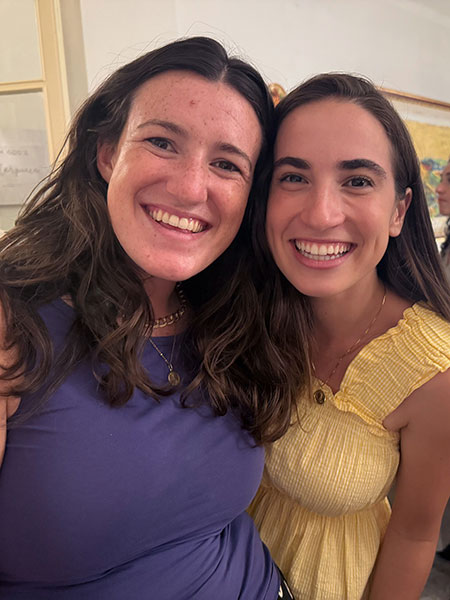
Deslongchamps shared a very personal connection, confessing that Carlo had actually been her chosen confirmation saint “before he was a saint.” On a trip to Italy as freshmen in high school, her student group met Carlo’s mother and heard her very intimate and moving story of conversion through “my holy son, who was a witness to me.”
Air Force Chaplain Father Garrett Braun, who serves at Aviano Air Base north of Venice, stated he had first heard about Blessed Pier Giorgio in college and could relate to him as an outdoorsman but eventually as someone radically living the Gospel to the point of risking alienation from his family.
“It was thought that he was not doing anything productive with his life,” Fr. Braun added, “but we’re not living for this world, but for the Kingdom and God’s glory.”
As a military chaplain, Fr. Braun’s ministry has been helped immensely by St. Carlo’s devotion to the Eucharist. “The military is such a transient community” with airmen and women uprooting every two-to-four years, “but if they can be rooted in the Eucharist, they have Someone stable in their life, finding the Lord in the tabernacles of all the chapels where they serve.”
After the canonization
After a long wait for a hearty, post-canonization lunch of pasta and gelato, I joined a brief walking tour featuring three of the Roman churches that were personally significant to both Carlo and Pier Giorgio.
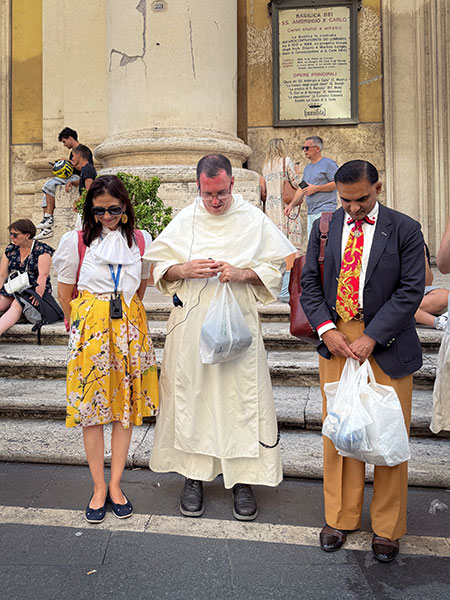
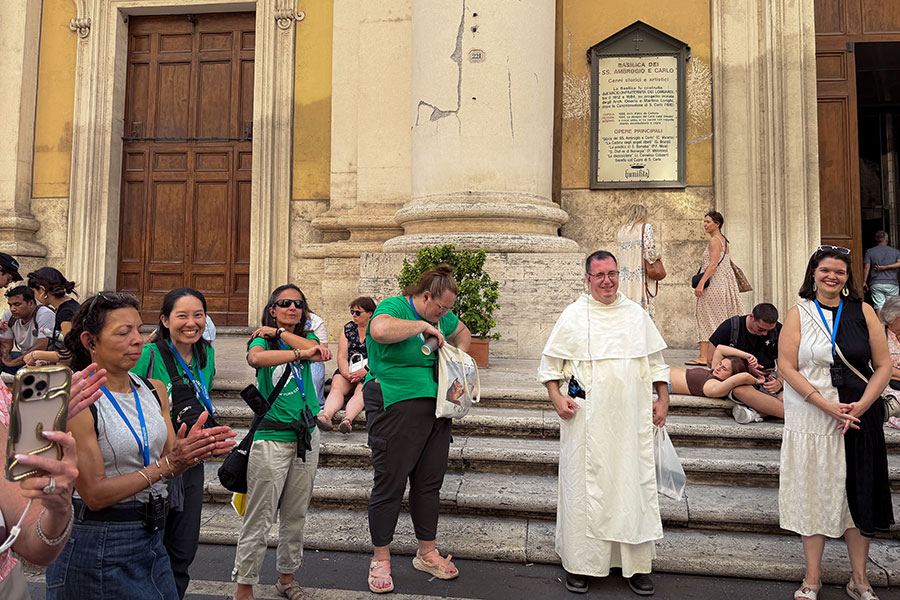
Our knowledgeable guides, John and Ashley Noronha, started us at the Basilica of Sts. Ambrose and Charles Borromeo on the Via del Corso, where I met three members of the Frassati Fellowship of New York City. Dominican friar Pier Giorgio Dengler, Tricia Chai-Onn, and Angela Dilalla acquainted me with the vitality and rapid growth of their Frassati Fellowship chapter, which sprang from a group of young adults in the wake of World Youth Day 2000. Said Chai-Onn, “Our fellowship is now one of the largest young adult groups serving twenty-to-thirty-somethings in the Archdiocese of New York.”
According to the chapter’s website, “activities consist of service, faith formation, and fellowship across our various ministries — ranging from hikes, Bible studies, holy hours and dinners to retreats, pilgrimages and more.”
Dilalla explained that they were drawn to Pier Giorgio’s charisms of Eucharistic Adoration, Christ-centered friendship, and service to the poor, and that many lasting friendships and even marriages had resulted through the fellowship.
Jonathan Cunningham, a physician’s assistant working in pediatric oncology in Houston, was in Italy for a friend’s wedding but made pilgrimage stops in Assisi and Rome. He had been closer to Pier Giorgio but also prayed at Carlo’s tomb in Assisi and learned more about his death from leukemia at the age of 15.
He now asks for St. Carlo’s intercession for and accompaniment with him in better caring for his patients and their families. “I have been inspired by how generously he lived his cancer journey — and his life in general — and hope to offer my work in charity for others and for the intentions of the Pope and the Church, as he did with his suffering.”
Called to be saints
The French novelist Léon Bloy said, "The only real sadness, the only real failure, the only great tragedy in life, is not to become a saint."
Reflecting on my experience in the Eternal City during the Jubilee Year of Hope, and especially on September 7, I was inspired in my encounters with young people who so earnestly shared the desire to become saints by following the examples and seeking the intercession of Sts. Carlo Acutis and Pier Giorgio Frassati.
Somewhere among those 80,000 people in attendance, I’m sure there are future saints waiting to be canonized — maybe even martyred — for their heroic faith in Christ. May we, by God’s grace, be counted among them.
Special to the NTC, by Sharon K. Perkins, a parishioner at St. Thomas Aquinas in Pilot Point. Perkins is a 45-year veteran of parish and diocesan catechetical ministry who is now enjoying retirement by freelance speaking, writing, board service, and playing with her two grandsons.