
“Get Away, Satan!” – the significance of fasting
It’s interesting to consider which aspects of Catholic life have managed to penetrate the secular consciousness.
Take fasting, for instance, a timely example. I believe it would be safe to assume that for the vast majority of non-Catholics, when they hear the word “Lent,” their minds immediately jump to the concept of fasting (or maybe just fried fish).
Given the seemingly ever-increasing popularity of fasting in our culture, if only for purely health and fitness purposes, I might expect this familiarity to have become even further widespread. Yet, I have a suspicion that, when placed in the context of organized religion, it takes on a decidedly distasteful cast to those same individuals, perhaps occupying a space alongside other mortification practices which, to the modern mind, are frequently believed to represent nothing more than manifestations of self-loathing. Admittedly, I fear that some Catholics may hold a somewhat similar view of the practice, though subconsciously.
Thus, the question: why do we fast, really?
Fasting is a universal human practice and has been for thousands of years. There are essentially no religions that do not proscribe a period of ritualized fasting either at some point on their calendars or as a way for its adherents to make reparation for wrongdoing. The basic truth present in this appears to be that depriving ourselves of either a quantity or kind of food for a period of time acts as a great mental reset; a way to declutter our brains by removing excess stimuli.
There is clearly a spiritual component at work, as well, whether or not this is acknowledged by non-religious practitioners of fasting. Namely, it grounds us, places us back into our proper “context,” plays the role of a tap on the shoulder.
Our society is in the midst of a stimulation crisis. Everywhere we look, almost every second we are awake, something or someone is trying to distract us, steal our attention, trick us into thinking that it or they are the most important thing in our lives at that moment. I used to think that people were mostly unaware of the war of attrition being waged for our senses each and every day, but I’ve begun to grow more hopeful. You could point to the aforementioned prevalence of things like intermittent fasting as evidence of this, along with the proliferation of apps whose entire purpose is to curtail the amount of time we spend “doomscrolling” (maybe my favorite word coined by my generation).
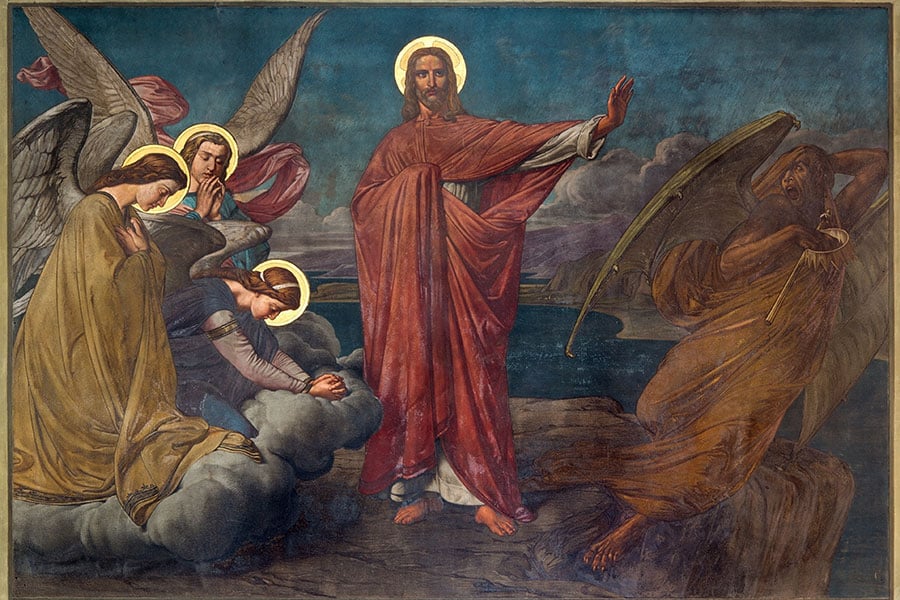
So, to answer my initial question, we fast because it is necessary. Now more than ever. We must fast, not only from the excesses which foster gluttony, but we must fast, in a figurative sense, from anything which has the potential to turn our faces away from God. There has never been a time where it would be more beneficial for us, both physically and spiritually, to emulate Jesus in his 40-day sojourn into the desert. As Matthew’s Gospel reads:
“Then Jesus was led by the Spirit into the desert to be tempted by the devil. He fasted for forty days and forty nights, and afterwards He was hungry. The tempter approached and said to Him, ‘If you are the Son of God, command that these stones become loaves of bread.’”
Matthew 4:1-3
As can be extrapolated from this familiar episode in the life of Jesus, the experience of fasting may lead us to profound personal reexamination. The temptations we receive might make us realize that we were far weaker in ways we hadn’t thought of. We may very well break our fast. Yet we must not be discouraged; failure is part of the process.
Like the saints, we must learn to draw strength from any failure we experience in our personal fasts this Lent, whether in our fasting from meat on Fridays, or in our commitments to eschew other sources of distraction. Let’s all be sure to make time to practice this phrase in the coming weeks: “Get away, Satan!” (Matthew 4:10)

Walker Price is an award-winning columnist for the North Texas Catholic and a lifelong resident of the Fort Worth area; he attended St. Andrew Catholic School and Nolan Catholic High School. He has a passion for reading, writing, and nature. Find more of his columns for the North Texas Catholic here.