
Joanna, Susanna, and the other women who supported Jesus

Detail of "Christ in the House of Mary and Martha," Diego Velazquez, c. 1620, Spain
We catch only fleeting glimpses of them in the Gospels, the gentlewomen who spared Jesus the more mundane aspects of His earthly ministry, such as feeding and domiciling Himself and the Twelve. As they roamed the land of Israel preaching the coming of the kingdom, the Gospels tell us that “many women” served Our Lord, out of generosity, having been "cured of evil spirits and infirmities, [they] provided for Him from their own means" as Luke 8:2–3 explains. Unhappily, only seven names have come down to us: Joanna, Susanna, Salome, Mary of Cleophas, Mary Magdalene, along with Mary and Martha of Bethany.
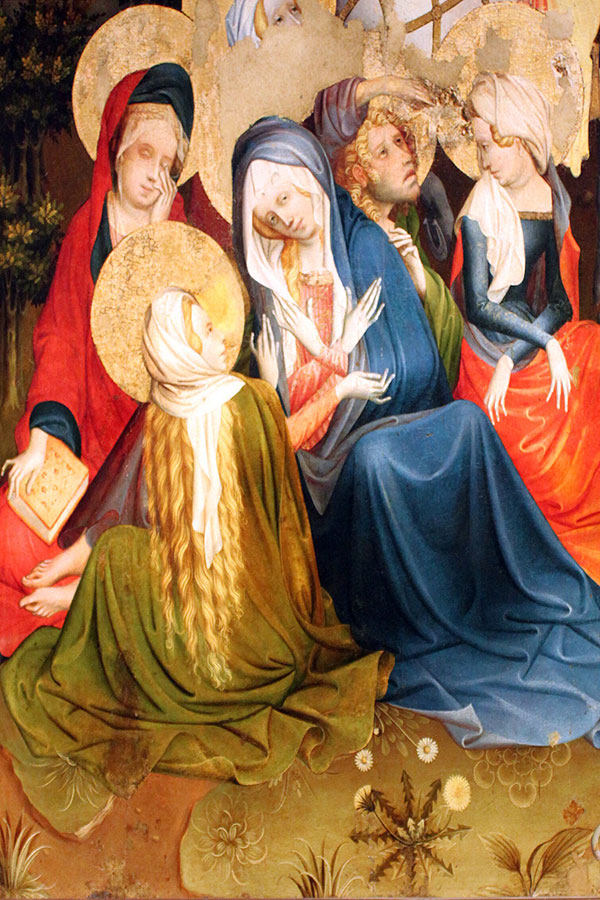
The Eastern Churches add the Blessed Virgin to their number and, each year on the Third Sunday of Pascha (the 2nd Sunday after Orthodox Easter), all eight women are commemorated for their devotion and constancy. Due to their bringing unguents and spices to the tomb of Christ, they are saluted as the Holy Myrrhbearers, the first witnesses to the Resurrection. What is otherwise known about these women so enthusiastically dedicated to the ministry of Jesus?
The Holy Women of Galilee
Joanna, described in Luke 8:3 as “the wife of Chuza, Herod’s steward,” would certainly be the most socially prominent among these women. Chuza, as steward of the palace in Sepphoris, the capital of Herod Antipas’ Galilean tetrarchy, acted as a prime minister in the Tetrarch’s absence.
One story about Joanna is recounted by St. Jerome. He tells of “the frenzied Herodias” repeatedly stabbing John the Baptist’s tongue with a needle, then throwing his head into a dung heap. “But the pious Joanna … buried the head of John the Baptist in an earthen vessel on the Mount of Olives,” as reported in the Orthodox Church in America website.
Almost certainly, Joanna shared details of Antipas’ mockery when Pilate sent Jesus to the tetrarch with Luke, as the careful historian assembled details for his Gospel since he alone records the event (23:8-12).
St. Joanna is one of the patrons of travelers. She is also invoked by those in need of financial aid and support. Her feast day is May 24.
Susanna is linked by St. Luke with Joanna but, aside from the single mention of her name as a woman of substance cured by Jesus, there is nothing else written about her. There are no later traditions about her or patronage given. She is not found in the Catholic Encyclopedia nor was she ever venerated in the Roman Martyrology. Susanna is, however, revered as a saint by the Eastern Rites of the Catholic Church and her icons may be found online. Her legacy endures as a symbol of faithful service and dedication to Christ.
Salome was the wife of Zebedee the fisherman and mother of James and John. Salome was ambitious for her sons, approaching Jesus to request that James and John sit in places of honor in His kingdom (Matthew 20:20–21). She was also one of the women “looking on from a distance” (Matthew 27:55-56) at the Crucifixion.
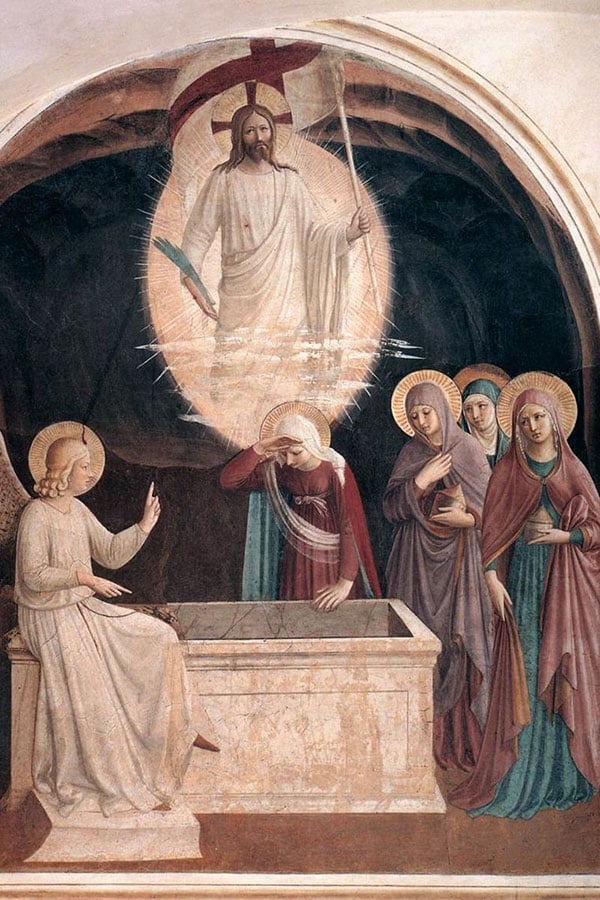
These same women traveled to the tomb of Jesus on the third day following, bringing spices to anoint Him. Mark 16:1 alone calls Salome by name, when the women encountered an angel informing them that Jesus had risen. St. Salome’s feast day is April 24.
Mary of Cleophas is thus identified in John 19:25 as one of the women standing at the foot of the cross. John calls her the sister of the Blessed Virgin. This obviously is the same Mary described by the Synoptic Gospels as the wife of Alphaeus and mother of James, Joseph, Simon, and Jude, “the other Mary” in Matthew 28:1.
This is made plain by the early Christian historian, St. Hegesippus, who interviewed the grandsons of St Jude in the early 100s. Cleophas, he learned, was the brother of St Joseph, so his wife, Mary, is really the sister-in-law of the Virgin Mother. Whether Cleophas and Alphæus are the same man is a matter of conjecture which would take more space than here allotted.
St. Mary of Cleophas (Alphaeus) is honored as patroness for caregivers. She shares her feast day with St. Salome on April 24.
Mary Magdalene came from the town called Magdala Nunayya in the Babylonian Talmud, the name meaning “Tower of Fishes,” located on the northwest corner of the Sea of Galilee. Financially well off, it may be that she or her husband ran a fishery. In any case, Mary of Magdala devoted her life to Christ, witnessing not only His death but also His resurrection. Directly commissioned by Christ to carry the news of His resurrection to the Eleven, she has long been dubbed the “Apostle to the Apostles.”
Pope St. Gregory the Great (590-604), in an influential sermon, conflated the penitent “woman of the town,” in Luke 7:36ff, with Mary Magdalene in Luke 8:2, “from whom seven devils had been driven out.” Modern exegetes dismiss St. Gregory’s theological reflections, but think a moment. In the sixth century, the Bible was not divided up into chapters and verses. One read each book of the Bible right on through as originally written. It is very easy to see a major sinner who became devoted to Jesus a few lines earlier and deduce that she is the same ardent soul as Mary Magdalene, freed from seven demons.
Gnostic gospel forgeries featured Mary in the second century opposing the Twelve. A number of legends sprang up — with the Magdalene now misidentified with Mary of Bethany — pagans slap her with Martha and Lazarus into a rudderless boat. Miraculously, it washes ashore at Marseille in southern France where Lazarus becomes bishop, and Mary goes to live in a cave, forever in penitence. In another tale, the custom of dyeing Easter eggs is attributed to Mary.
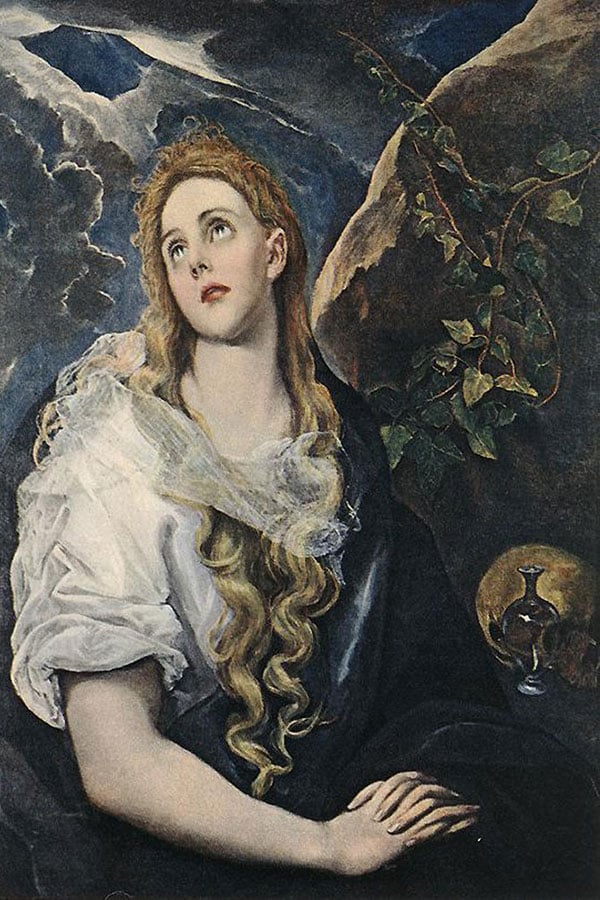
St. Mary Magdalene is the patroness of converts, apothecaries, penitent sinners, tanners, women, people ridiculed for their piety, perfumeries, glovemakers, hairdressers, Spain, the diocese of Salt Lake City, Slovenia, Laguna, Santa Magdalena, and other places. St. Mary Magdalene’s feast day on July 22 is on par with feasts of the Apostles.
The Holy Women of Judea
Mary of Bethany lived with her sister, Martha, and her brother, Lazarus, in a village about two miles from Jerusalem. The family is greatly devoted to each other. Mary is presented by Luke and John as being dedicated to spiritual contemplation and completely faithful to Jesus. After Lazarus was raised from the dead, she anointed the feet of Jesus with expensive spikenard, causing some commentators to confuse her with the unnamed woman in Luke 7 and with Mary Magdalene.
St. Mary of Bethany is the patroness of the contemplatives, students of spiritual studies and lectors.
Martha of Bethany may have been a widow left with a home large enough to hospitably accommodate Jesus and His following (see Luke 10:38). John repeatedly reports how much Jesus loved the family.
Martha was capable, prudential, and practical, briskly managing her home. Even so, she was resolutely devoted to Jesus. When Jesus arrived after Lazarus died, she affirmed her belief in Jesus with an astounding declaration of faith: "Yes, Lord, I believe that you are the Christ, the Son of God” (John 11:27).
St. Martha is the patroness of butlers, cooks, dietitians, domestic servants, homemakers, hotel-keepers, housewives, innkeepers, laundry workers, servers, single laywomen, and travelers. She shares a feast day with her siblings Lazarus and Martha on July 29.