
Local artist John Andrew Sustaita uses his passion for sacred art, Catholicism in Japan to evangelize
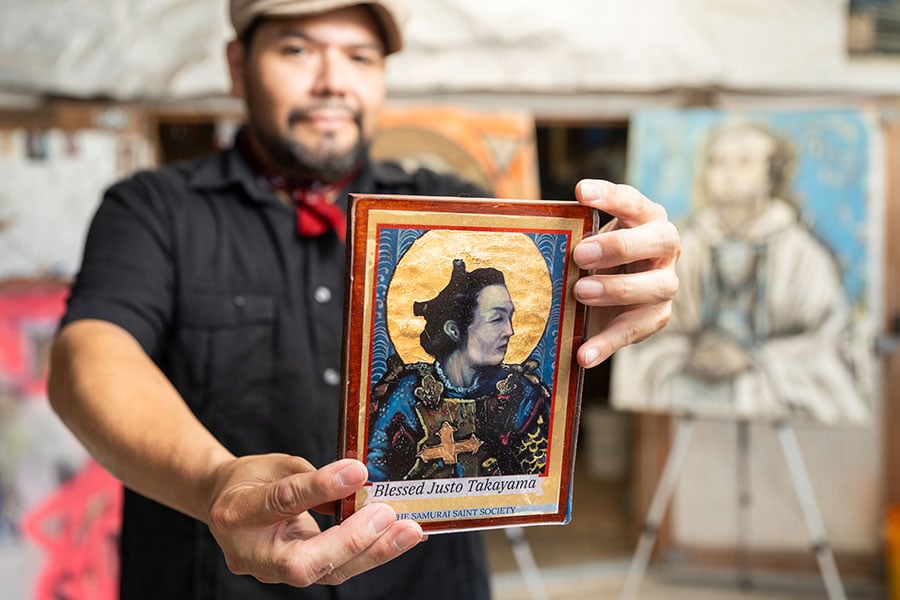
Artist John Andrew Sustaita presents a reproduction of his portrait of Blessed Justo Takayama at his workshop in Lake Worth on July 15. (NTC/Juan Guajardo)
LEARN MORE ABOUT THE SAMURAI SAINT
St. Augustine once intimated that beauty is the fastest way to God. Through his lived experiences, Fort Worth-based multimedia artist John Andrew Sustaita would heartily agree.
“God is the Creator, the Master Creator. And through His beauty, we are called to Him,” Sustaita said.
In a rustic yet industrial studio Sustaita built in the well-kept garden of a house he’s personally renovated over the past two years, one can glimpse many elaborate art pieces along with the many mediums and tools with which he works: plaster, acrylic paints, wood, fabric, repurposed material, epoxy, metalworking, and more.
Sustaita’s focus in his art is his faith.
“I have let God take me, and I have just surrendered to Him with my art,” he said. “All I do is Catholic art now.”
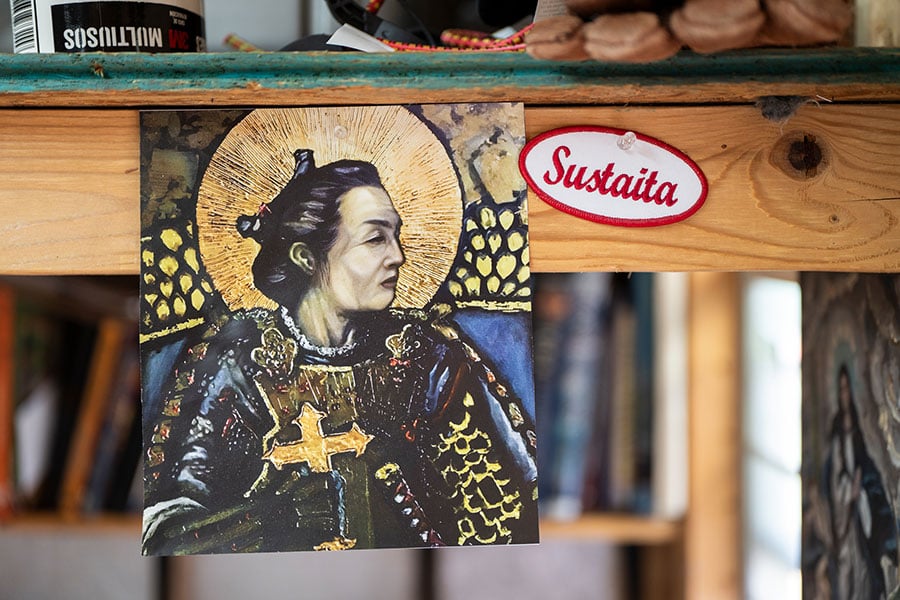
The talented artist followed God’s call to Japan in 2017, where he was inspired to paint a portrait of a blessed Japanese martyr. Sustaita’s original artwork of the venerated samurai was presented to the Vatican and now sits in its extensive collection.
In the seven years since, the parishioner of St. Elizabeth Ann Seton Church in Keller has opened his eyes to an incredible opportunity God has provided him to attract people far and wide to the Church through his love of sacred art, passion for Japanese culture, and vast experience.
‘GOD’S BUMBLING ARTIST’
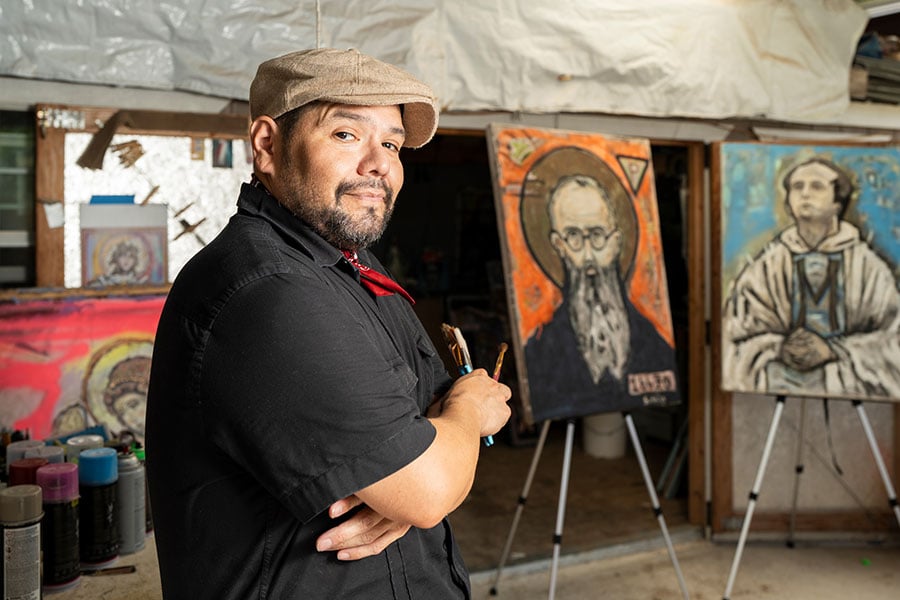
The last thing Sustaita wanted for his career was to become an artist; however, God continued to draw him back time and time again with a new medium or opportunity.
“I call myself God’s bumbling artist,” Sustaita said. “I didn’t even know where I was going — He just sent me.”
After dropping out of high school, Sustaita earned his GED and began taking classes at a local community college. One of the courses, classical opera, became a passion which led him to apply to a program at the University of North Texas. His GPA may have prevented him from further training, but Sustaita formed a connection with a UNT professor, who later extended to him the opportunity to teach English and art at a university in Osaka, Japan.
“Everything just started snowballing right after that,” Sustaita said. “But the power of God — once you dedicate your skill or your art to God’s works, man, He just has so much. You just embrace this plan and embrace the cross as He says.”
While in Osaka, Sustaita took on a personal mission to learn more about the history of Blessed Justo Takayama Ukon, a former samurai and Catholic Japanese feudal lord turned exile and martyr for refusing to abandon his faith. Fortunately, the Blessed’s castle was just a 25-minute walk from the university where he worked.
“This is the Samurai Saint,” Sustaita said, pointing to a smaller reproduction of the painting of Blessed Justo Takayama he made and presented to the Vatican. “I see him every day. I’m reminded constantly of this man.”
A HISTORY OF JAPAN
Sustaita described Japan as having a buried Catholic culture.
“Blessed Takayama was higher up in the echelon when the Catholics came through,” Sustaita said. “The Europeans reached Japan around the 1540s, and when they finally hit Japan, the Japanese didn’t welcome them, but they started noticing their trade.”
However, as trade and Christianity began affecting the economic and social dynamics, Japan closed its borders by 1603.
“At that time too, the peasants were becoming Catholic,” Sustaita said. “By the time the Europeans were told to leave Japan, there were an estimated one million Catholics. What happened?”
With the borders closed and strict religious restrictions placed on the people, some became martyrs or exiled, like Blessed Justo Takayama, Sustaita said. Others became creative in hiding their Catholicism, which is how age-old customs, like engaging in tea ceremonies, have many hidden Catholic influences and details.
“The guy who started the tea ceremony was a hidden Catholic,” he said. “In the tea ceremony, you have the cross facing you when you’re drinking tea from the vessel. The same as in Mass.”
Sustaita said he saw a hunger for the faith during his time in Japan.
“We’re not even a hundred years into the evangelization of Japan,” he said, explaining the passion he holds for the country, its culture, and its Catholic roots. “That’s why I’m saying there’s so much work to be done.”
REACHING OTHERS THROUGH ART
Upon his return from Japan, Sustaita continued to work on his art and his love for the history of Japanese Catholic culture even while owning and managing his own upholstery business and renovating his property.
Together with his fiancée, Yoko, who is a Japanese actress and Catholic convert, Sustaita organized a Catholicism in Japan event in the Metroplex that drew the interest of many young Christians.
“Everybody loves sushi, anime, samurais, ninjas, kimonos, geisha — all that stuff,” he said. “But we just couldn’t believe how many Catholics came out to that event.”
The huge turnout inspired Sustaita and Yoko, who plans to start a Catholic tea ceremony ministry, to organize more of these events, including an upcoming Catholic couples painting party. The couple hopes to continue ramping up interest and love in the faith — via art.
“I didn’t think I was going to be a prophet, but here I am,” Sustaita said. “I had to listen to God’s call, and I did.
“After years and years of honing my skill, my talents, I actually feel like it’s time,” Sustaita continued. “I think it’s time to really start converting and converting and converting. And that’s through the Church and going to Japan.
“And it’s working,” he said.