
Not yet: Smart Families encourages Catholic families to delay smartphones for kids
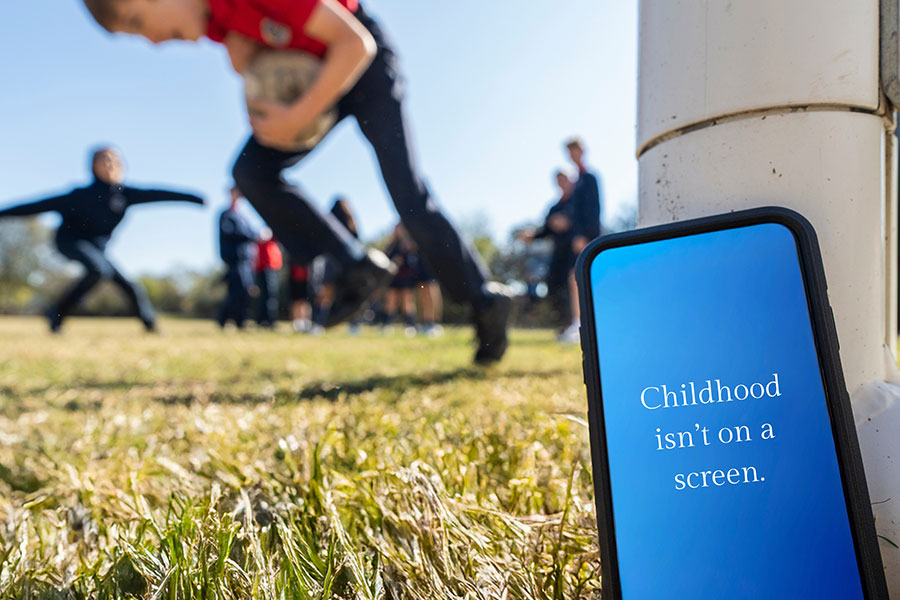
Students play soccer during recess at Holy Family Catholic School in Fort Worth on Dec. 2. (NTC photo illustration/Juan Guajardo)
When Diane Price, principal at St. Joseph Catholic School in Arlington, first heard about the Smart Families program over a year ago, she knew instantly it could be a game changer for the families at her school.
Smart Families, which started in the Archdiocese of Galveston-Houston, asks families to delay giving their children smartphones until high school and keep them off social media until age 16.
Why? Because a growing mountain of research shows that abundant use of technology in childhood has a detrimental impact on the developing brain.
Apps and video games are designed to boost dopamine levels, which make them highly addictive to children who haven’t fully developed parts of their brain that govern self-control, according to research presented by Smart Families. As with any addictive behavior, the younger you get hooked, the harder it is to break the habit and the more it impacts the brain’s functioning.
Add to that reports that rates of depression in teens doubled between 2011 and 2021 and anxiety in teens doubled since 2016. Some researchers say that internet usage is a key contributing factor, reducing time teens spend interacting in person and sleeping.
Even though smartphones, tablets, and smart watches are not allowed in classrooms, Price said she saw the impact of too much technology outside of school in shortened attention spans and increased anxiety and depression. She saw Smart Families as a way to equip parents and students with knowledge and a supportive community for going against the culture.
Price said, “We’re all moms and dads, and we’re all trying to do what we can to help our children develop in an emotionally healthy and God-centered way.”
‘Rewire their brains’
Smart Families, founded by Catholic parents Brian and Jennifer Kuzma, offers schools a three-year program to help change the culture in delaying the use of smartphones and social media. A foundation they established covers all the costs for participating schools.

(NTC/Juan Guajardo)
Patrice Hall, Smart Families regional director for North Texas, said more than 20 schools in the Fort Worth and Dallas dioceses are currently participating in the program.
Smart Families is growing exponentially, from 18 schools in the Archdiocese of Galveston-Houston three years ago to 115 today, with one in England, one in Mexico, and two at other Christian schools in Houston and Wichita, Kansas.
The program aims to educate teachers, parents, and students about the neuroscience behind technology and “balance that with Catholic formation and Catholic values,” Hall said.
In the three-year program, year one focuses mainly on the neuroscience; year two looks at a holistic approach of mind, body, spirit, and soul; and year three examines the impact of artificial intelligence and rapid changes in technology and algorithms.
The program includes five events a year per school: two for parents; two for students; and the family code dinner, where families sit down to a technology-free dinner provided by Smart Families to discuss their family values and develop a family code
Hall said some schools offer extra programming and support.
At St. Andrew Catholic School in Fort Worth, educators are offering parents a book study on “The Anxious Generation: How the Great Rewiring of Childhood is Causing an Epidemic of Mental Illness” by Jonathan Haidt.
Hall said, “Haidt’s thesis is we’ve spent the past generation over-parenting in the real world and under-parenting online.”
Instead of spending time engaging in creative play with friends or on their own, children are playing online games or endlessly scrolling TikTok or YouTube because of the dopamine rush.
“Tech is designed to rewire their brains, and that’s not what God wants for us at all,” Hall said. “God created our brains for wholeness, and there’s no ending to YouTube or games.”
Not God’s design
Like Price, St. Andrew Principal Laura Behee said she was “onboard instantly” when Smart Families presented at a diocesan principals’ meeting.
“We’ve never allowed smartphones on campus, but we were seeing issues around tech creeping into the school,” Behee said.
When the Smart Families program kicked off at St. Andrew in August, they made parent meetings mandatory for at least one parent or guardian in each family.
The “Anxious Generation” book study for parents is going well and will wrap up in March.
Behee said, “It gives parents an opportunity to talk with other parents in the community and support each other.”
Smart Families recently came to St. Andrew for two days of student education based on grade level.
“It was really well-received,” Behee said. “We sent parents information on ways to further that education at home.”

At St. Rita Catholic School in Fort Worth, educators offered parent meetings in both English and Spanish.
Principal Kindra Johnston said one of the parents at the Spanish meeting was excited to talk about the information with her eighth grader and older children. She also asked about education going beyond the school.
Johnston said she talked with Hall about offering an educational session open to the parish as a whole.
The school will have its family code dinner in the spring, and Johnston said she’s looking for other opportunities to host phone-free family events.
She also linked limiting the use of technology to faith.
“It’s taking care of the body and mind God gave us. Bringing in Catholic education is really, really important from kindergarten all the way up,” Johnston said.
She said Smart Families encourages parents whose children already have smartphones to reconsider.
Johnston said, “While it can be scary to say ‘no’ to teens, parents have got support and it’s science-driven.”
There’s always the option of a “dumb phone” with the ability to talk or text but not go online.
Price said she urged parents who had already given their children smartphones to reconsider and ask themselves, “What benefit is it truly?”
Price said she’s still waiting to see the positives of social media for children.
“What I see is unpleasantness and disconnection,” she said. “This is not how we make friends and keep friends. This is not how God designed us.
“We need to build bonds and community the old-fashioned way — in person and not by words on a screen.”