
Pope Francis’ funeral explained, by a Fort Worth funeral director

Archbishop Diego Ravelli, master of papal liturgical ceremonies, places a silk cloth over the face of the late Pope Francis before his casket is sealed during a prayer service in St. Peter's Basilica at the Vatican April 25, 2025. (CNS photo/Vatican Media)
Martin Thompson was always fascinated by how the world buries its presidents, kings, and particularly popes.
“I’ve been in the funeral business 50 years,” said the son of the late Guy and Kathleen Thompson, longtime owners of the family-operated Thompson’s Harveson & Cole Funeral Home. “Call it professional curiosity, but there’s something uniquely powerful about the ceremony, tradition, and symbolism behind their farewells.”
Now the proprietor of his own business —Martin Thompson & Son Funeral Home & Crematory — the funeral director said two visits to Rome inspired him to research the formalities involved in a papal funeral.
The first visit was with his parents and siblings to witness the ordination of his brother, Father Tim Thompson, to the transitional diaconate. The now pastor of All Saints Church was studying for the priesthood in Rome at the time.
“I made sure to go beneath St. Peter’s Basilica into the Vatican Grottoes — often mistakenly called catacombs,” Thompson said, explaining the grottoes lie beneath the main altar of the basilica near what is believed to be St. Peter’s original tomb. “Most modern popes and several saints are buried here.”
First through fourth century popes were entombed in ancient Roman underground catacombs during the era of Christian persecution.
Approximately 91 popes are buried beneath St. Peter’s.
“Some tombs are ornate. Others are unmarked and humble,” he pointed out.
A few pontiffs lie in rest outside St. Peter’s entirely. Some were interred in San Giovanni in Laterano (St. John Lateran), the cathedral of Rome. Pope Clement II is the only pope buried outside of Italy. After his death in 1047, he was returned to his native Germany.
Pope Francis, who died April 21 from a stroke and heart failure, also opted for burial outside the Vatican walls. After a funeral Mass celebrated April 26, the late pontiff’s body was carried to the Basilica of St. Mary Major and placed in a niche between two chapels and near an altar dedicated to St. Francis of Assisi. Made of white Ligurian marble, Pope Francis’ plain tomb features a rendering of his pectoral cross and states simply “Franciscus.”
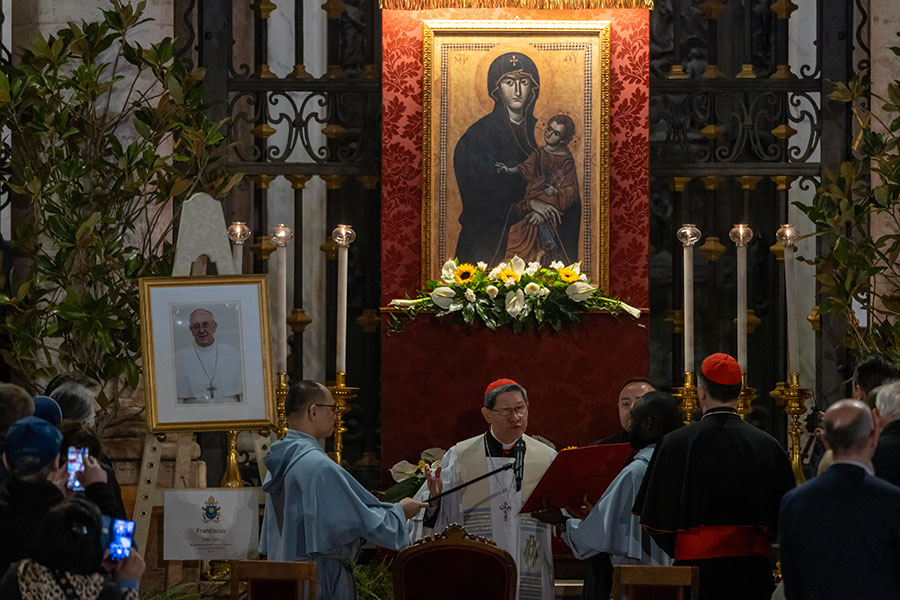
The late pope had a special attachment to the historic Marian basilica. Before and after every one of his 47 international trips, he would stop to pray before the Salus Populi Romani — an image of Mary draped in a blue robe, holding the infant Jesus. It’s where Pope Francis visited on his first full day as leader of the Catholic Church in 2013 and it’s also where he brought flowers to place before the icon of the Virgin Mary after a long hospital stay shortly before his death.
His connection to the basilica is also tied to his Jesuit background. St. Ignatius of Loyola, founder of the Jesuits, celebrated his first Mass there in 1538, making it a fitting burial place for the church’s first Jesuit pope.
Other popes buried at St. Mary Major include Pope Honorius III, Pope Nicholas IV, Saint Pius V, Pope Sixtus V, Pope Clement VIII, Pope Paul V, and Pope Clement IX along with Saint Jerome, one of the Doctors of the Church.
“It’s a fitting choice for Pope Francis who has always preferred the humble, the historic, and the deeply Marian traditions,” Thompson said.
The late pontiff’s desire for the simple and ordinary is also reflected in his casket. Unlike his predecessors, who followed the long-standing tradition of the triple casket burial (Cypress-inner, Zinc-middle, and Oak-outer), Pope Francis, dressed in red papal vestments symbolizing resurrection and martyrdom, was placed in a single zinc-lined wooden coffin. During the public viewing, his casket rested on the floor, facing the pews, rather than on a traditional, elevated platform.
“Each pope is buried with carefully selected items with deep symbolic meaning,” the local funeral director explained.
Several possessions placed inside Pope Francis’ coffin before it was sealed included the rogito, a parchment document placed in a metal tube that summarized the pope’s life and papacy, the long, white pallium (robe) he wore, and coins minted during his pontificate. His hands were folded around a rosary.
“He was a very humble, inclusive man, and I think that’s reflected in his funeral,” Thompson said. “In keeping with his humility, he didn’t want a big affair, even though it is.”