
St. Thomas More Society Fort Worth explores immigration in light of Catholic social teaching

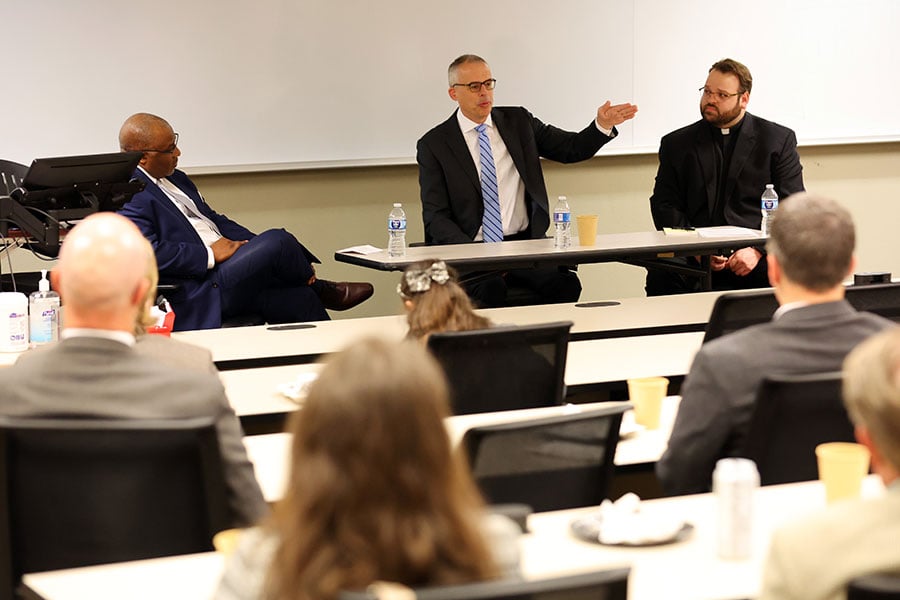
From left, District Court Judge Christopher Taylor served as moderator for the panel discussion with Paul Hunker, former general counsel for Immigration and Customs Enforcement, and Father Samuel Maul, chaplain of the St. Thomas More Society Fort Worth. (NTC/Richard Rodriguez)
FORT WORTH — What exactly is Catholic social doctrine? How should faithful Catholics react to immigration? What are the changes in immigration enforcement?
The answers to those probing inquiries were addressed during a panel discussion on “Immigration Law and Catholic Social Teaching” hosted by the St. Thomas More Society at the Texas A&M University School of Law in Fort Worth on April 3. Serving as moderator for the lunchtime event, District Court Judge Christopher Taylor posed the questions to Father Samuel Maul, chaplain of the Society’s local chapter, and Paul Hunker, former general counsel for Immigration and Customs Enforcement (ICE), in front of an audience of lawyers and law students.
Immigration is a timely topic, according to Courtney Taylor, president and CEO of the St. Thomas More Society Fort Worth.
“It’s in the news a lot right now, particularly with the changes in policy coming from this [presidential] administration,” said the health care/government lawyer. “People care about immigration and for some, it’s personal.”
The Catholic Church has a unique perspective on the issue.
The Church's stance
“But Catholic social teaching is an area few people grasp,” she continued. “This is a good opportunity to refresh or learn for the first time the principles involved.”
Immigration policy remains one of the most contentious, consequential issues in the United States. The U.S. Census Bureau estimates the foreign-born population (both legal and undocumented) reached a record high of 53.3 million, or 15.8% of the total U.S. population in January 2025.
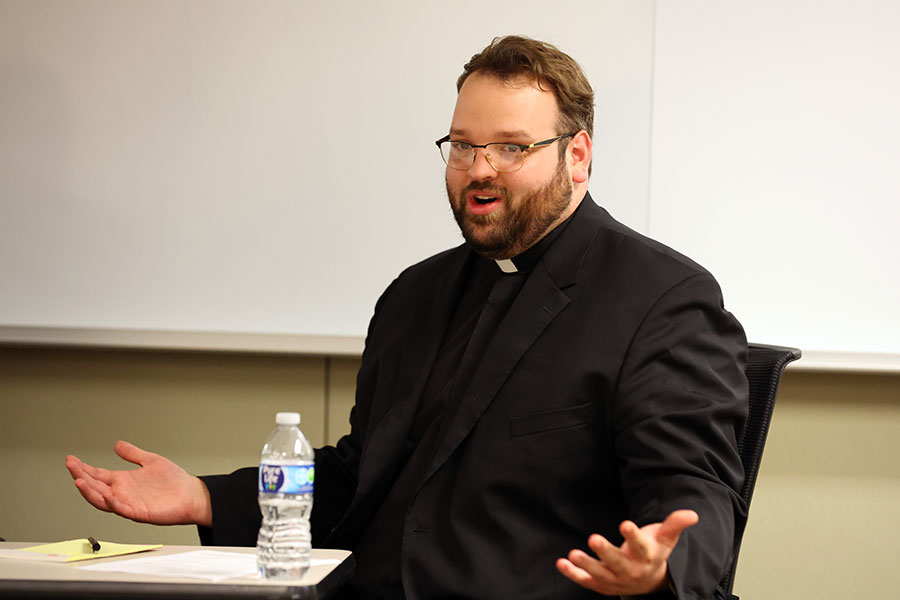
“With the current administration’s efforts to, quote, ‘fix’ the immigration problem, there’s a lot of concern to make sure the dignity of the migrants in our nation is being upheld,” Fr. Maul told the North Texas Catholic. “The St. Thomas More Society is a confederation of Catholic lawyers and judges who come together to talk about different issues and how their Catholic faith can influence them.”
The pastor of St. Maria Goretti Parish in Arlington has also served as chaplain for both the professional and law school society for the past three years. When asked to define Catholic social doctrine, Fr. Maul explained the core principles are based on the words of Christ, letters of the Apostles, and Church teachings throughout the millennia. In 2004, the Compendium of the Social Doctrine of the Church, commissioned by Pope John Paul II, was presented to give an overview of the rich teachings of the Catholic Church on questions of the human person, society, political authority, economics, the environment, and world peace.
“Whenever we talk about the social doctrine of the Church, we’re talking about the application of divine principles we receive from Christ to the overall reality we experience in our daily lives,” he told the audience. “I always tell people if you’re trying to figure out what position to take in society, go back to the words of Christ Himself and ask, if these are the absolute truths, how do we understand ourselves in relationship to them?”
No full outline solves all the issues of immigration in all cases, but the Church does offer precepts by which people can determine whether they are adhering to Christ’s command to take care of our neighbor.
Major documents, which touch on the issue of social justice or immigration, stress several main tenets, Fr. Maul pointed out.
- People are to be provided the dignity of work and the right to access the goods of the earth for livelihood.
- The world was not created for an individual nation but created for all peoples. Even though there are private property rights, there is the responsibility, out of charity, to take care of the poor among us.
- Nations, if they follow Christ, must take the stance to welcome the stranger.
- Policies cannot be based on social class or race discrimination.
- Nations have a right to an enforceable border.
- All nations have the responsibility to promote the common good not just for their own nation but for the world. They should not engage in policies that are exploitive of neighboring or poorer countries.
- Address the root causes of migration: war, poverty and famine.
- Most importantly, people ought to be seen as people and not pests.
“That’s a good qualifier for making any moral decision,” Fr. Maul said. “I tell parishioners Christ is clear about how He will judge us. We must feed the hungry, give drink to the thirsty, take care of the sick, visit the imprisoned, clothe the naked, and welcome the stranger.”
‘Prudence is key’
Paul Hunker, an immigration attorney in private practice, said there hasn’t been any significant change in U.S. immigration law since 1996 but there have been shifts in the way immigration enforcement is handled.
Because of limited resources, ICE is currently focusing on deporting criminals and immigrants who pose a national security or public safety risk. If ICE encounters someone who is in the country illegally, agents will detain him or her.
Hunker has two clients who were placed in ICE custody following traffic violations.
“Generally the focus on aggressively removing everyone who is here is certainly not good for families and communities,” he asserted. “I have clients who have been here 20 or 30 years and that’s going to be disruptive to their lives.”
The number of undocumented immigrants who crossed the border during the past four years is a problem, the attorney admitted.
“And there’s this general thinking out there that people are the problem,” he added. “That’s inconsistent with Catholicism. People aren’t the problem — they’re the solution for a country and economics show that.”
Hunker is an advocate for more legal immigration, guest worker visas, and a more secure border.
“I think immigration policy and law could be structured in a way that promotes the common good and also allows more people in the U.S. to enjoy free speech, economic development and education,” he said. “Our current system doesn’t do that. It tends to lead to broken families.”
St. Jude parishioner Royce Hansen enjoyed hearing the views of someone who was in the ICE organization.
“We learned specifically what the real issues were, and it was great to have Father [Maul] bring it back to what Catholics need to be concerned about,” he explained. “If I got anything out of this, it was all of these decisions are complicated, but prudence is key.”
For further reading:
- Matthew 2:13-14, Matthew 15:21-22, Matthew 22:36-40, Matthew 25:33-46
- Gaudium et Spes (Vatican II Constitution, 1965)
- Rerum Novarum (Pope Leo XIII, 1891) (see especially §§ 20, 37, 47)
- Exsul Familia Nazarethana (Pope Pius XII, 1952)
- Mater et magistra (Pope John XXIII, 1961) (see especially §§ 83, 155)
- Pacem in Terris (St. John XXIII, 1963)
- Populorum Progressio (St. Paul VI, 1967)
- Laborem Exercens (St. John Paul II, 1981)
- Sollicitudo Rei Socialis (St. John Paul II, 1987)
- Centesimus Annus (St. John Paul II, 1991)
- Veritatis Splendor (St. John Paul II, 1993)
- Erga migrantes caritas Christi (Pontifical Council for the Pastoral Care of Migrants and Itinerant People, 2024)
- Compendium of the Social Doctrine of the Church (Pontifical Council for Justice and Peace, 2004)
- Pastoral Letter to the Faithful (Bishop Michael F. Olson, January 24, 2025)
immigration, Catholic social teaching, migration, St. Thomas More Society, trending-english