
Tales from a Swiss Guard: Renato Peter shares memories of service, papal transition
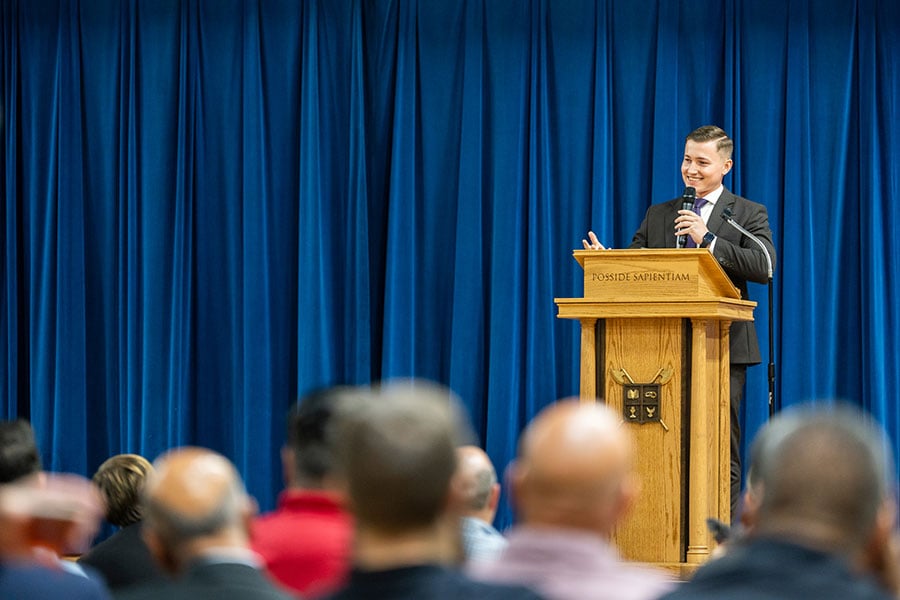
Swiss Guard Renato Peter leads a talk for Guardian ministers from across the Diocese of Fort Worth on Sept. 19, 2024 at St. Elizabeth Ann Seton Church in Keller. (NTC/Juan Guajardo)
Renato Peter was an altar boy in Switzerland when he made a pilgrimage to Rome with others from his diocese. When he returned home, he told his parents, “I want to be in the Swiss Guard someday.”
He remembers his mother laughed, but more than ten years later, his dream became a reality. Peter just completed two years of service in the Swiss Guard.
Peter recently sat down with the North Texas Catholic and talked about the history of the Swiss Guard, what is required of its members, and the experience of serving at the Vatican during a papal transition.
EDITOR’S NOTE: This interview has been edited for clarity and brevity.
NTC: You’ve traveled to the Diocese of Fort Worth and spoken at schools and parishes, but for those who haven’t met you, please share a little bit about where you grew up, your background, your education, and a little bit about your current job.
Peter: I'm 25 years old, born and raised in Switzerland. I grew up as the third of four children on a traditional Swiss farm. My mother is Protestant and my father is Catholic.
After finishing basic school, I trained in construction. Then I joined the Swiss Army. After my military service, I went back to work on construction until I entered the Pontifical Swiss Guard in the fall of 2023. I just finished my time, and now I am ready to marry my fiancée in the end of the September.
NTC: Will you remain in the Swiss Guard after your marriage?
Peter: When you are in the Swiss Guard, you can't marry or can't be married the first five years. When you serve for five years, then you can marry and stay in the Swiss Guard.
NTC: Most Catholics recognize the Swiss Guard from seeing photos from the Vatican, particularly when you are in your ceremonial uniforms. However, we don't know much about the Swiss Guard. Can you tell us the history of the Swiss Guard?
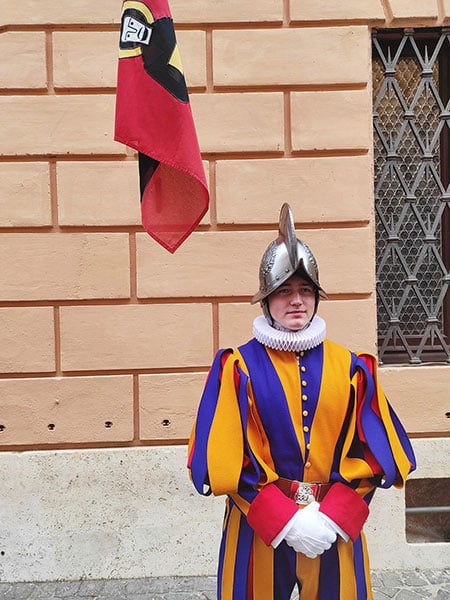
Peter: The Swiss Guard has a unique history of more than 500 years. It was founded in the year 1506 by Pope Julius II who called the Swiss soldiers to Rome because they were renowned throughout Europe for their loyalty, courage, and discipline.
One of the most heroic moments came in the year 1527 during the Sack of Rome. On that day, 147 of the 189 guards gave their lives as they stood against the overwhelming force from Germany and Spain, thus allowing Pope Clement VII to escape to safety. That sacrifice has shaped our identity — our mission has remained unchanged — to protect the Holy Father and to serve the Church at the heart of the Vatican.
NTC: You're most recognizable when you're in your ceremonial uniforms. Tell us a little about that.
Peter: We wear the ceremonial uniform for different kind of duties, like Masses, ceremonies, the pope’s Wednesday audience.
A lot of people think that it was designed by Michelangelo because it's very colorful: blue, red, yellow, like a Renaissance uniform. The uniform was designed by a Swiss Guard commander in the early 20th century to reflect the Renaissance style.
NTC: When you were first exposed to the Swiss Guard, you wanted to join. Why?
Peter: For me it was truly extraordinary to have the military service and the faith united in one vocation. And also to work at the heart of the Church, to serve the pope, and, if it's necessary, even with my own life.
It was also a way for me to give something back to the Church, which does so much for us. At the same time, I saw it as a chance to grow in my own faith. Unfortunately, Switzerland is becoming less and less Catholic, like everywhere in Europe.
NTC: What are the requirements and training?
Peter: The application process is very clear but also demanding. First you have to meet the basic requirements: You have to be Swiss, Catholic, and unmarried; between 19 and 30 years old; have completed high school and have done military service in Switzerland; plus, interviews with a recruiter, the Guard Commander, and the Guard Chaplain.
The training is a lot about discipline, ceremonial duties, and security basics. In the beginning it was really hard because it's a new language, a new country. I knew the military culture from the Swiss military, but in the Swiss Guard it's stricter and harder. Step by step you grow into it, and at some point you realize now you are a truly a part of this unique corps.
NTC: How many men serve in the Swiss Guard at a time?
Peter: 135 men. We are the smallest army in the world. But our job is to protect the pope, not to protect everything.
NTC: I'm sure working in the Vatican and being surrounded by the Church had an impact on your faith. Describe how being a member of the Swiss Guard has impacted your faith life.
Peter: Living in the Vatican, at the very heart of the Church, you encounter the pope regularly and experience him up close, not only as the head of the Church, but also as a person in his daily life. And then there are the countless pilgrims who comes to Rome from every corner of the world full of joy and hope. That often moves me deeply and made me realize we are a part of the worldwide Church that is alive and truly cares for people.
Another important part for me was the spiritual support we have in the Swiss Guard. We have a Benedictine monk who accompanies us in all matters of faith. We also have our own chapel. I had the opportunity to talk every day with religious people, priests, and bishops. I was able to learn from their faith and from their dedication. It made me realize how rich and diverse the Church is.
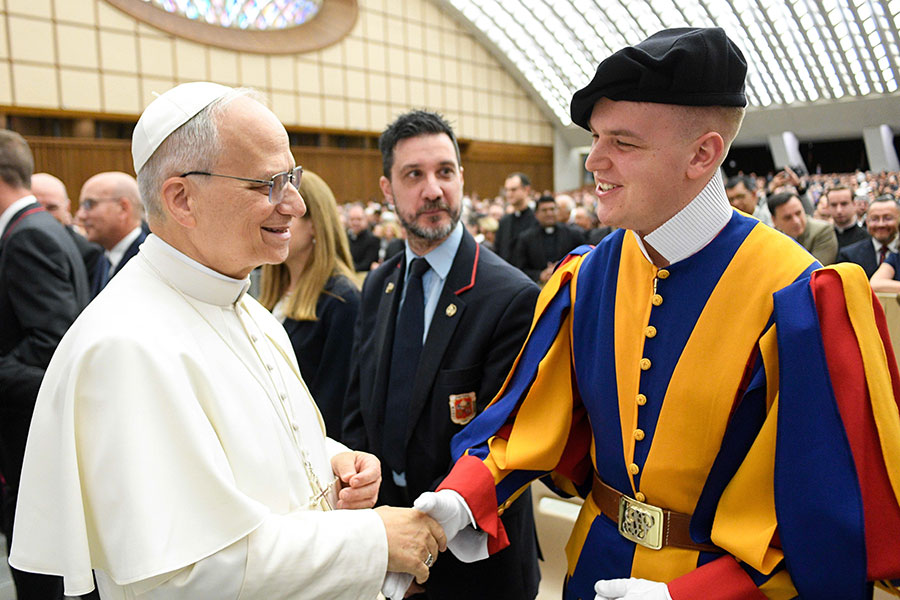
In the Guard, I was surrounded by many people my own age, 20 to 30 years old, who shared the same faith, the same values, and together we could really grow. They showed me that faith is not just tradition or duty, but something alive that truly transforms lives.
NTC: This year, of course, the Church has transitioned from Pope Francis to Pope Leo.
Can you share with us some of your memories of being in and around the Vatican during the death of Pope Francis and the selection of Pope Leo?
Peter: The time of transition from Pope Francis to Pope Leo was something very special for me and also very moving. When Pope Francis passed away, there was a deep silence over the Vatican, but also over Rome. I’ll never forget the moment when I heard like the death bells, ringing really slow and you could feel it in your body. I was in the Apostolic Palace, and I saw people just stand on the street and not move. You could feel that a Shepherd had gone home, who had shaped the Church for many years.
It was an honor to stand watch during that time and to show our respect and loyalty in this way. We stood there at his funeral until he went into the tomb, and then there came the day of the conclave. In those moments you realize that you are witnessing a truly historical event. The whole world is looking at the Vatican, and at the same time you experience the atmosphere up close, full of suspense but also full of prayers.
When Pope Leo was finally elected and stepped out on the balcony, it was a moment of great joy and relief, to see the people in St. Peter’s Square cheering with tears in their eyes and welcoming the new Pope with open hearts. And for me it was an unforgettable moment that I will always carry with me, to have been a part of this history.