
The lesson of the Mount
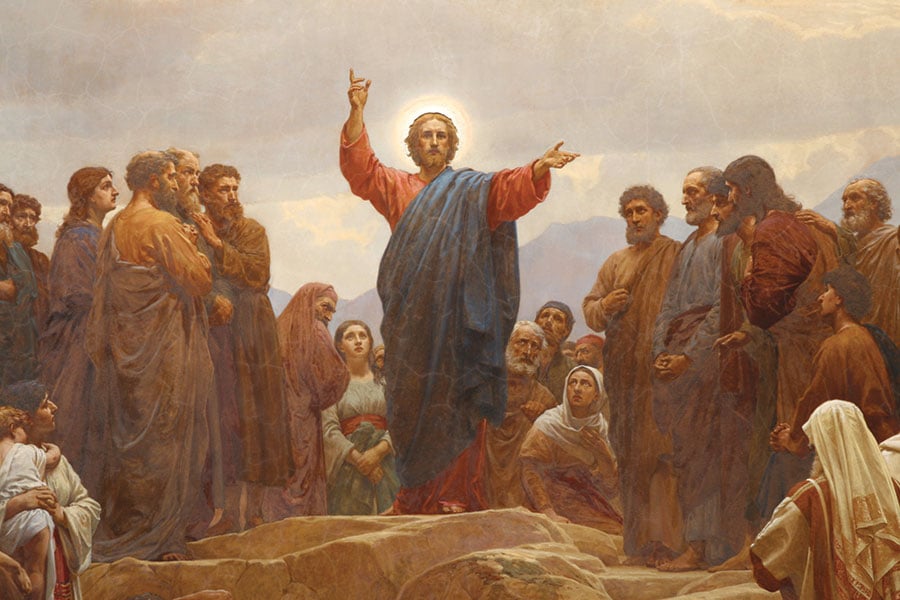
Sermon on the Mount, detail by Henrik Olnik. St. Matthew Church, Copenhagen. @1860.
“You have heard that it was said, ‘You shall love your neighbor and hate your enemy.’ But I say to you, love your enemies, and pray for those who persecute you, that you may be children of your heavenly Father, for he makes his sun rise on the bad and the good, and causes rain to fall on the just and the unjust.”
Over two thousand years in the future, we still have much to learn from the words spoken by Jesus at the Sermon on the Mount. Presently, we’re living through a time when (I fear) a growing number of people have firmly decided that this command of Jesus’ is trite, unrealistic, or, ironically, injurious. How could we ever be so foolish to believe we could ever truly love someone who stands athwart of everything we hold dear. How could we let some high-handed, delicate “morality” get in the way of us doing what needs to be done for “the good of all.”
Besides what is obvious on its face, this shift in cultural attitude worries me for other reasons. The old adage which says those who do not learn from history are doomed to repeat it gets thrown around perhaps too often, but I feel that it can be applied with particular severity in our own time.
One can be assured that Jesus knew, in his human nature, the full weight of his words when He stood in front of that crowd. His was an ancient, scarred society, one that had fought war after war after war, both with expansionist neighboring powers who sought their destruction or displacement, and amongst themselves, amongst people who should have been neighbors. They were acquainted with, far more intimately than we, the reality of conflict, most of it deadly.
Hating your enemy was as natural, and as expected, as the gradual erosion of a cliff face; it was physics. That’s why Christ’s command to love someone who is your enemy, an enemy who might very well be plotting your destruction at any given moment, was and is still so radical. How could it be possible for a Hebrew to love an Assyrian, or an Egyptian, or even a Roman? This was all too much.
For much of the 20th and 21st centuries, “radical” would be the last adjective many secularly minded people would apply to any idea remotely associated with Christianity. It was the religion of parents and grandparents, of the people who were trying to unreasonably control them along with the rest of society. It was a great big NO FUN plastered across their forehead. And worse, it was in the way.
I believe that perception is about to change. We’ve been gradually rediscovering that hate can be satisfying, can be indulged like any other pleasurable thing. It conjures the unquiet specters of tribal warfare, of the generational feud, of culturally prescribed vengeance. Read only a couple historical narratives and see if this hasn’t been an incessant, discordant undertone for most of the time humans have existed. “An eye for an eye, and a tooth for a tooth.”
If we continue to isolate, continue to hide behind online masks that become harder and harder to distinguish from our actual faces, then we will be in danger of forgetting what loving another person truly means, because we will have (in some sense) forgotten what a person actually looks like. Back in Jesus’ time, you could at least be assured, as a citizen of Jerusalem, that the Assyrians were real and posed a physical threat to your well-being; now, we spend hours of our time losing our peace to ephemeral names paraded before us on a screen.
This is my exhortation to you. Get outside. Talk to people; ask them how their day’s been going. Go for a hike. Spend time that you otherwise might’ve spent doomscrolling in the magnificence of God’s creation. Reset.
But above all, commit in your heart of hearts to the words of Jesus. Contained in them is the most revelatory physics equation in the universe. To will the good of another, to realize that you have far more in common with the person next to you than not, is the antidote to it all.