
Transforming lives with gospel music
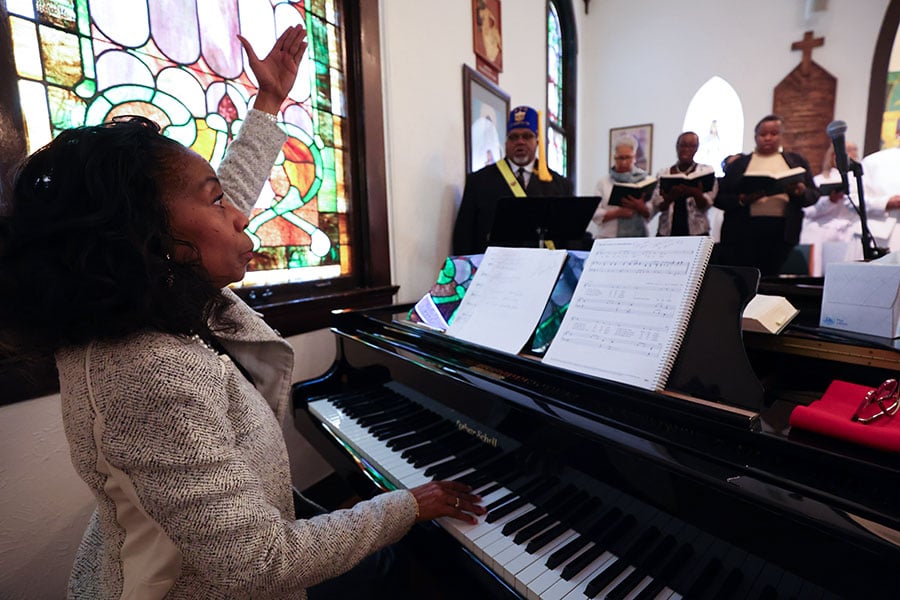
Donna Renay Patrick plays accompaniment and leads the choir at Our Mother of Mercy Parish on Jan. 19. (NTC/Richard Rodriguez)
FORT WORTH — Donna Renay Patrick began taking piano lessons at age seven and played for the choir at her Baptist church by the time she was 11. But being a skilled musician and trained worship leader isn’t what kept the native of Decatur, Illinois, in music ministry most of her life.
“It’s not just something I know how to do. It’s my calling,” stressed the new music director at Our Mother of Mercy Parish. “I want people to understand why I’m so passionate about leading people into God’s presence and setting the right atmosphere for worship on Sunday morning.”
Our Mother of Mercy, the only historically African American Catholic parish in the Diocese of Fort Worth, offered Patrick the job of directing its acclaimed gospel choir a year ago. Since then, the 15-member ensemble helped the parish celebrate its 95th anniversary and performed a rousing rendition of “Lift Every Voice and Sing” during the 39th Annual Dr. Martin Luther King Jr. Memorial Mass in January.
“The choir members are very committed to ministry and Our Mother of Mercy,” said the director, remembering the warm welcome she received. “I was so proud of them during the MLK event this year. They worked for months to prepare for that and executed so well.”
During her career, the author of two award-winning devotionals has worked with Baptist congregations across the Metroplex. Her introduction to Catholic liturgy came with a learning curve.
“It was a new environment for me,” Patrick admitted. “I had to learn the responsorial psalms and all the parts of the Mass, so it was a big adjustment.”
When it came to gospel music though, “I’ve always done that so there was no transition,” she added. “Gospel is part of my life.”
With deep roots in the African American experience, gospel music always served as a way to express hope and resilience during times of hardship. The genre centers around announcing the Good News of Jesus Christ. Lyrics come from Scripture and convey messages of hope, love, and personal connection with God. Powerful vocals add to the imagery and emotion.
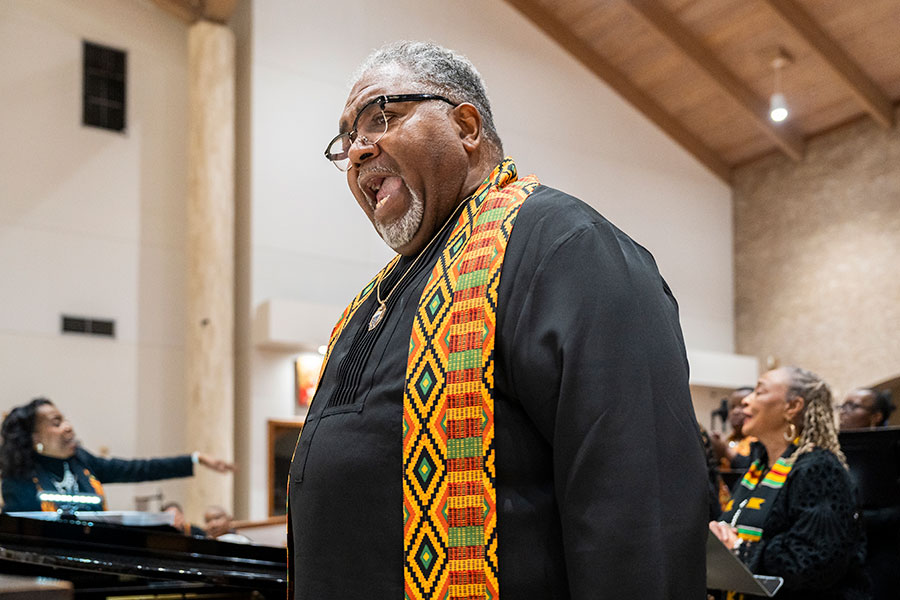
“Gospel music is special because of its message and rich heritage,” said Patrick, calling Thomas Dorsey, the father of gospel music, one of her favorite artists. “It runs through the very thread of African American culture.”
Over the years, a myriad of artists shaped the genre creating memorable songs such as “Total Praise,” “How Excellent Is Thy Name,” and “Peace Be Still.”
“I have so many favorite artists I can’t name them all,” continued the music enthusiast and popular convention speaker on purposeful worship. “Gospel music is what I love. I started playing for the church when I was just a young girl. I love it now as much as I did back then.”
Although an integral part of the African American Christian community, the influence of gospel music extends beyond church doors. It inspired leaders of the Civil Rights Movement and impacted the development of soul and R&B music as well as other areas of popular culture.
The goal of gospel music is to share it.
“We don’t sing on Sunday morning for us. We sing so the world might be changed and understand there is real salvation in Jesus Christ,” Patrick emphasized. “That’s accomplished through song. We sing about Jesus and His saving grace.”
It’s a universal message meant to transform lives. No one should come to church depressed and leave depressed.
“If the music ministry can help uplift somebody, that’s what we should be doing,” the choir director pointed out. “We want to uplift people and give them hope through music.”