
What St. Monica teaches us: A homily from Fr. John Robert Skeldon
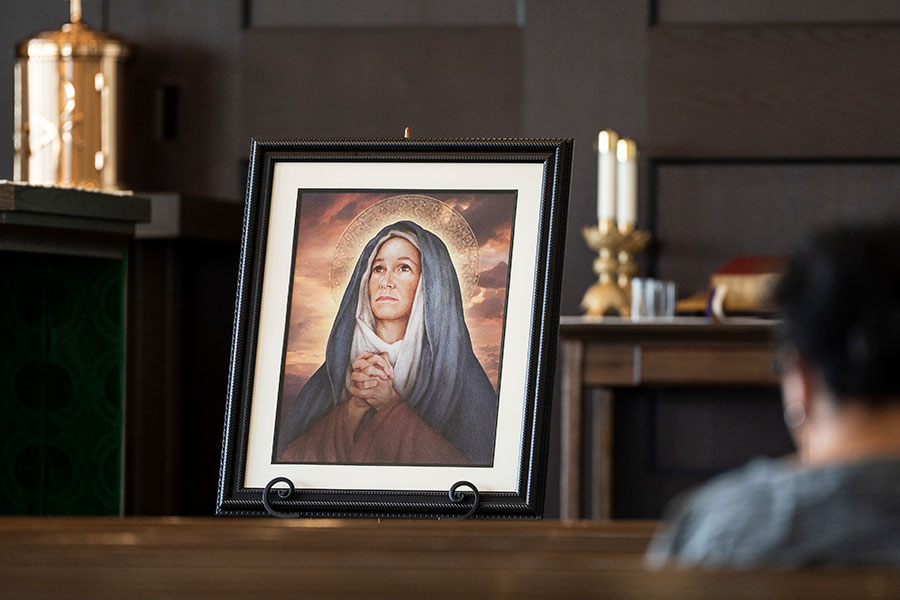
A portrait of St. Monica is seen in the chapel at St. Martin de Porres Church on August 9, 2023, during a prayer meeting of the Millions of Monicas ministry. (NTC/Juan Guajardo)
Homily for the Memorial of St. Monica
Wednesday, August 27, 2025
Readings: 1 Thessalonians 2:9–13 | Matthew 23:27–32
Yesterday St. Paul spoke of sharing with the Thessalonians “not only the Gospel of God but our very selves.” Today he continues: “We worked night and day… we treated each one of you as a father treats his children… and you received the word of God… which is now at work in you who believe.” (cf. 1 Thes 2:9–13). Paul’s phrase Gospel of God — the same language Mark uses to open Jesus’ ministry (Mk 1:14) — reminds us that the Church does not own the Gospel. We receive it; we hand it on. The Gospel is God’s initiative, God’s mercy at work.
On this memorial of St. Monica, the Church sets before us a living icon of how the Gospel of God moves from page to person: through persevering love that will not let go. Monica’s faith was not a theory. It was intercession with tears, patient fidelity in the ordinary, and a hope anchored in God’s promise. Augustine tells us that when his mother pleaded for him, a bishop consoled her: “The son of so many tears will not be lost.” Her tears were not magic. They were the sacrament of a heart aligned with the God whose gospel seeks and saves.
Paul describes a ministry that “toils night and day,” that exhorts, encourages, and charges “each one” toward a life worthy of God. That is Monica: a mother who would not tire, who could be strong and tender, who bore misunderstanding and delay without surrendering to bitterness. And Paul says the Thessalonians received the word “as it truly is, the word of God, which is now at work in you.” That too is Monica: not merely speaking to her son about God, but speaking to God about her son until the word went to work within him.
The Gospel’s inner work is where Jesus’ words in today’s Gospel passage strike home. He denounces the scribes and Pharisees as “whitewashed tombs” — beautiful outside, dead within (Mt 23:27). Monica’s witness is the antidote: she let grace cleanse inside first. Her holiness was not painted on; it was prayed in. She would not settle for Augustine’s outward success while the interior remained far from God. Her love refused the cosmetic solution. She prayed for conversion, not mere compliance.
Confessions Book IX gives us two luminous scenes. At Ostia, mother and son lean at a window and speak together of heaven; their desires rise beyond created things and rest in God. It is the fruit of years of hidden intercession: not only Augustine converted, but Monica herself enlarged in hope — her maternal love dilated into a contemplative gaze. Later in the same book, as she prepares to die, Monica asks not to be fussed over with earthly arrangements, but simply to be remembered at the altar of the Lord. The woman of tears becomes the woman of Eucharist: her hope is no longer anxious; it is surrendered.
What, then, does this day ask of us?
First, let the Gospel of God do its work within. Jesus’ charge about the whitewashed tombs is not moralism; it is mercy. Ask for the grace to be cleansed from the inside out — desire purified, motives made simple, resentments released. Monica teaches that the interior life is where conversions begin.
Second, persevere in intercessory love. Some of us carry a son or daughter, a spouse, a friend, a parishioner on our hearts. Do not give up. Bring their names to the altar as Monica asked Augustine to do for her. God wastes no tears offered in faith.
Third, receive and hand on the Gospel as gift. Paul “worked night and day,” yet he never claimed the word as his own achievement. The Church mothers us like Monica and fathers us like Paul — so that the Gospel we receive might labor in us and, through us, in those we love.
Finally, remember that Monica’s perseverance was not grim. It was joyful fidelity. By the time of Ostia, her longing had become praise. That is where all true intercession leads: to worship, to Eucharist, to the peace that comes when we entrust the ones we love to the God who loves them more.
So today, at this altar, we remember St. Monica. We place our loved ones within the mercy of the Gospel of God. And we ask for her grace: a heart steadfast in prayer, patient in hope, and pure within — so that what we show outside will be the truth of what God has made inside.
This homily was delivered by Father John Robert Skeldon at St. Patrick Cathedral on August 27, 2025, the Memorial of Saint Monica.