
Where justice meets mercy: sharing the Gospel with the incarcerated
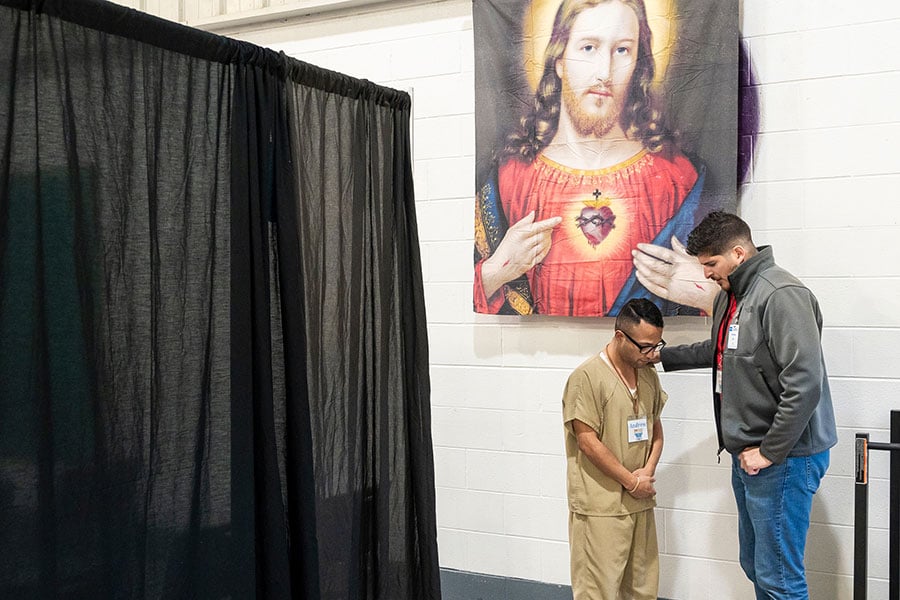
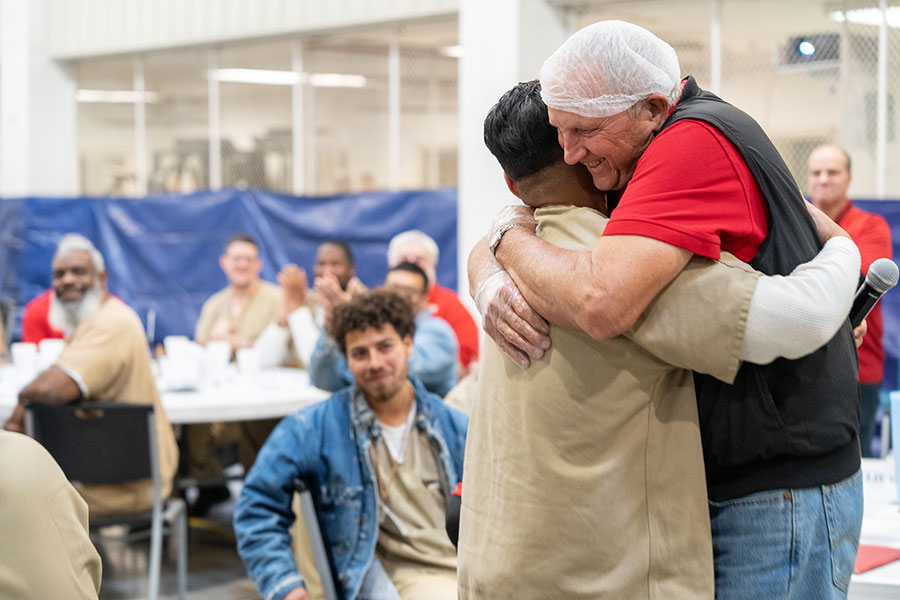
A trained parish volunteer participating in prison ministry prays together with an inmate who gave a talk during a Kolbe Prisoner Retreat at Bridgeport Correctional Center. (NTC/Juan Guajardo)
The first time someone invited Myles Jacob Miller to visit a local prison, he quickly dismissed the idea.
“I was really coldhearted,” admitted the cradle Catholic who was living in San Antonio at the time. “My thoughts about inmates were they screwed up, got caught, and now they’re getting what they deserve.”
Over the years his heart and attitude softened. So when parishioner Howard Biel asked if he would help with a Kolbe prisoner retreat at the Bridgeport Correctional Center, the now permanent deacon responded with an enthusiastic and immediate yes.
“It’s really been a blessing,” said Deacon Miller, who was ordained in 2000 for the Diocese of San Antonio. “Jesus tells us to visit the people in prison and that’s what we do. We bring Christ to the forgotten.”
Clergy, chaplains, and trained parish volunteers share the Gospel, friendship, and truth about the Catholic faith with incarcerated men and women in 15 correctional facilities across the Diocese of Fort Worth. Depending on a location’s restrictions, people involved in prison ministry provide one-on-one pastoral care, Catholic Masses, Communion services, sacramental preparation, prayer opportunities, Bible study, and retreats.
And the need for spiritual services to the imprisoned continues to grow.
Texas has the highest incarcerated population in the United States. According to the Texas Department of Criminal Justice, there were 134,668 inmates in Texas prison facilities in September 2024. Of the roughly 40,000 Texans released from state prisons every year, nearly half are rearrested within three years. Between 15% and 20% return to prison.
Faith-based rehabilitation can make a difference.
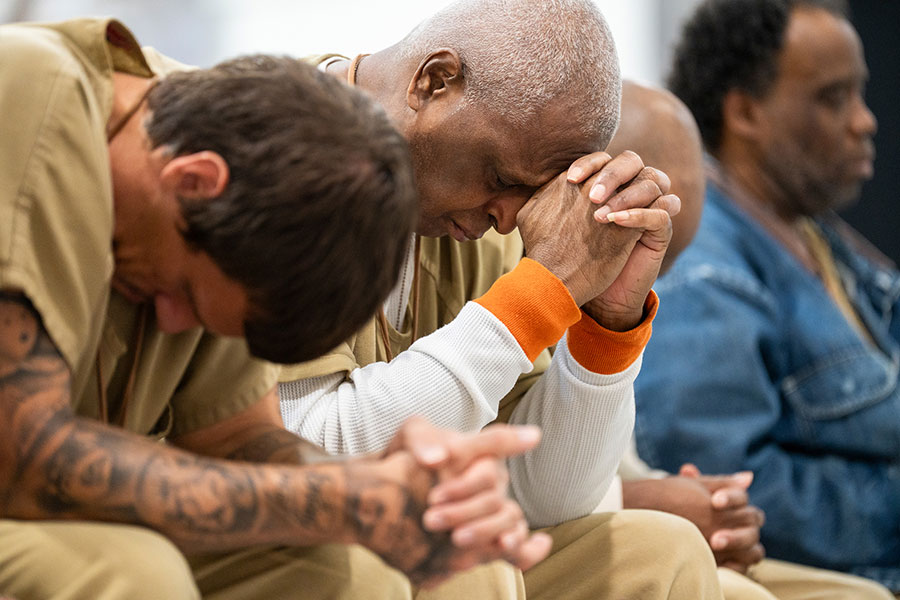
“The rate of recidivism is [close to] 50%. That drops down when inmates get their heads wrapped around a job or life skill,” Dcn. Miller said. “For the ones that become stronger in their faith, it goes down to less than 20%. If they attend a spiritual retreat, there’s less than a 10% chance of them returning.”
The retired Air Force veteran is part of a team that organizes a Kolbe prisoner retreat twice a year — one in English and one in Spanish — at the Bridgeport prison.
Finding faith
Named to honor St. Maximilian Kolbe, a Polish Franciscan priest who died in place of a fellow prisoner at the Auschwitz concentration camp during World War II, the three-day retreats were started in 2009 by a group of Catholic men from the Texas Hill Country. They modeled the spiritual exercises after the adoration, community, theology, and service of the “ACTS” retreat experience. Known today as Kolbe Prison Ministries, the effort to help the incarcerated in Texas heal and find their faith has expanded to prisons in Louisiana, Oklahoma, Florida, and Kansas.
“To be perfectly honest, they come for the food. We feed them physically but spiritually, as well,” explained Raul Soto, who coordinates volunteers for the Bridgeport event from the tri-parish communities of St. John the Baptizer in Bridgeport, Assumption of the Blessed Virgin Mary in Decatur, and St. Mary in Jacksboro. “They receive strong teaching on everything dealing with the sacraments, Rosary, Mass, Eucharistic Adoration.”
Typically, 50 men gather in the prison’s gymnasium from 6 a.m. to 6 p.m. for the retreat, which is organized with help from 25 parishioners who provide meals, testimonies, and do other outreach.
“We ask the men to make the Lord the center of their life because He’ll stick with you,” said the St. John the Baptizer parishioner. “We all change, but the Lord will never change. The guys take that to heart.”
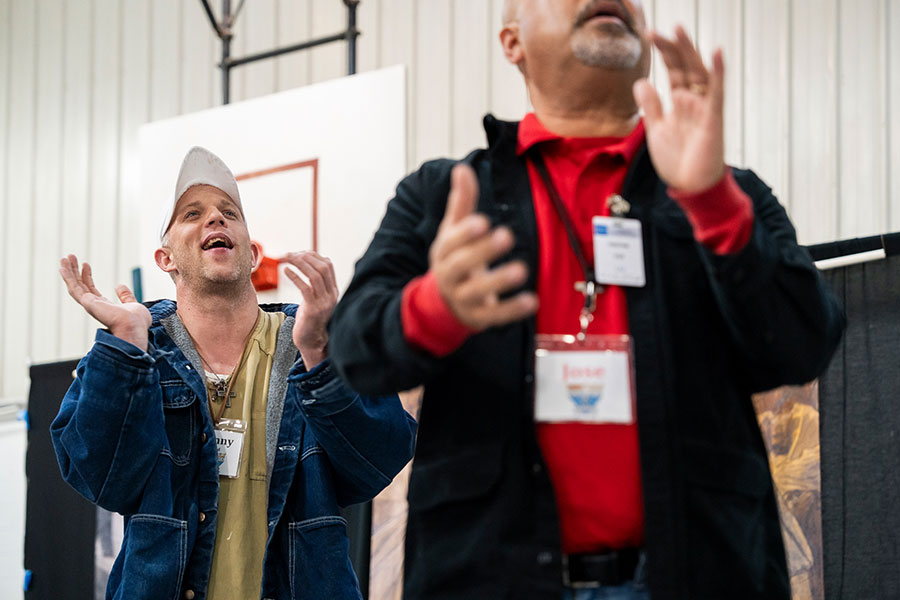
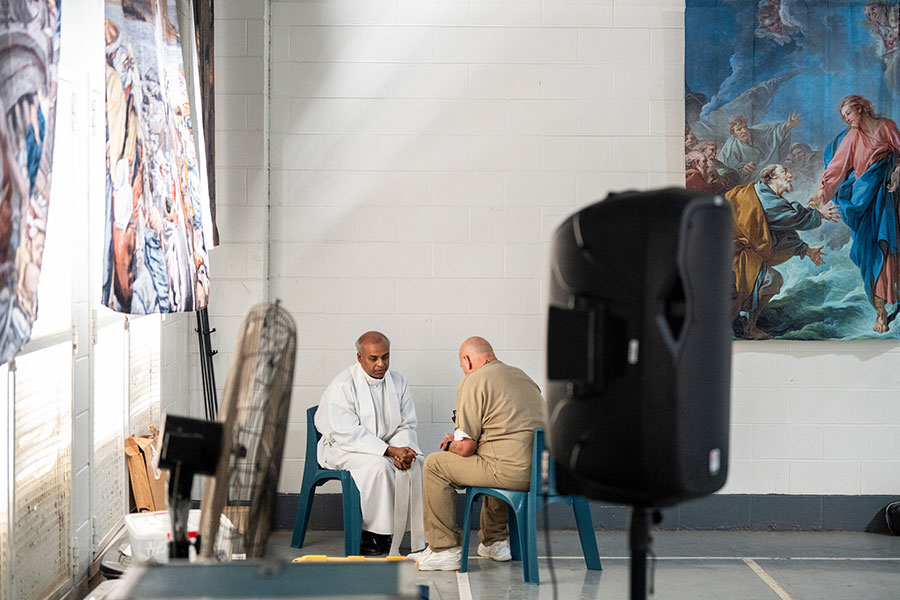
Regular prison ministry includes weekly Bible lessons, OCIA, and a Rosary class. On Thursdays, the priests assigned to the tri-parish communities, Father Sam Ferix Antony Jesu Antony, SAC, or Father Anto Carloose, SAC, celebrate Mass at the correctional center.
Soto remembers when a non-Catholic inmate, an accomplished cellist, performed for the liturgies. “It was bittersweet when he was paroled because it was such a blessing to have him with us,” the volunteer said. “He sent me a note to say what an impact playing during Mass made in his life. It touched my life as well.”
When visitors come to the prison, inmates “light up,” maintains the bilingual Texan, who communicates with Spanish-speakers from Mexico and South America.
“We’re not trained counselors or professionals, but we can listen to their stories and concerns,” he added. “Some of them are really lonely and get no visitors. Seeing how they react to a friendly hug makes what I do so worth it.”
Giving hope
Some inmates haven’t had a visitor in months — even years.
“Their families are far away, or they’ve burned bridges and are alienated from relatives,” Biel pointed out. “Prisons are depressing, and the conditions aren’t good. Just walking in with a smile can change the whole outlook of the day for someone.”
Biel, an Assumption of the Blessed Virgin Mary parishioner, began assisting Deacon Eldon Gray with Communion services at the Bridgeport Correctional Center more than eight years ago.
“He took me to the prison, and I fell in love with helping the guys,” said the 77-year-old retiree. “It’s a wonderful opportunity to get to know somebody and share with them the love of Jesus Christ.”
An inmate he met in his early days of ministry let Biel know the prison lacked a Catholic presence. Faith-+oriented books available at the prison were written from a Protestant perspective.
“I realized this was something I could help with, so we started a Catholic Bible study and brought in materials explaining the fullness and truth of the Catholic faith,” Biel continued. “At church I talked about how good I felt helping people at the prison and others joined me. That’s how our ministry grew.”
The Holy Father designated 2025 as a Jubilee Year marked by hope.
“Pope Francis wants us to become tangible signs of hope for people in difficult situations,” he emphasized. “To me, prison ministry is that. When you visit the imprisoned, you’re doing what Jesus said. These are people often abandoned by family and viewed by society as dangerous and morally flawed. You give them hope.”
Offering encouragement
Gustavo García became passionate about prison ministry long before he was ordained a permanent deacon in 2020. The former St. Jude parishioner began visiting inmates in 2014 and continues to go to the Sanders Estes Unit in Venus three Mondays a month to pray the Rosary, distribute Communion, and preach.
“Men start coming just to get out of their cells and have someplace to go,” the deacon said candidly. “But some really get involved in worship, start singing in the choir, and play instruments.”
The convicts he meets learn to appreciate their faith and begin to see themselves from a different perspective. Sanders Estes is a re-entry unit so Dcn. García offers encouragement to the men returning to society. “One of the men told me he used to come to services just to kill time but then he began to think of God in a different way and drew closer to Him,” he explained. “When I hear those stories, I know God is working through me to accomplish that.”
Phil Luebbehusen described a similar feeling when he visits inmates at the Federal Medical Center prison.
“It’s the most rewarding thing I’ve ever done in a religious framework,” said the Good Shepherd in Colleyville parishioner. “They’re just human beings who need a chance to seek redemption. If you talk to them in a way that gives them hope, it’s a good thing.”
Limited to one-hour visits since the COVID pandemic, Luebbehusen assists chaplain Father Richard Collins with Sunday Mass at the prison, using the remaining minutes to talk with the 35 to 40 men who come to the liturgy.
“There are guys who come from Catholic families, and we help reacquaint them with the sacraments,” he said, recalling two inmates who died within a year of returning to the faith. Both asked for Communion on their deathbeds. “That tells me we’re in the right place at the right time.”
Showing mercy
Parishioners interested in reaching out to the imprisoned are always welcome to “come and see,” Biel said, uttering the same persuasive words he once heard. The new volunteer had no experience with inmates the first time he visited a prison.
“These people made a mistake,” Biel pointed out. “It’s not who they are. It’s what they did. Not helping them would be like Jesus dispensing justice and not mercy.”