
Bishop Olson leads diocesan pilgrimage to Italy
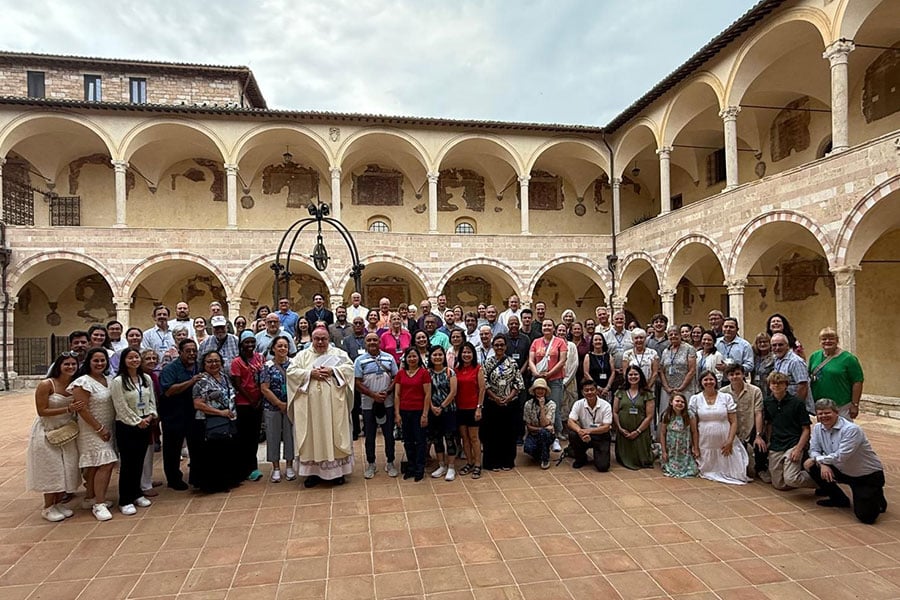
Pilgrims from the Diocese of Fort Worth took a pilgrimage to Rome and Assisi. (courtesy photo)
Bishop Michael Olson; Vicar General Father Jonathan Wallis; and Pastor of St. Elizabeth Ann Seton Parish Father James Flynn led 80 pilgrims recently on a Diocese of Fort Worth Jubilee Pilgrimage to Rome and Assisi, Italy.
“What I cherished most about this pilgrimage to Rome was how every moment drew me closer to the heart of the Church and, more importantly, to the heart of Christ. From beginning to end, the entire journey felt like a sacred invitation to go deeper in faith,” said Josie Geisler, whose home parish is St. Ann Church in Burleson.
The pilgrims’ ages and backgrounds varied: families with teenage children, married couples, young single adults, a father and son, a mother and son, several widowed women, friends traveling with friends, older single adults, and young seminarians, one of whom brought his family with him.
The pilgrims’ reasons for attending were as diverse as their walks of life.
“It was a special opportunity to travel with my Catholic community and our bishop. It was my first pilgrimage, and I was drawn to the idea of traveling independently, and yet still being part of a group. It turned out to be the perfect time to go, as it coincided with the Jubilee Year, making the experience even more meaningful,” said Kyrie Osborne, a member of Sacred Heart Parish in Wichita Falls.
Renee Hoffman of St. Elizabeth Ann Seton Church in Keller attended the pilgrimage with her husband, Scott, and her sister and brother-in-law, Debbie and David Lain.
“Scott was diagnosed with stage four kidney cancer a few years ago and, by the grace of God and a lot of prayers, he is doing well. We wanted to spend time to learn our faith and strengthen our relationship with God,” Hoffman said.
Raymond Castagnaro, also a member of St. Elizabeth Ann Seton Parish, said he attended the pilgrimage to ask for God’s grace and help for his disabled son, Brett. He said that dedicating his pilgrimage, every Mass, and every candle he lit to his son was the most meaningful part of the trip for him.
A message from Pope Leo XIV
The pilgrims attended the general audience of newly elected Pope Leo XIV in St. Peter’s Square on June 25 with thousands of visitors from all over the world. The Pope’s address centered on the hope of Jesus’ healing based on the Gospel reading for that day, Mark 5:21-43, which tells of a 12-year-old dead girl and a woman who has been suffering from bleeding for 12 years.
The pope’s message that day was a reminder to all the pilgrims of the theme for Jubilee 2025, hope.
“Today we will again consider the healings of Jesus as a sign of hope. In Him, there is a strength that we too can experience when we enter into a relationship with His Person,” he said.
The diocese’s pilgrims experienced the universality of the Church as the Gospel was read in eight different languages.
Robb Catalano, a member of St. Andrew Parish in Fort Worth who attended the trip with his mother, JoAnn Catalano, said traveling with Bishop Olson and the other pilgrims in Rome during the Jubilee year and seeing the Pope Leo XIV was a “once-in-a-lifetime” opportunity and was a “life-changing” experience.
“I truly enjoyed getting to know and bond with the other pilgrims on this trip. The conversations during meals, bus rides, and visits to all the special places we went were outstanding. The most meaningful part was attending Mass with my mother every day in the most beautiful basilicas and passing through the four Holy Doors with her. I am so thankful for Bishop Olson and his staff for making this special trip possible,” Catalano said.
Door to conversion
Several pilgrims commented that visiting the basilicas with the bishop, priests, seminarians, and other pilgrims made the entire trip even more incredible.
“The celebration of the Holy Mass in all the different basilicas with the bishop was extraordinary. I am just overwhelmed that these blessed saints who had so much faith — some of whom were martyred — walked along these same streets and prayed in these chapels. It is overwhelming and makes you feel so much hope,” said Kim Locus, a member of St. Frances Cabrini Parish in Granbury who traveled with her husband, John.
During the jubilee year, the pilgrims walked through holy doors of four basilicas in Rome: St. Peter’s, which has the door that is unbricked and opened only during a jubilee year; the Archbasilica of St. John Lateran, which is the Diocese of Rome’s cathedral and is known as the oldest and most important basilica in the West; the Basilica of St. Paul Outside the Walls, the largest Roman basilica after St. Peter’s; and the Papal Basilica of St. Mary Major, which is the only basilica in Rome to have preserved the primitive early Christian structure.
“Walking through all four Holy Doors was profoundly moving. Each door felt like a threshold of grace, a passage into deeper conversion, renewal, and mercy. I carried with me so many intentions for myself, for loved ones, and stepping through each door felt like placing all of them into the hands of God,” said Geisler, who works in the diocesan vocations office and traveled with her friend Araceli Arteaga.
Geisler said she has had a deep desire to go on a pilgrimage to Rome for many years and felt like it was the right time to go when she learned Bishop Olson, Fr. Wallis, and Fr. Flynn would be leading this pilgrimage. She said their presence gave her a powerful sense of spiritual guidance and reassurance.
Osborne of Wichita Falls also said what she liked the most about the pilgrimage was attending daily Mass in different churches.
“It’s one thing to visit a beautiful basilica, but it’s something entirely different to be able to worship inside of one — it brought a deeper spiritual connection to each place,” she said.
Adventures in Assisi
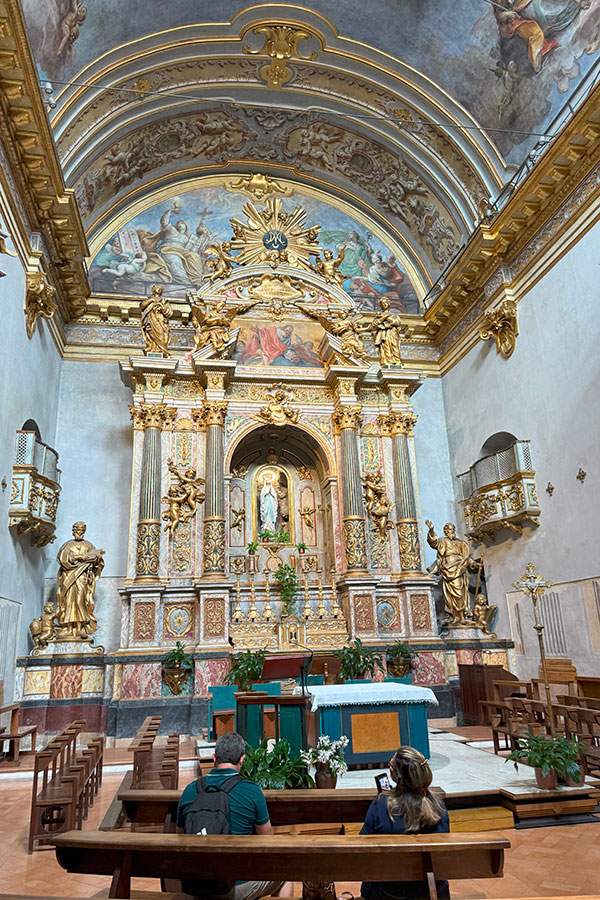
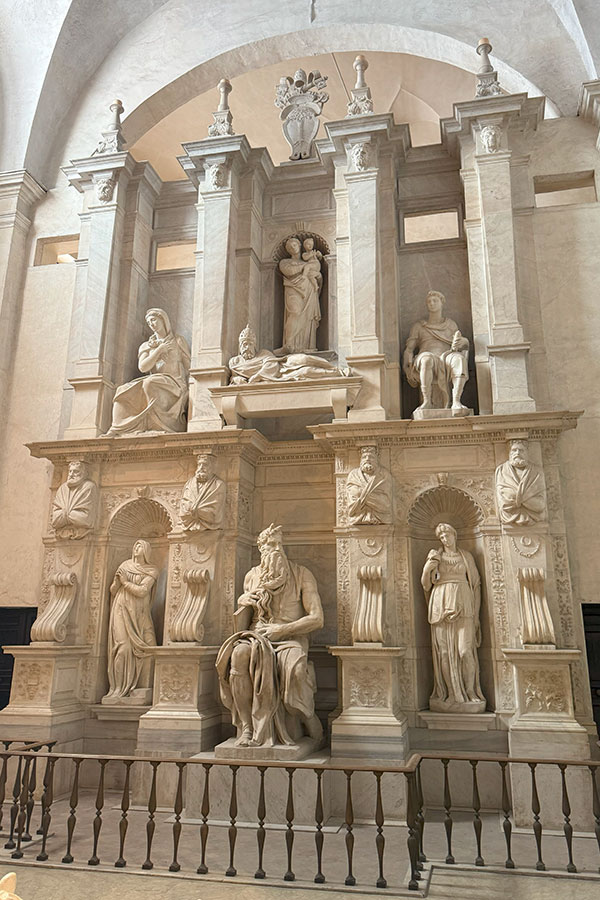
Pilgrims attended daily Mass together in the private chapel of the Swiss Guard in the Vatican as well as chapels in the Basilica of St. Mary Major, the Basilica of St. Peter in Chains, the Basilica of St. Sebastian, the Cathedral of Orvieto, the Basilica of St. Mary of the Angels, and the lower Basilica of St. Francis in Assisi.
Bishop Olson concelebrated the Masses with Fr. Wallis and Fr. Flynn, assisted by two seminarians, Trent Barton and Paul Trinh. Some Fort Worth pilgrims read the Old Testament Readings and Psalms on the days that the seminarians did not. The group celebrated these Masses in English and attended a Mass in St. Peter’s Basilica in Italian once as well.
In Assisi, the pilgrims visited the Basilicas of St. Mary of the Angels, St. Francis, and St. Clare and viewed Blessed Carlo Acutis’ body in a humble church with subtle beauty, Santa Maria Maggiore.
“Being in Assisi and seeing the significant places of St. Francis was very gratifying as I worked for the Sisters of the Third Order of St. Francis for 42 years,” said Elaine Frye, a parishioner of St. Elizabeth Ann Seton who traveled with her husband, John.
Martha Silva-Rivera, another pilgrim, said she was grateful to find a pilgrimage during the jubilee year. She said the group was very welcoming to her, and she enjoyed the free time that was built into the schedule.
“I had the opportunity to join in a Eucharistic procession in Assisi, see the relics of the Holy Cross, nails, and crown of thorns, and climb up the holy stairs kneeling. I didn't foresee being this close to Christ's passion. I bawled,” Rivera said.
An understanding unearthed
One of the tours that several pilgrims mentioned enjoying the most was the Scavi Tour.
“All the history was present in one place,” Rivera said as she described the experience. “It is hard for me to not get overwhelmed with emotions there.”
The Scavi, or Vatican Necropolis, is the underground excavation which lies 9 to 36 feet under St. Peter’s Basilica. In 1939, Pope Pius XII ordered an excavation beneath the grotto of St. Peter’s Basilica, where many popes are buried.
Groups of pilgrims were allowed only 12 at a time to be led through some very narrow passageways, which at times were only wide enough for one person to navigate. The guides presented artifacts and an untouched and preserved underground city that is more than 1,600 years old. Brightly colored frescos and intricate sculptured ceiling tiles are still visible.
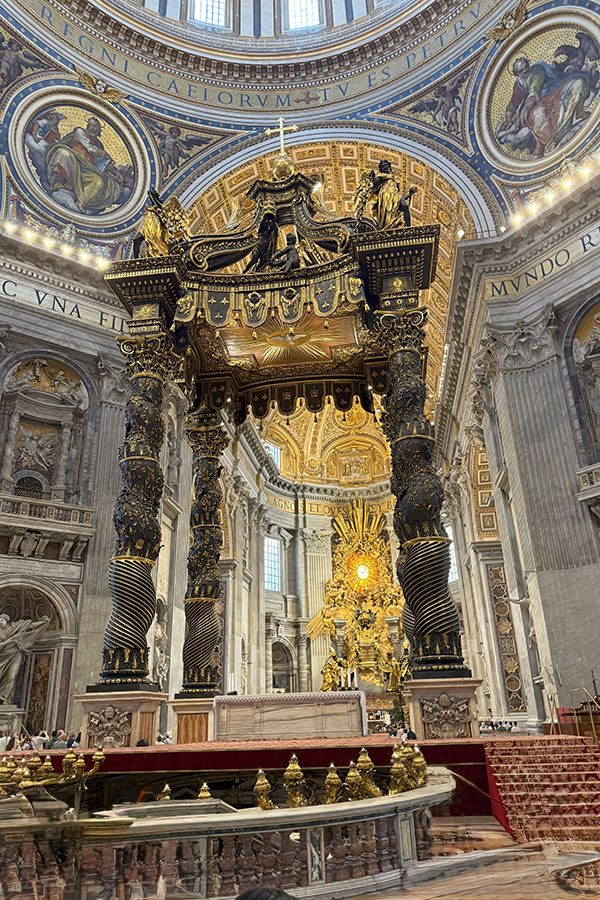
The guides explained how the first Christian Roman Emperor Constantine built what is now called Old St. Peter’s Basilica over the ancient burial grounds. Later, the present St. Peter’s Basilica was built over some of Constantine’s structures. The guides also helped the pilgrims discover where St. Peter’s bones lie today, in a shrine in an area of the necropolis that is directly under St. Peter’s Baldachin, a decorative sculpture by artist Gian Lorenzo Bernini above St. Peter’s Basilica’s high altar. The pilgrims had walked around that sculpture in the basilica the day before without realizing that St. Peter’s bones were below.
“The Scavi Tour, visiting the very tomb of St. Peter, was perhaps the most spiritually powerful moment for me. To stand in silence at the bones of the first Pope was overwhelming. It reminded me that our faith is not just an idea,” Geisler said. “It is a living, breathing reality rooted in real people, real sacrifice, and the living presence of Christ throughout history.
“This pilgrimage was not just a trip,” she continued. “It was a deep encounter with the sacred, a renewal of my spirit, and a confirmation of the unshakable truth that the Church is alive, and Christ is at its center.”
author's personal reflection on the pilgrimage