
Reflections on a pilgrimage of hope: Jubilee 2025
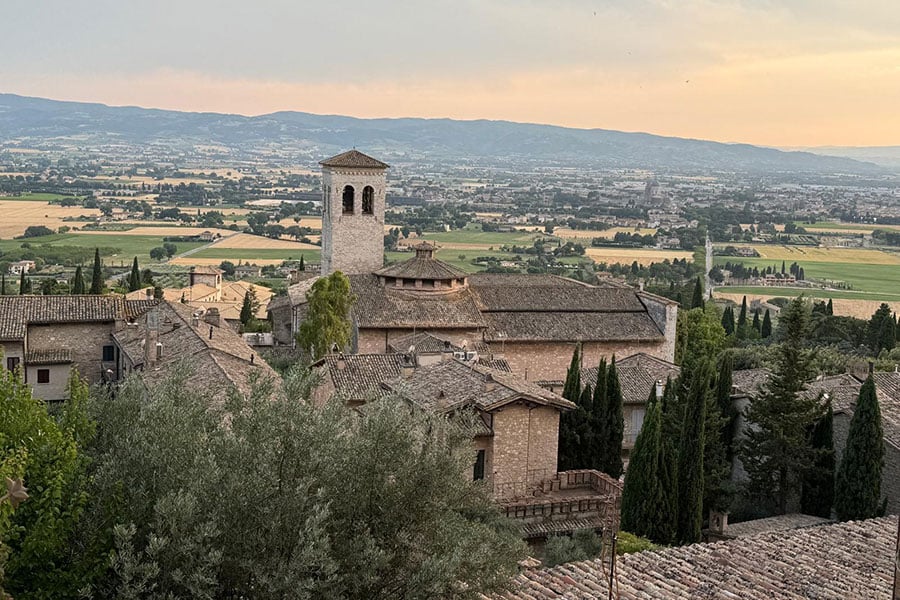
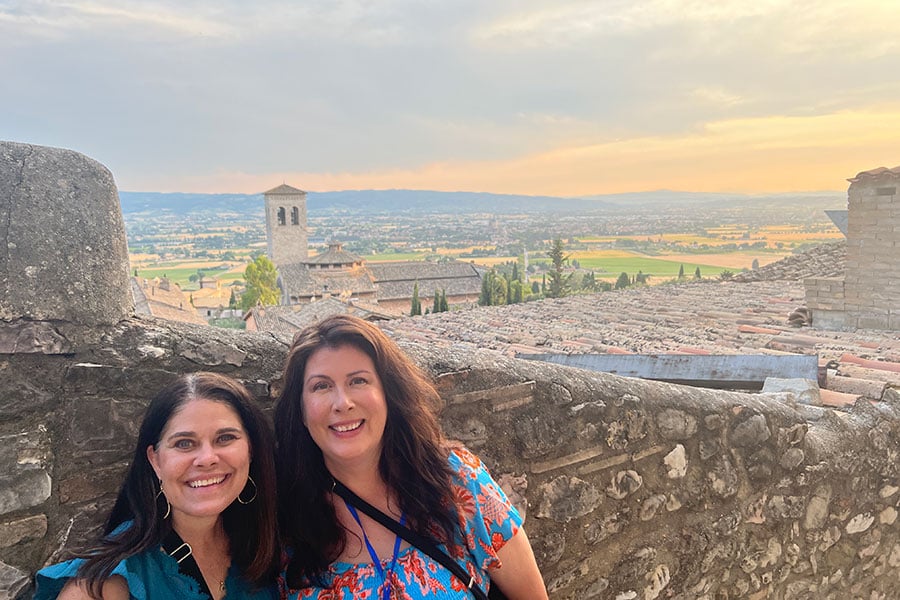
The countryside of Assisi. (courtesy photo/Ashley Hance)
I was recently blessed to be able to take the trip of my lifetime. For as long as I can remember, there was one place I always said I wanted to visit before I died: Rome.
As only God’s providence could have planned it, I was able to visit during an incredible point in history — during the 2025 Jubilee Year, just after the first pope from America was elected, Pope Leo XIV. I also celebrate my 50th birthday this fall, another reason I took the trip this year.
More specifically, I had always intended to go on a pilgrimage to Rome, but until I experienced this pilgrimage with 80 other Fort Worth Catholics, including Bishop Michael Olson; Vicar General and Moderator of the Curia Father Jonathan Wallis; Pastor of St. Elizabeth Ann Seton Parish Father James Flynn; and two seminarians, I realized I didn’t fully understand what a pilgrimage was.
Fr. Flynn and Fr. Wallis prepared us well by reminding us in emails in the months before we embarked that a pilgrimage is different from other trips. It is not a luxury vacation or a relaxing tour of a beautiful area. As Fr. Flynn wrote in his email, it’s “a profound opportunity for spiritual growth.”
On the pilgrimage, we would have the opportunity to literally walk in the footsteps of the saints; have time for prayer and reflection in beautiful, often ancient places in Rome and Assisi; and celebrate Mass together as a group. And we did indeed do all of that.
Fr. Wallis also predicted plans and schedules might change, and we would have to adjust in ways that might not always be comfortable. As in life, we could choose to offer up those difficulties and inconveniences to Christ for ourselves and the group and keep going with a positive attitude, which would in turn affect the overall experience of the pilgrimage in a positive way.
Reflecting on the whole experience after the pilgrimage, I realized learning how to be comfortable with being uncomfortable was a central part of the trip. Living as a pilgrim is more about survival than comfort.
I quickly realized, as I already knew about myself, I am quite the spoiled American. I think in the U.S. in particular we are constantly encouraged by the media on every screen to buy this or try that to fulfill our every wish.
Now, with these phones we carry along with us, we can get these comforting items, in some cases, almost instantaneously: food, answers to almost any question, beauty products, supplements, relaxation items, etc. Every car and room we enter is heated or cooled to the exact temperature we desire.
Although I am also able to acquire many of these things, over the past six years since my husband died, I have become remarkably familiar with living with being uncomfortable in every way imaginable.
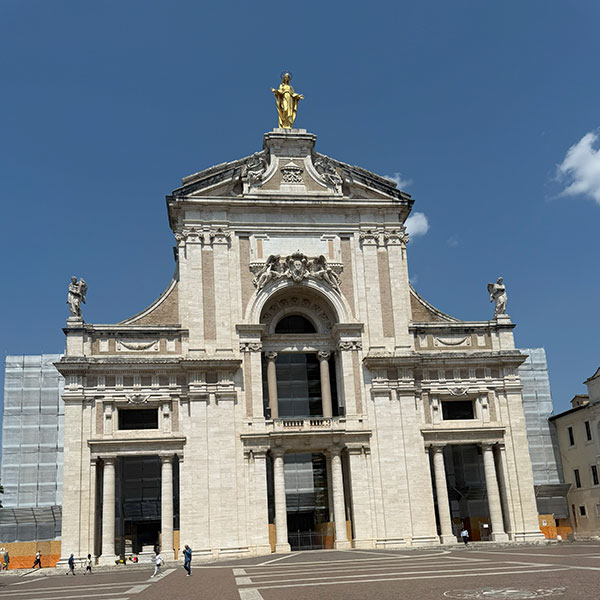
During our very first Mass as pilgrims in the Basilica of Santa Maria degli Angeli (Saint Mary of the Angels) in Assisi on June 21, the second reading included one of St. Paul’s most famous writings, which has been a verse I have leaned on throughout my life, especially in my life as a widow:
“My grace is sufficient for you, for power is made perfect in weakness,” (2 Corinthians 12:9).
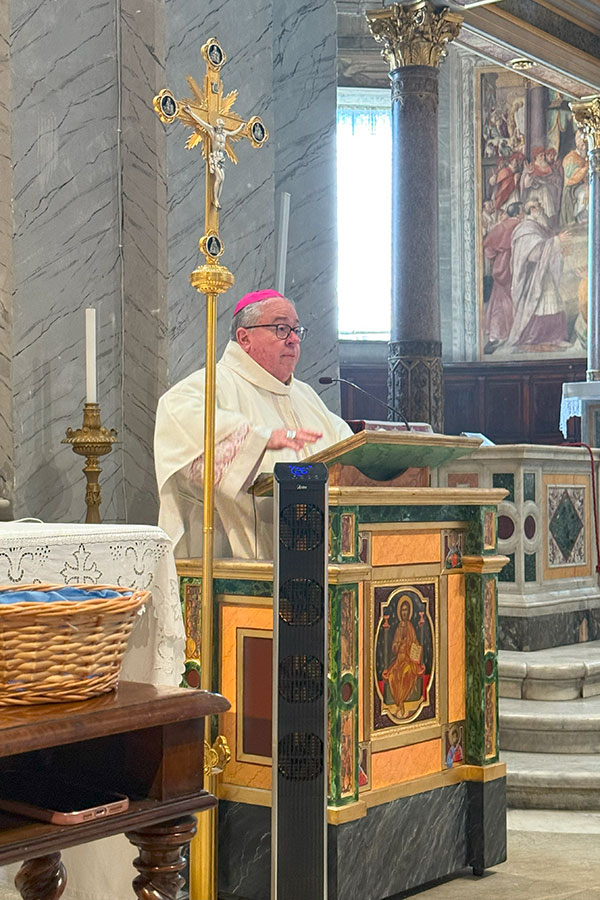
“God works where we are; the Lord perfects us,” Fr. Wallis explained during the homily.
God often perfects us in ways that are extremely uncomfortable, and at times, are even quite painful. Analogies in both in the Old and New Testaments speak of God molding us or purifying us as with fire.
When we give in to the world we live in right now and focus on ways to comfort ourselves during times of difficulty, we can end up in a place where we don’t need to be, and more importantly, where God doesn’t want us to be. Learning how to be uncomfortable can be the key to growing stronger in our faith and in our lives.
Sometimes in choosing what brings us comfort in the present moment, we can actually cause ourselves pain in the future. For example, I tend to overpack for trips because I want to be prepared for anything. They warned us of very steep hills in Assisi. I experienced great difficulty climbing the hill to our hotel partly because my carry-on item, my backpack, was almost 15 pounds. And yet, I still forgot some things that would have been helpful on my trip. I was grateful I did not have to roll my suitcase up that hill; they had already put our suitcases in our hotel for us.
The hills of Assisi were only one of the uncomfortable experiences of the trip. We never knew when bathrooms would be available, and often we had to pay to use a bathroom. It was usually only a coin or two, but it was different than normal. We carried water bottles with us and sometimes had to fill them up in bathroom sinks, because although there were many places to get water for free or places to buy water and other drinks, we didn’t know where or when we would find them.
It is summer in Italy in June and much like Texas, ridiculously hot and very humid. We often walked outside while being constantly drenched in our own sweat. Many of the buildings we went into did not have air conditioning.
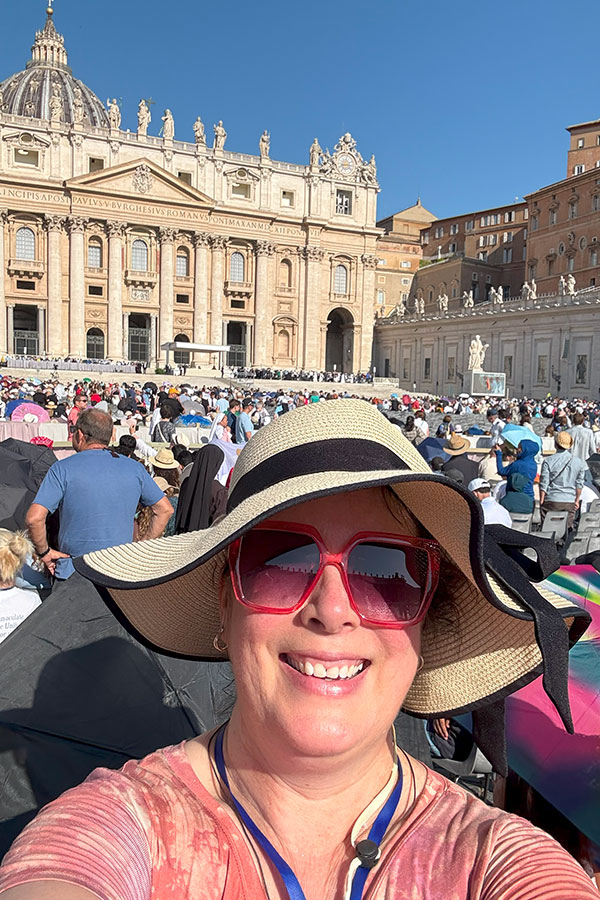
It was all worth it, though, when we saw the breathtaking views of the countryside from the hills in Assisi and the beautiful sacred art in so many basilicas and cathedrals including the Pieta in St. Peter’s Basilica and the Sistine Chapel. We walked through the holy doors in four separate basilicas; tasted sweet, creamy, authentic Italian gelato; prayed by St. Peter’s tomb, and stood a couple of arm lengths from Pope Leo XIV as he rode in his car through St. Peter’s Square.
During our second Mass on Sunday, June 22, the Solemnity of the Most Holy Body and Blood of Christ, at the Cappella Frate Leone at the Lower Basilica of San Francis in Assisi, the Gospel reading was Luke 9:11-17, the miracle of the loaves and fishes.
In Bishop Olson’s homily, he remarked that the disciples wanted to send the people away because they felt like the people were getting in the way of their work. Jesus used what little the disciples had to give, two fish and five loaves, to feed 5,000 people.
Bishop Olson said when we receive the Eucharist and are thinking of taking the bread, we should also think of giving back at the same time.
“The Lord asks us to give from our poverty,” said Bishop Olson.
Both my roommate Jodie Gibson, a member of St. Mark Parish in Argyle, and I, as widows, could greatly relate to giving from our poverty. We often discussed on our trip how we did not feel like we had enough to give to our children, God, or the world around us after our husbands died, but that is exactly what we have been asked by God to do.
Bishop Olson also mentioned in the same homily that the late Pope Francis proclaimed 2025 as the Jubilee of Hope.
“We cannot be people of hope without realizing our own powerlessness,” he said.
Bishop Olson said our hope is that God has control over everything and “to realize that in hope, we have to give our poverty over to God.”
He also said that when we do what God asks us to do, that’s infinitely better than what we want to do.
“Hope is in what we fear — our powerlessness. That’s where God meets us and acts on our behalf,” he said.
The death of my wonderful husband and the father of my children was my worst fear, and I have felt powerlessness many times since he died.
St. Paul in 2 Corinthians 12:10 ties into the hope that the bishop was talking about:
“Therefore, I am content with weaknesses, insults, hardships, persecutions and constraints, for the sake of Christ; for when I am weak, then I am strong.”
When I woke up the first morning after returning from our pilgrimage, I was filled with hope for my future and my children’s futures. I felt as if I was able to gracefully (for the most part), with God’s help, of course, fully participate in that pilgrimage, and I truly felt like there was no limit to what God could accomplish through my life. Not because of me, but because of Him.
The day after I returned from Rome was the feast of St. Peter and St. Paul. As I listened to the account of St. Peter being freed from his chains in prison (Acts of the Apostles 12:1-11) and the words of St. Paul as he talked about finishing the race strong (2 Timothy 4:6-8, 17-18), I was reminded that with God, nothing is impossible — and that’s our ultimate hope on this lifelong pilgrimage, this journey, we call our lives.
more coverage: "Bishop Olson leads diocesan pilgrimage"