
Lent, Scrutinies, and transformative grace
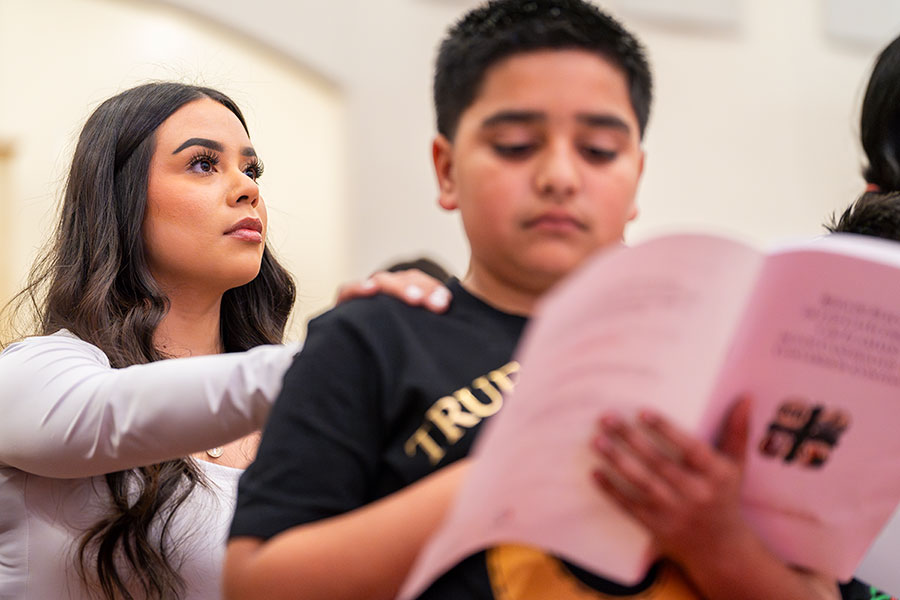
Zulema Cano places her hand on the shoulder of her nephew, Jayzel Cano, during the Rite of Election ceremony at Holy Name of Jesus Parish in Fort Worth on March 6, 2025. (NTC/Juan Guajardo)
To any confirmed Catholic, the liturgical season before Easter known as Lent is marked by prayer, almsgiving, and fasting. However, to the Elect — those preparing for baptism at the Easter Vigil — it’s also the period of purification and enlightenment, the final stage of formation before baptism, confirmation, and Holy Eucharist, marked by prayerfully discerning full communion with Christ and His Church in their lives.
But the Lenten season can and should be treated as one and the same by both long time Catholics and those about to enter the Church through baptism, according to many faith formation directors.
“Purification and enlightenment is all about reflection and examination of our interior life and how everything that has been received during the catechumenate period — all the doctrine and traditions of our faith — how that is reflected in the life that we are living, and how we can live that more deeply,” said Laura Nelson, diocesan director of faith formation. “It’s not just for the Elect. It takes place during [the liturgical season] when all the faithful are called to reflect on how we are living a life of faith.”
Three Scrutinies
The final six weeks of the Elect’s formation are also shaped by the Scrutinies, to ready the Elect for their relationship with Christ in the sacraments.
“The word scrutinize — we shouldn’t think of it as something negative,” said Michelle Ebambi, OCIA coordinator at St. Joseph Parish in Arlington. “‘Scrutinize’ here is in the sense of trying to find out where we stand with God, and during Lent, the Church as a whole is called to stop being busy and take time to pray more, to repent, to examine our sinfulness and come back to God, because Jesus is the healer.”
“The beautiful thing about the Scrutinies is that they have a double purpose: to reveal what is weak, sick, and sinful in the hearts of the Elect so that it can be healed; and to reveal what is honorable, strong, and holy so that it can be strengthened,” said Robin Harris, OCIA director at St. Michael Parish in Bedford. “It’s really about preparing them for the effect of baptism and understanding that God does what He says in the sacraments.”
Water, light, and life
Usually celebrated on the third, fourth, and fifth Sundays in Lent, each of the three Scrutinies begins with Gospel readings from John.
The Gospel for the first Scrutiny is Christ and the Samaritan woman at the well (John 4:5-42), calling us to examine our sins and to welcome Christ as the living water in our baptism.
“I always thought when I was younger, ‘Why would you be joyful about having all your sin pointed out?’” Harris laughed. “But when you realize that the joy of being healed from sin is like going to reconciliation, when you leave feeling that grace and complete relief having been absolved of your sin because you’re truly contrite, that’s the beauty of those stories.”
The second Scrutiny, the healing of the man born blind (John 9:1-41), calls us to reflect on our need for Christ to give us His vision.
“We have eyes, but we don’t see — like spiritual blindness,” Ebambi stated. “We think that we see, but we might be blind to God’s light. Jesus is the light of the world. Seeking Jesus puts us on the path of the light.”
The raising of Lazarus (John 11:1-45), the final Scrutiny, calls us to recognize Christ as the Resurrection.
“People are called to think about why they should follow Jesus,” Ebambi said. “We have the hope of gaining eternal life with Him. He has power over death and will resurrect us, and we’re going to be with Him in heaven forever.”
“If we’re really opening Gospels up for people before they get to the Scrutinies,” Harris noted, “then the reality of what happens within the sacraments is so much greater, especially when it comes to baptism and new life and being called out of death. You’re a new creation. You see things with the lens of God instead of the lens of humanity.”
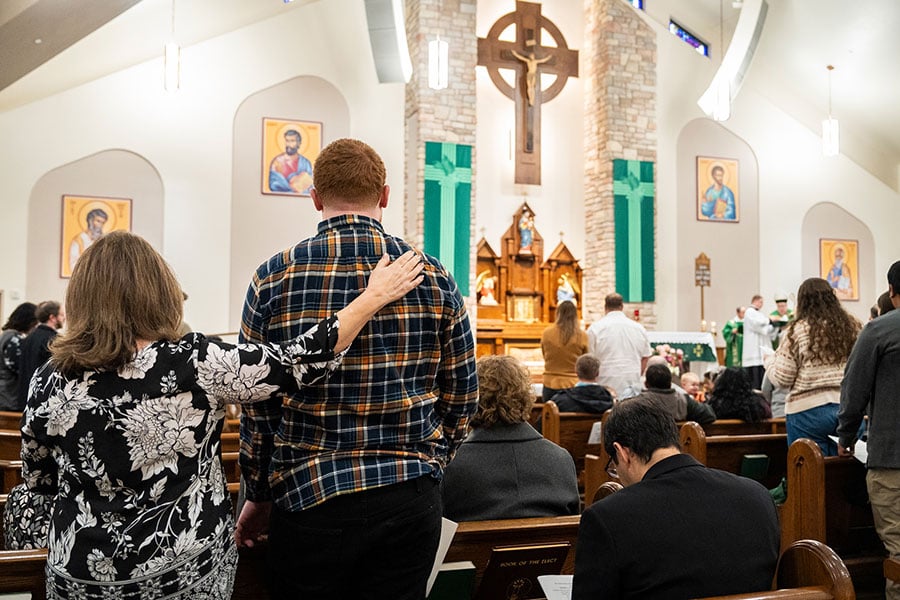
After the homilies these Sundays, the Elect are then called forward to receive prayers from the congregation and priest, first in silence, then in intercessory prayer. The priest lays hands on them individually, praying a minor exorcism prayer for strengthening and healing.
Abundant grace
The Gospel readings and the prayers of these Sundays all combine to mutually benefit both the Elect and the faithful alike.
“We do this during Mass so the whole congregation is witness,” said Ebambi. “It reminds them that, when they were baptized, they committed to something.”
“Sometimes as an adult Catholic, you get lethargic, like, ‘Okay, it’s time to stand and say this; repeat after me,’” Harris said. “But for somebody receiving the sacraments, you’re reminding them that there’s power in what we’re professing to be true and revealed by God.
“It helps us in our renewal of our faith, and that can be a powerful exercise of faith for somebody. We as a community here are going to do it again because we witnessed them making that profession for themselves, and then we’re going to do it for ourselves as a reminder of our baptism. We’re professing and we’re proclaiming, but we’re also witnessing our faith in the world.”
“Lent is the time to ask ourselves if we are just going through the motions of our faith,” Nelson remarked. “Are we actually believing it and living a life of love in response to the gift of love that God has given us? It’s a time to assess where we are in the journey of faith and to strive for an ongoing conversion of heart that is expressed bodily by the way we live our lives.
“The most important thing to emphasize to the Elect is that these aren’t just rituals,” Nelson continued. “They are gifts. The graces that they receive are going to be transformative.”