
Reflections of Mary
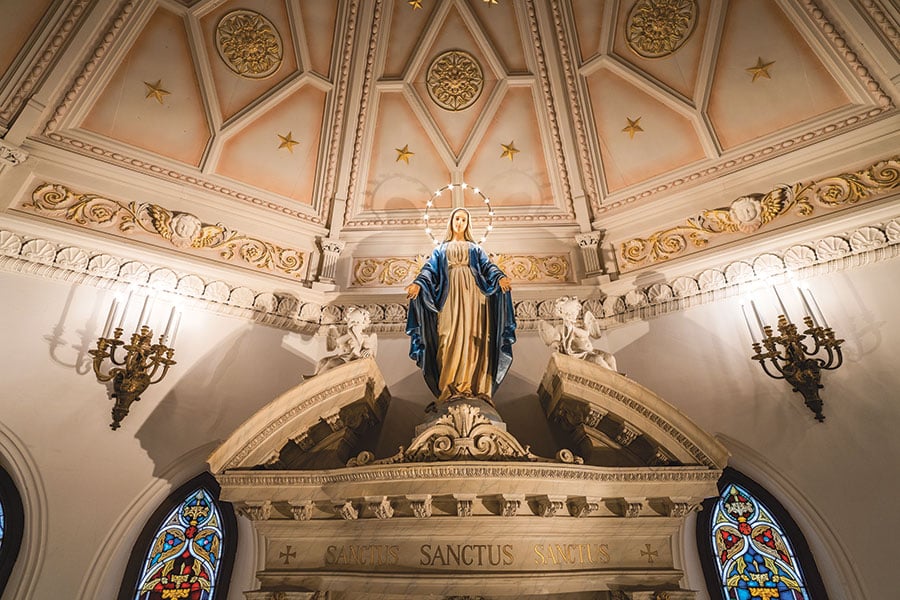
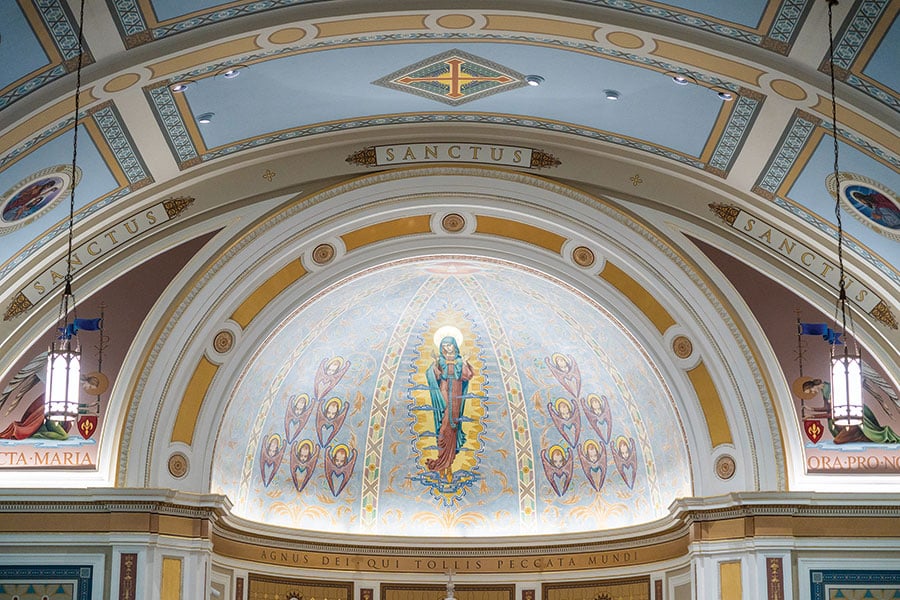
Our Lady of the Apocalypse stands in the apse of St. Patrick Cathedral in Fort Worth. (NTC/Juan Guajardo)
The painting of a resplendent Virgin Mary being assumed into heaven immediately captures your attention when you walk into St. Mary of the Assumption Church in Fort Worth. The familiar depiction for many Catholics honors the role Mary plays in Catholic tradition.
According to artist and University of Dallas theology professor Sister Mary Angelica Neenan, OP, Marian art has been prominent in Church history since the second century. She said, “One of the earliest depictions of Mary dates back to approximately 150 A.D. and is in the catacomb of Priscilla in Rome.
“The Theotokos (Greek for ‘mother of God’) image of Mary holding the baby Jesus has been accepted as historic proof of the devotion to Mary as the mother of God,” Sr. Angelica continued.
Step into St. Patrick Cathedral, and Mary is featured in several places, most obviously as Our Lady of the Apocalypse in the apse of the Fort Worth cathedral. The image is based on the description of St. John: “A great sign appeared in heaven, a woman clothed with the sun, the moon under her feet, and on her head a crown of 12 stars” (Revelation 12:1).
The cathedral also has a Marian altar, which features three different depictions of the Blessed Virgin. The altar is centered around a statue of Mary, Queen of the Angels. Mary is standing on a cloud, surrounded by the busts of angels with her heel crushing a serpent. To her right is an Our Lady of Guadalupe statue that is modeled after the sacred image of Our Lady as she appeared in 1531 on the cloak of an indigenous Mexican peasant named Juan Diego.
At the top of the altar, the image of the Virgin Mary is inlaid with a Russian icon brought to this country in 1917. In her book “Cathedral Treasures,” the late author and cathedral historian Kathryn Fialho explains it depicts the face of the Madonna “with her arms and hands raised in supplication with the child Jesus resting on her heart.”
Mary throughout history
History has played a powerful role in how artists depict the Blessed Virgin.
“The Protestant Reformation definitely had an effect on the art world, and Catholic artists responded by painting Catholic themes about Mary, re-emphasizing, what we always teach, that Mary is a big part of God’s plan,” Sr. Angelica said.
Images of Mary also changed as the Church grew and the outreach of the missionaries brought the teachings of Christ to other countries. Mary was often depicted with the ethnic features of the countries where Catholicism took hold.
“As artists, our own personal culture comes out in our paintings. In Vietnam, there’s the Vietnamese Madonna, and then in Africa, there are many different images of African Madonnas,” Sr. Angelica continued.
“If we believe God is our father, and Jesus, His son, then it is natural that the Virgin Mary would look like us as our mother,” Sr. Angelica said. “When we’re praying the Rosary or praying, just praying from [our] hearts, it’s useful to have an image to pray with. And we’ve always done that throughout history, especially when people were illiterate.”
The importance of Mary in history has sometimes provided fodder for legend and lore to explain the unexplainable. The Black Madonna of Czestochowa, Poland, the most famous of the Black Madonna images, has been the subject of various stories to explain the darker skin tone. Historical experts have said the coloring is soot because the painting was in close proximity to burning oil lamps and candles. Others theorize the original was painted on cedar wood, while others think the painting is reflective of Eastern Europeans. Pope Clement XI issued a pontifical decree of canonical coronation to the image in 1717.
As varied as the images are of Mary, so too are references to “Our Lady.” According to Sr. Angelica, different depictions and names come primarily from two places.
“One is when Our Lady actually appears somewhere, like Our Lady of Lourdes or Our Lady of Fatima, that are very well known. But then there’s also a smaller tradition, especially in Italy, and other countries, where they have their own Our Lady image, or their own statue, or stained glass, or church in honor of Our Lady for each little town.”
References such as “Our Lady of the Lake,” come from people who “want to show devotion and love for her. We ask her for special intercession,” Sr. Angelica said.
“It’s like making it very personal, our devotion, our love for her, and then our trust in her intercession for us, her protection and prayers.”
Marian art, locally
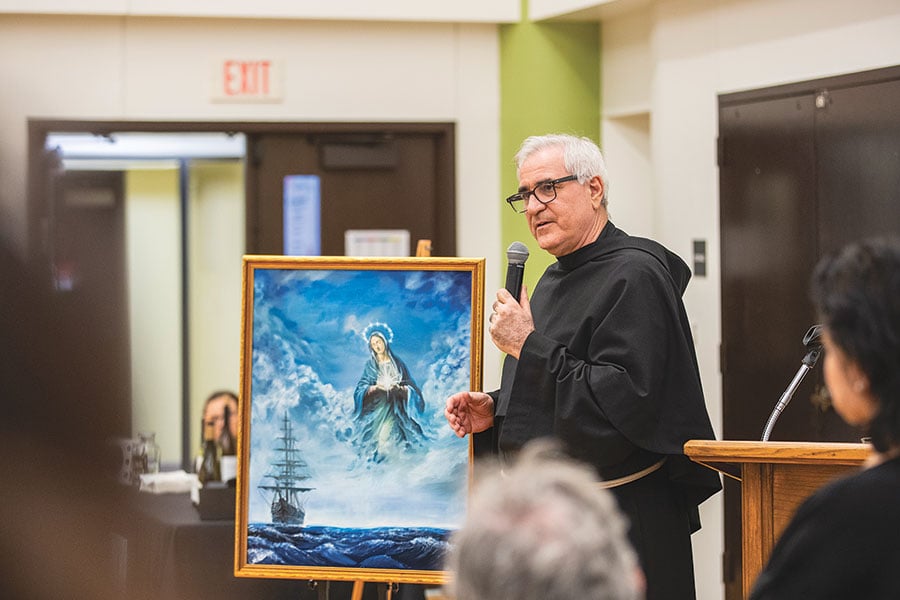
This devotion Catholics have for Mary often extends beyond church walls. Jose Trevino, the cathedral’s communications director, said throughout his career, he has drawn over 100 images of Mary.
“I spent about 12 years as a tattoo artist and a lot of people wanted a Mary tattoo,” he said.
Trevino has created custom works depicting Mary for several parishes and apostolates in the diocese. Among them is a framed image of a pregnant Mary which was created in support of the Fort Worth nonprofit Mother and Unborn Baby Care.
“I used gold leaf to show a radiant glow coming out of her belly [representing] Christ unborn,” he said.
Trevino takes pride in creating paintings that reflect the Catholic tradition and his signature style. His portrayal of the Blessed Virgin Mary, Star of the Sea (Stella
Maris) places Mary over the water, calming the rough seas. In Trevino’s painting, which will eventually be turned into a stained-glass window at St. Andrew Parish in Fort Worth, Mary is hovering over a ship, blessing it as it makes its way through a stormy sea.
Trevino said the painting shows “Mary has arrived and calmed the waters. The ship is coming out of a storm. The sails are not set. And the waves are still kind of heavy. But she’s calming the sea for their travel.”
Over 25 parishes in the diocese are named after Mary or her apparitions. The statues, stained-glass windows, and paintings are reflective of the story of Mary, but also continued acknowledgment of her importance to our Catholic faith.