
Tales from the Holy Land, Part 2: Is it Safe?

The main reading room of the National Library of Israel has a cluster of chairs with a poster of each hostage along with a favorite book. (NTC/Susan Moses)
If I had a dollar for every time someone asked me — “You went to Israel? Is it safe?” — I’d be booking my second trip.
Yes, I’m exaggerating, but only because I haven’t spoken to enough folks. Almost always, it’s the first question I’m asked.
In case you missed the first article, in March I joined three others for an eight-day whirlwind tour of Israel, hosted by the Israeli Ministry of Tourism. We saw more than 20 holy sites around the Sea of Galilee and Jerusalem. But more about that later — in this article I want to address the primary question.
Is it safe?
Since Hamas attacked Israel on Oct. 7, 2023, news organizations have filled our screens with images of war. On our tour, we steered clear of Gaza and the borders with Lebanon and Syria, of course.
Life doesn’t come with guarantees, but I can assure you I felt safe throughout the visit. In Galilee and around the Dead Sea, we saw no security forces, but armed military or police were never far from public areas in Jerusalem, comparable to something you’d find in any large city or event.
Life in Israel seemed fairly normal, with one large exception: a highly visible and unified focus on bringing the hostages home.
Recognition of the hostages began as the airplane descended into Ben Gurion Airport, when the pilot included a call to remember the hostages in his landing announcements. The airport had posters of each hostage.
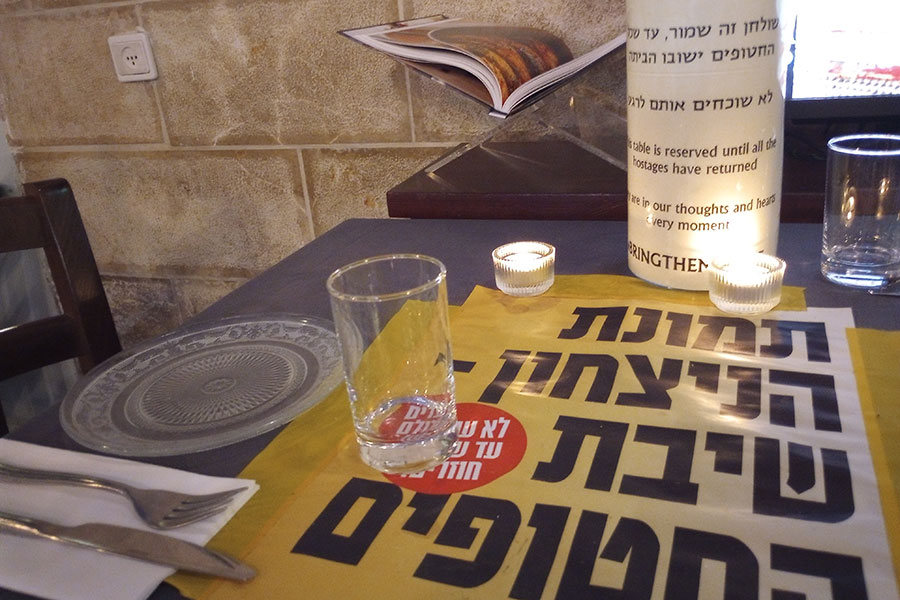
Posters, banners, and ribbons decorated fences in public parks. At a restaurant, a yellow sign and candle on an empty table denoted that it was reserved for hostages. Hotels, museums — if a building had a lobby, it usually had photos of each hostage.
At the National Library of Israel, I was moved by a large cluster of empty chairs in the main reading room. Each chair had a photo of a hostage, along with a library book that was a favorite of the hostage, according to their families. The due date: now.
Just around the corner from Prime Minister Benjamin Netanyahu’s home in Jerusalem, about eight volunteers gathered in a makeshift booth, passing out yellow ribbons and stickers and talking with passersby.
“This is a whole 24-hour a day operation,” explained family physician Tali Sahar, who said hundreds of volunteers ensure that the booth is constantly occupied.
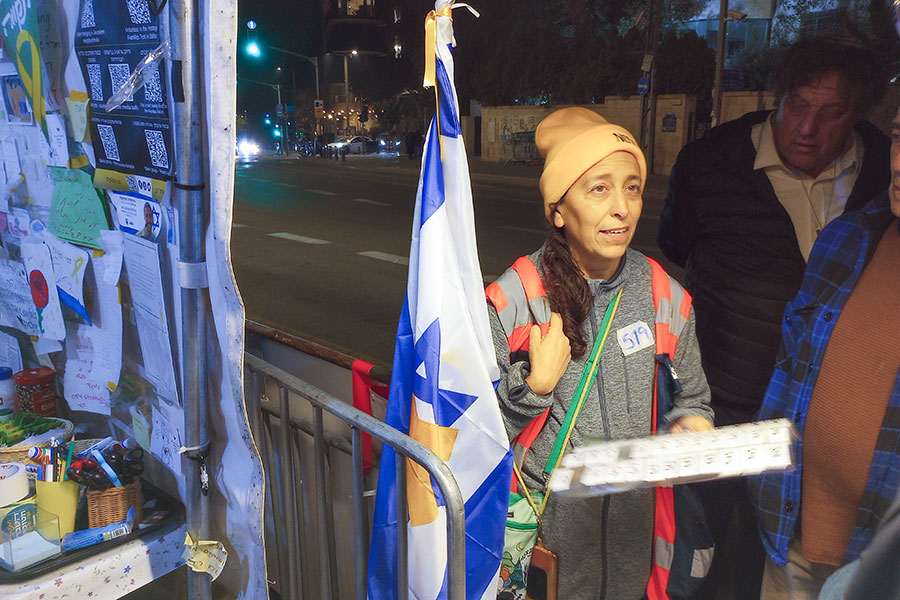
Sahar volunteers most days, in part because one of her patients had been a hostage of Hamas for 54 days.
She said the volunteers have a presence at several locations in Jerusalem. “We keep their faces everywhere,” as well as pray and fast for their release.
“It's not a matter of religion; it's not a matter of political views. It's the pure humanitarian thing that a country should do for her citizens and her soldiers,” she said.
She admitted that she was exhausted, but added, “I think it would take a much harder toll on my health if I wouldn't do anything.”
As of April 14, when this article was written, 59 hostages were in their 555th day of captivity. Israel believes 35 of those hostages are deceased.
read part 1: entrepreneurs face challenges