
The Jubilee of Hope is a Grace and Not a Wish
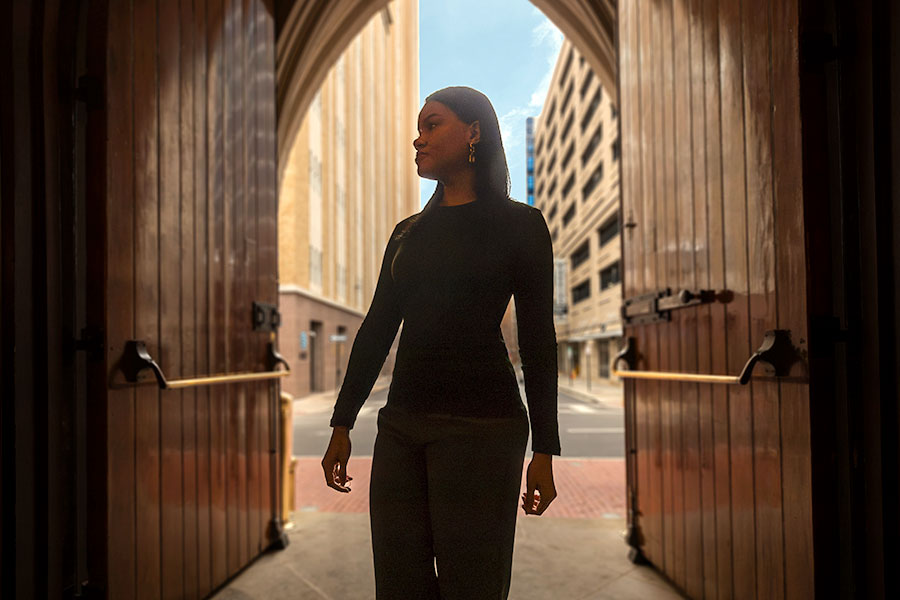
A woman enters the doors of St. Patrick Cathedral in Fort Worth, which has been designated a Jubilee site. (NTC/Juan Guajardo)
For over 700 years, the Holy Father has decreed that a jubilee year be celebrated as a time for pilgrimages to the holy sites of the martyrdom of the Apostles and the earliest saints to seek mercy and conversion won by Christ’s Passion, Death, and Resurrection. These ordinary occasions occur every 25 years and are marked by the unsealing of the Holy Door at St. Peter’s in Rome as well as similar doors at the Basilicas of St. Paul, St. Mary Major, and St. John Lateran for pilgrims to pass through and receive sacramental confession and pray for their own conversion and that of the entire world.
This year, Pope Francis has proclaimed that in order to prepare for the 2,000th anniversary of the Death and Resurrection of Jesus Christ in 2033, the Church should focus and reflect on our vocation to be pilgrims of hope. As St. Paul writes in Romans 5:5, “Hope does not disappoint.”
In order to promote greater ease for many Catholics to receive these graces, the Holy Father has also proclaimed that such pilgrimage sites should be made available in every diocese in the world. In the Diocese of Fort Worth, our pilgrimage sites include St. Patrick Cathedral in Fort Worth, St. Philip the Apostle Catholic Church in Flower Mound, Our Lady of Guadalupe Catholic Church in Fort Worth, Immaculate Conception of Mary Catholic Church in Wichita Falls, and Sacred Heart Catholic Church in Comanche. Please avail yourselves of these opportunities to pray for these spiritual graces.
I would ask all of us to reflect upon this great theological virtue of hope that we are given at baptism and nurtured in throughout our sacramental life. St. Thomas Aquinas taught that the motive for Christian hope is God’s omnipotence and more specifically God’s mercy. Hope requires that we trust God for whom all things are possible even when we observe in a current set of facts that change seems impossible for us to bring about through our own efforts. It is precisely in our powerlessness where we are most capable to witness on behalf of the virtue of hope.
The situation at our southern border appears hopeless. Our society very much urgently needs us to act faithfully as the Church that Christ intended us to be, a People of Hope. I offer the following quote from St. Augustine. He once wrote, “Hope has two beautiful daughters: Anger and Courage. Anger at the way things are, and Courage to see that they do not remain as they are.”
Many of us are rightly angry at the injustices involved in this muddled situation: violent acts perpetrated against the innocent by gangs who are illegally present in our nation; violence suffered by migrants forced to leave their nations because of oppression and threats to children and the elderly; the influx of drugs and human trafficking; the abdication of responsibility of legitimate authority to maintain a secure border from threats of terrorism; the delaying of due process in adjudicating refugees’ claims for political asylum; and the exploitation of unaccompanied children who have arrived without supervision, to name a few.
Yet, unfortunately, too many of us too easily become stuck in anger and neglect to seek Hope’s second daughter, Courage. The anger that we justly feel must oblige us in Christian Charity to work to change this system that has brought us to this miserable state of affairs. If we hope, God gives us the courage to reform an immigration system to include the rule of law and the recognition of our international responsibilities as a good neighbor to assist those who are persecuted, oppressed, and needing refuge. Anger without courage becomes destructive rage. The time has never been more opportune for immigration reform for the sake of the poor, the vulnerable, and for an ordered peace. “Hope does not disappoint.”