
The "Saintly Seven": A look at seven African American candidates for sainthood, pt. 1
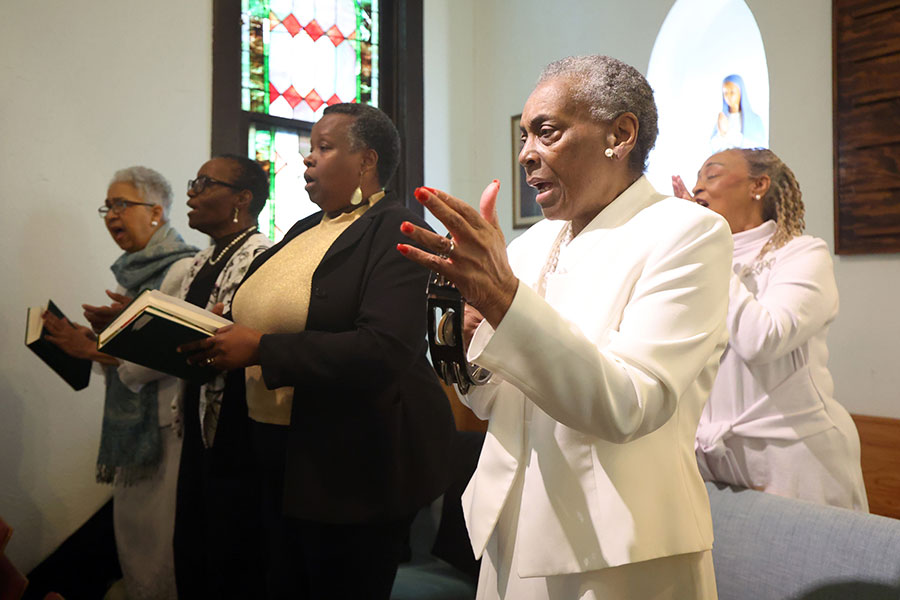
Members of the choir (including Marie Barks, far right) sing during a Mass celebrated by Bishop Michael Olson on Jan. 19 at at Our Mother of Mercy Parish, which once saw saint candidate Sister Thea Bowman visit and share wisdom. (NTC/Richard Rodriguez)
In the mid-1980s, Servant of God Sister Thea Bowman visited Our Mother of Mercy Parish in Fort Worth.
Longtime parishioner Marie Barks recalled meeting the potential future saint.
“She mostly told us to let our lights shine, and that meant to shine as an African-American Catholic, not to be ashamed of our culture, of who we were,” Barks said.
On Feb. 9, the Cause for Canonization of Sister Thea Bowman advanced to its next step when Bishop Joseph R. Kopacz of the Diocese of Jackson, Mississippi, formally closed the diocesan phase and sealed the documentation to be delivered to the Dicastery for the Causes of Saints at the Vatican.
While there are many Black saints, there are no African Americans counted among them. However, Sister Thea is one of seven African American candidates for sainthood, known as the “Saintly Seven.” Any one of the seven — Vens. Pierre Toussaint, Henriette Delille, Augustus Tolton and Mary Lange, and Servants of God Julia Greeley, Thea Bowman and Martin Maria de Porres Ward — could be the first African American saint.
Venerable Pierre Toussaint (1766-1853)
Like half of these candidates, Pierre Toussaint was born enslaved June 27, 1766, in present-day Haiti. When his enslaver Pierre Bérard moved to New York City, he and other slaves joined him, including his younger sister and his aunt. While in New York, Bérard had him apprenticed to a local hairdresser, and he developed a client list made up of rich women.
When his master died, Toussaint remained enslaved and supported his fellow slaves as well as his master’s widow with his earnings as a hairstylist.
“At that time, it was a very lucrative trade to have,” said Kaye Crawford, the founder of BlackCatholicHistory.com, which develops supplemental curricula about Black Catholics to be used in Catholic schools. “When his enslaver died, the enslaver’s wife did not manumit [release from slavery] him. She fell on very dire financial straits, and he supported her.”
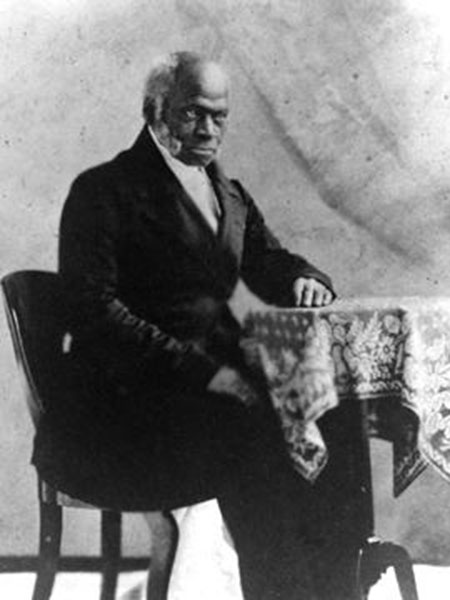
His list of wealthy clients included Angelica Schuyler, Alexander Hamilton’s sister-in-law. He purchased his sister’s freedom before purchasing his own in 1807. He later married Marie Rose Juliette in 1811 after purchasing her freedom. The couple later adopted his niece Euphémie after his sister died of tuberculosis.
During this time, the couple developed a reputation of devotion and charity within the Catholic community. They opened their homes to the marginalized — the sick, orphans or anyone in need — regardless of color or status. He was instrumental in raising money to build the first Catholic orphanage in the city as well as the first school for Black children. Because of these actions, he’s considered to be the founder of what would become Catholic Charities of New York.
“Pierre Toussaint is married, is raising his niece as his daughter, and he’s working and trying to provide, and yet he’s going to daily Mass, and he is philanthropic for Catholic institutions,” said Crawford. “As a married lay person myself, he is a role model for us.”
Toussaint continued to work so he could support these causes, famously responding when asked why he wouldn’t retire and enjoy his own wealth, “I have enough for myself, but if I stop working I have not enough for others.”
He died June 30, 1853, and the church was filled at his funeral. His cause began in 1968 under then-Cardinal Terence Cooke of New York. His body was transferred to New York’s St. Patrick’s Cathedral — the only layman to receive that honor. On Dec. 17, 1997, St. John Paul II declared him “Venerable,” two steps away from canonization, becoming the first African American to have his cause advance to that level.
Venerable Henriette Delille (1813-1862)
Henriette Delille was born a free woman of color in 1813 in New Orleans. She was raised in the plaçage system, a form of legal concubinage between white men and women of color. Under this system, she had two sons who died before the age of 3. She was one-sixteenth Black but based on the “one-drop” standard of the time, where individuals with even one ancestor of Black African ancestry were classified Black, Delille was still denied many rights.
She experienced a religious conversion at 24 and discerned a call to religious life at a time when Catholic religious orders would not accept women of color. Instead, she established her own community, the Sisters of the Holy Family, in 1842.
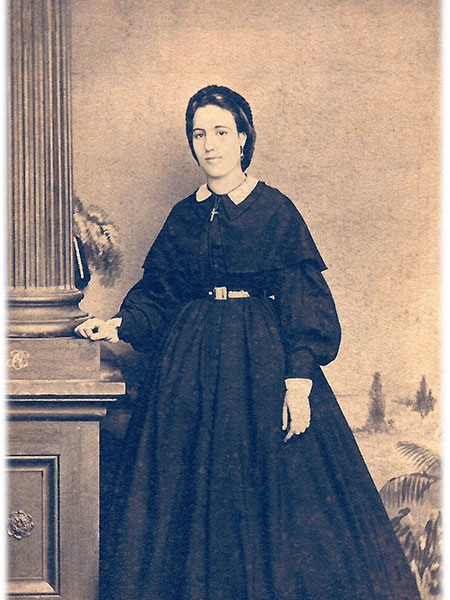
“Ursulines had been there almost since the city of New Orleans was founded. Ursulines wouldn’t take her. Carmelites wouldn’t take her. So what did she do? She founded her own order,” said Dennis Cowles, an English, history, and theology teacher at Cassata Catholic High School in Fort Worth.
The community responded to the needs of the marginalized, serving the enslaved, sick, and elderly, and teaching children who couldn’t otherwise receive an education.
“She wanted an opportunity not just for herself; she wanted to be able to share that with others and that led her to education,” Cowles said. “I’m thrilled that her cause seems to be progressing; and it’s just a good story.”
As a teacher, Cowles developed a particular devotion to Mother Henriette. He lived in New Orleans, just two miles from the Sisters, and he encountered many students who’d gone through their schools. He was also living there when the Archdiocese of New Orleans formally opened her cause in 1988. Pope Benedict XVI declared her “Venerable” March 27, 2010.
“They were sharing their passion for Christ, their passion for God, their passion for the Church. It came out in education. So, they’re not only opening up what we might call secular opportunities for their students, they’re trying to improve them spiritually, as well,” Cowles said, referring to Mother Henriette and Mother Mary Lange. “In my own terms of my own faith life, that’s something I try to emulate, something that inspires me as a teacher.”
Venerable Augustus Tolton (1854-1897)
Augustus Tolton was also born enslaved in Missouri. At the outbreak of the Civil War, his father escaped slavery to fight for the Union Army before being killed in combat. At that, his mother took her children to Illinois, settling in Quincy. Even in the “free” North, the family still faced discrimination with other parents’ reluctance for their children to attend Catholic school with the Toltons.
“There are going to be people out there who have crazy ideologies and things that are contrary to the Catholic Church’s understanding of the dignity of the human person, and Father Tolton was that man who just put one foot forward and knew what he had to do because he had a prayer life and he knew God was wanting him to step forward as a seminarian, and as a priest,” said Father Maurice Moon, vice rector and dean of students at St. Joseph Seminary College in St. Benedict, LA.
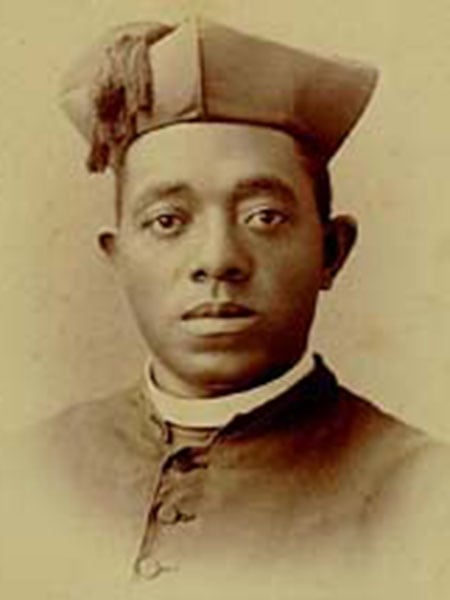
Tolton discerned a call to the priesthood, but no seminary in the United States would take him because he was Black. He relied on private tutoring from the priests and sisters who supported his vocation while supporting himself with menial jobs. He had to go to Rome to receive a seminary education with the Propaganda Fidei, who are responsible for providing missionaries throughout the world.
Expecting to be sent to Africa, newly ordained Fr. Tolton was surprised when his superiors sent him back to the United States. “America has been called the most enlightened nation; we'll see if it deserves that honor,” Cardinal Giovanni Simeoni said to him. “If America has never seen a Black priest, it has to see one now.”
Fr. Moon first became familiar with Fr. Tolton while he was in his own seminary studies. Despite all the obstacles Fr. Tolton faced, he continued to trust God, serving as an inspiration for vocations and seminarians, Fr. Moon said.
“Fr. Tolton was a great example of a man who faced quite a bit of adversity at that time period, the 1800s, and became a great priest because of it,” Fr. Moon said. “His example of perseverance and laying down his life, trusting in God’s will, trusting in God’s providence is a big, a big help for seminarians today who are looking for inspiration and help in their discerning this vocation.”
Returning to the United States, Fr. Tolton continued to face resistance from many of his white brother priests. As the nation’s only openly Black priest (the Healy brothers concealed their African heritage), he addressed the first Colored Catholic Congress — the precursor to today’s National Black Catholic Congress — in 1889.
He worked tirelessly as a pastor, eventually establishing the first Black Catholic parish in Chicago — St. Monica. In 1897, he collapsed while making calls to his parishioners and died July 9 that year at 43. His cause opened in 2010, and Pope Francis declared him “Venerable” June 11, 2019.
“It’s easy to be comfortable. It’s easy to not speak out. It’s easy to just lay low. But God’s calling us to step out into the deep, like Fr. Tolton, and to speak out for injustices, and to trust in God’s providence and be bold and courageous for the Gospel,” Fr. Moon said.
Biographical information for this article was taken from the U.S. Conference of Catholic Bishops “Saintly Seven” page, the National Black Catholic Congress’ “Noteworthy Black Catholics” page and from the websites for the causes for canonization of each of these candidates.